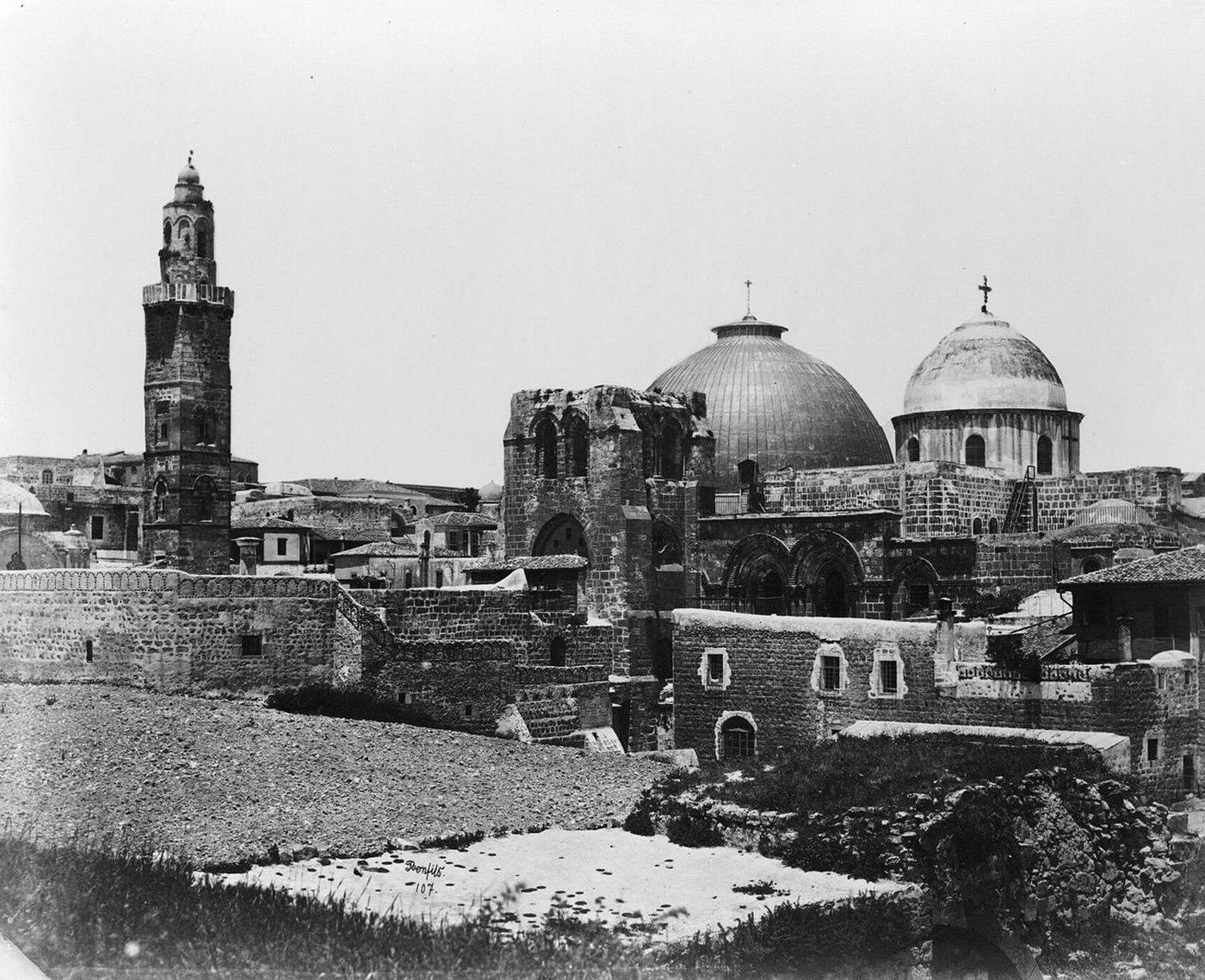
The crucifixion is the point where Islam and Christianity part most sharply. For Christians it is the centre of salvation. The Quran denies that the enemies of Jesus killed him or crucified him.
The debate is often argued as one question when it is three: whether the crucifixion happened, what the Quran means when it denies it, and whether one person’s death can bear another’s sins. The six facts below take the three in turn, and they set out the strongest objection to each answer before replying to it.
The Roman historian Tacitus, writing around AD 116, records that Christ suffered the extreme penalty under Pontius Pilate in the reign of Tiberius.[1] Scholars broadly accept the passage as authentic and as an independent Roman witness.[1] The Jewish historian Josephus, writing around AD 93, also says that Pilate condemned Jesus to the cross, although later Christian copyists touched up the surviving text and scholars disagree over how much of it Josephus wrote.[2] Even historians who doubt much of the Gospels’ account treat the execution as among its surest facts; John Dominic Crossan called it as sure as anything historical can ever be.[3]
Muslims should state this plainly. The Quran’s account runs against the consensus of historians, and Muslims hold to the Quran on the authority of revelation. Historical method can neither confirm nor overturn that authority. The verse also speaks of appearance: it says the matter was made to seem so to the people involved. Sources written by observers of the time record what observers believed, and the Quran claims that the belief was mistaken.
The verse begins with a claim attributed to the Messiah’s enemies: “Indeed, we have killed the Messiah, Jesus, the son of Mary, the messenger of Allah.” It answers that “they did not kill him, nor did they crucify him”, that it was made to appear so to them (shubbiha lahum, “it was made to resemble to them”), and that “Allah raised him to Himself”.[4]
The surrounding verses describe a people who broke their covenant, killed prophets without right and slandered Mary, and the boast about Jesus is listed among those deeds.[4] The denial is aimed at the boast. The Quran’s concern is that God’s messenger was not defeated by his enemies, and that God, and no human court, decided his end.
The Arabic verb shubbiha is passive and names no subject, so the commentators differed over what exactly was made to resemble what. Al-Tabari (died 923) records several readings side by side.[5] Nearly all classical scholars took the verse to deny the death on the cross itself. A few modern writers have asked whether it denies only that the enemies of Jesus prevailed. That question is a reading of the verse, and the classical consensus remains the stronger one.
Critics point out that the classical commentaries give incompatible accounts of who was made to resemble Jesus, from a loyal disciple to a volunteer. They are right. The scholar Todd Lawson, in a book-length study of the question, shows that these substitution stories fill the commentaries while the Quran itself names no one, and traces much of their material to sources outside Islam.[6] Irenaeus, bishop of Lyon, reported in the second century that the Gnostic teacher Basilides taught that Simon of Cyrene was crucified in place of Jesus, so the idea was circulating among Christians long before the Quran.[7]
The commentators themselves weighed the stories critically. Fakhr al-Dīn al-Rāzī rejected several versions while holding to the orthodox position that God protected Jesus and raised him up.[8] Al-Tabari gives his sources and leaves the reader to judge.[5] Muslims are bound by the verse; the stories are attempts to explain it, and their disagreement is a disagreement among commentators. A Muslim loses nothing by saying that the details were never revealed.
A modern Muslim reading takes a different route. Ahmad Shafaat proposes that a namesake of Jesus was crucified in his place by mistake, while Jesus himself was released.[9] He points to the prisoner Barabbas, whom a small group of manuscripts of Matthew, among them Codex Koridethi and the Sinaitic Syriac, call “Jesus Barabbas”; the standard critical edition prints the name in brackets, and some modern translations print it in full.[10] The variant is real. The reading built on it is Shafaat’s own, and the Quran itself names no one.
The Quran does not make Jesus immortal. In the cradle he speaks of “the day I was born and the day I will die and the day I am raised alive”.[11] God’s promise to him is to “take you and raise you to Myself”.[12] At the end of his ministry he says to God, “when You took me up, You were the watcher over them”.[13]
The word in those last two verses, from the root tawaffa, means to take in full, and it is also the ordinary Arabic word for death. A report from Ibn Abbas glosses the word in 3:55 as “cause to die”, and some early scholars followed it, while most later scholars took it to mean that God took Jesus up alive.[14] The hadith (reports of the Prophet’s words and deeds) about his return end with his death after a span of years on earth.[15]
What the Quran denies is that his enemies killed him. It leaves his death in God’s hands, and tells his story as a rescue from those who sought to kill him.
Christians who hold that sin can be forgiven only through blood often cite the Letter to the Hebrews, which says that nearly everything under the law is cleansed with blood and that without the shedding of blood there is no forgiveness.[16] That is the strongest form of the objection, and the author of Hebrews clearly means it as a rule. Yet the word “nearly” shows that the rule had exceptions even in the author’s own account.
The law of Leviticus supplies one. A worshipper too poor to bring two birds brings a tenth of an ephah of fine flour as a sin offering, “and he will be forgiven”.[17] The prophet Ezekiel sets down the governing principle: the soul who sins shall die, the son shall not bear the iniquity of the father, and the wicked man who turns from his sins shall live.[18] The law of Moses says the same of punishment: every man shall be put to death for his own sin.[19] Hosea quotes God as saying he desires mercy and not sacrifice, and a psalm calls a broken spirit the sacrifice God accepts.[20] The Quran likewise tells those who have wronged themselves not to despair of God’s mercy, because God forgives all sins.[21]
Critics often point to the Day of Atonement as a model for one dying for many. On that day lots were cast for two goats. One was killed as the sin offering for the people, and its blood was used to cleanse the sanctuary. Over the other, the high priest confessed all of Israel’s sins and laid them on its head; that goat was presented alive, carried their iniquities into the wilderness, and was released there.[22]
Christian writers read the two goats together with the suffering servant of Isaiah 53, who is pierced for the transgressions of others, and they see both as pointing to Jesus.[23] Jewish interpreters have generally read the servant as Israel. Whichever reading is right, the law as written lays the people’s sins on the one creature that lives. The first goat dies to purify the sanctuary, and no verse of the passage says it carries the sins of persons.
The Quran states the principle the prophets taught: “no bearer of burdens will bear the burden of another”.[24]
The bottom line
The three questions have three different answers. On the first, historians and the Quran disagree, and Muslims side with the Quran knowingly. On the second, the Quran denies that Jesus was killed by his enemies and leaves the manner of his rescue largely unexplained, which the commentators then tried to fill.
On the third, the Islamic objection to atonement by proxy stands whatever happened on the cross, because it rests on the Hebrew prophets’ own teaching that each soul bears its own sin. A reader who rejects the Quran can still weigh that point, since it is argued from the Hebrew scriptures themselves.
Notes
- Tacitus, Annals 15.44; on the scholarly assessment of the passage, Craig A. Evans, Jesus and His Contemporaries: Comparative Studies (Leiden: Brill, 2001), p. 42, and Paul R. Eddy and Gregory A. Boyd, The Jesus Legend (Grand Rapids: Baker Academic, 2007), p. 127.
- Josephus, Jewish Antiquities 18.3.3, the passage known as the Testimonium Flavianum.
- John Dominic Crossan, as quoted in Sean McDowell, Is God Just a Human Invention? (Grand Rapids, 2010).
- Quran 4:157–158, in the context of 4:155–159.
- Al-Tabari, Jami al-bayan, commentary on Quran 4:157.
- Todd Lawson, The Crucifixion and the Qur’an: A Study in the History of Muslim Thought (Oxford, 2009); see the review in the Journal of Qur’anic Studies 12 (2010), doi:10.3366/jqs.2010.0111.
- Irenaeus, Against Heresies 1.24.4, on Basilides.
- Fakhr al-Dīn al-Rāzī, Mafātīḥ al-Ghayb, on Quran 4:157; Todd Lawson, The Crucifixion and the Qur’an: A Study in the History of Muslim Thought (Oxford: Oneworld, 2009), p. 15.
- Ahmad Shafaat, The Gospel According to Islam (New York: Vantage Press, 1979), p. 88.
- Matthew 27:16–17. On the witnesses, Tyndale House, Cambridge, “Matthew 27:16, 17: was Barabbas called ‘Jesus Barabbas’?”; the reading appears in Θ, family 1, 700 and the Sinaitic Syriac, and is bracketed in Nestle-Aland 28.
- Quran 19:33.
- Quran 3:55.
- Quran 5:117.
- Sahih al-Bukhari, Book of Commentary (Tafsir), where the gloss of the word as “cause to die” is attributed to Ibn Abbas.
- Sunan Abi Dawud, Book of Battles (Malahim), on the descent of Jesus.
- Hebrews 9:22.
- Leviticus 5:11–13.
- Ezekiel 18:20–22.
- Deuteronomy 24:16.
- Hosea 6:6; Psalm 51:16–17.
- Quran 39:53.
- Leviticus 16:8–10, 15–16, 21–22.
- Isaiah 53:5–6.
- Quran 6:164; cf. 53:38.