
A charge that the other side has corrupted its scripture sounds like a late and sectarian charge. The early Christian sources show otherwise. Christians made it against Jews, outsiders made it against Christians, and Christians made it against each other, all within the first four centuries.
These seven points set out who charged whom, on what evidence, and with what result. Each entry says how firm it is. The Muslim charge of taḥrīf is graded in Did Islam teach that the Bible was corrupted?. This article does not argue that the Muslim charge is true because others made similar ones. It asks only whether the charge was an ordinary one in the world the Quran addresses.
Number 1: Justin charged the Jews with cutting passages out of their scriptures
In his Dialogue with Trypho, Justin Martyr says that the Jews removed sayings that pointed to Christ. He names a saying that Ezra made about the Passover, two lines of Jeremiah, and the words “from the wood” in the ninety-sixth Psalm.[1] One of the Jeremiah lines is the one about a lamb led to the slaughter and a plot to put wood on his bread. Justin adds that the line still stood in some synagogue copies, since it had been cut out only a short time before.[2]

The Hebrew Bible today has a line of this kind in Jeremiah 11:19, where the speaker is a gentle lamb led to the slaughter and the plotters say to destroy the tree with its fruit.[3] The other lines are not in it. The words “from the wood” in Psalm 96 are found in some Greek and Latin copies and are absent from the Hebrew, and most scholars take them as a Christian addition.[4]
The charge also shows how such arguments work. Justin did not claim that the Jews had added to their scriptures. He claimed that they had removed what hurt them, and he put the proof in the lines that the Jews would not now show him. A charge of that shape cannot be tested from the side of the accuser alone, and the only test is the manuscripts, which for these lines point away from him.
Strength: firm that Justin made the charge, since the text is before us. The charge itself has no support in the manuscripts known today, and the Muslim reader can say so without any cost to the argument.
Number 2: Celsus charged the Christians with remodelling the Gospel
Origen, answering the pagan critic Celsus, reports that Celsus said certain believers had corrupted the Gospel from its original integrity “to a threefold, and fourfold, and many-fold degree”, and had remodelled it to answer objections.[5] Origen does not deny that the Gospel had been altered. He says he knows of no others who altered it except the followers of Marcion and of Valentinus, and, he thinks, of Lucian, and that the existence of such people is no charge against the Christian system.
The exchange matters in two ways. A hostile outsider in the second century thought the Gospel text unstable. A defender in the third century admitted alteration by named groups and said it was the work of others. Both men treated the charge as a question of evidence and not as an insult.
It is worth noticing what Origen does not say. He does not say that the Gospel text is fixed by a divine guarantee. He says that alteration took place and that it was the act of identifiable groups, and he rests the Christian case on the teaching and not on the unbroken wording. The reply fits a view in which a text has a history and a message has a standard.
Strength: firm. The report comes from the defender and was not written to flatter anyone. The extent of the changes that Celsus alleged is not established by it.
Number 3: Marcion was charged with cutting Luke, and he charged the church with a different Gospel
Irenaeus says that Marcion mutilated the Gospel of Luke, removing the account of the birth and a great deal of the teaching in which Jesus names the Maker of the world as his Father. He says Marcion also cut the letters of Paul.[6] Tertullian says that of the writings the church holds, Marcion singled out Luke for his mutilating process.[7]
Marcion’s own aim was to separate the law from the gospel. Tertullian describes his Antitheses as contradictory propositions meant to set the gospel at variance with the law.[8] The church answered by condemning him, and Tertullian notes that Marcion’s Gospel carried no author’s name. So a man who held that the older scriptures were the work of a lesser god was himself charged with altering the newer ones.
Strength: firm as to the charges. What Marcion actually removed is known only from his opponents, and no copy of his Gospel survives.
Number 4: A Jewish-Christian work said the old scriptures carried false passages added by the wicked one
The Pseudo-Clementine Homilies, a Jewish-Christian work usually dated to the fourth century, say that the law was written after Moses عليه السلام by other hands, and that many falsehoods against God were joined to the Scriptures by the wicked one, so that those who loved God would be tested by refusing to hear them.[9] The writer gives the reader a method. He says Christ taught that the Scriptures hold true things and false ones, and he quotes the saying “be prudent money-changers” for sorting genuine words from spurious ones.
This is close to the Muslim picture of a mixed text with a criterion for sorting it. It came from inside the Christian world, and the church did not accept it. The comparison is worth making only for what it shows: the idea of a revealed text with human or hostile additions was thinkable to Christians, and was held by some.
Strength: firm. The passages are in the text. The date and the community behind the work are the usual scholarly view and were not checked here against a printed study.
Number 5: The Ebionites chose a smaller scripture and rejected Paul
Irenaeus says the Ebionites used the Gospel according to Matthew only, and rejected the apostle Paul as an apostate from the law. He adds that they expounded the prophetic writings in a somewhat singular manner, practised circumcision, and kept the customs the law enjoins.[10]
Here a group close to the Jewish roots of the church saw the same gap between the law and Paul’s letters that Marcion saw, and closed it in the opposite direction. Marcion threw out the law. The Ebionites kept it and threw out Paul. The church kept both and read them together.
Strength: moderate. What we know of the Ebionites comes from their opponents, and the wording of Irenaeus is the earliest account in our hands.
Number 6: The surviving manuscripts show that Christian scribes changed their own text
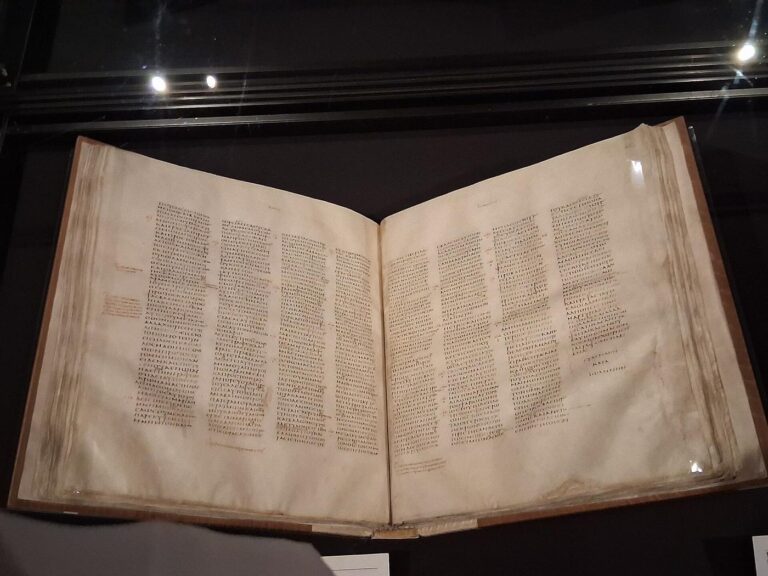
Two of the great early manuscripts of the Greek Bible, the Codex Sinaiticus and the Codex Vaticanus, end the Gospel of Mark at 16:8, with the women fleeing from the tomb and saying nothing to anyone. The verses that follow, 16:9 onward, are not in them.[11] The account of the woman taken in adultery, John 7:53 to 8:11, is also absent from the earliest manuscripts, and most modern Bibles mark both passages with a note.

Christians do not call this corruption. They call it textual criticism, and they treat the variants as a matter of recovering the original reading. The facts are the same facts that a Muslim writer points to when he says the text has a history. The question each side asks of that history differs: the Christian asks which reading was original, and the Muslim asks what the history says about who stood behind each reading.
Strength: firm. The manuscript facts are widely documented and are stated here from general knowledge; the notes say what was and was not checked.
Number 7: The charge was ordinary in the early centuries, and what it needs is evidence
Put the entries together. Christians charged Jews with removing passages. A pagan charged Christians with remodelling the Gospel, and a Christian defender partly agreed. Christians charged Marcion with cutting Luke. A Jewish-Christian writer said false passages had been added to the law. Christian scribes left a record of their own changes. In that world a charge of corruption was a normal move in argument, and the replies to it were also normal: show the manuscripts, name the culprits, deny the extent.

The Muslim charge of taḥrīf belongs to the same family. It rests on its own sources: the Quran, the sayings of the Prophet ﷺ, the early commentators. That is where it is to be weighed, and the taḥrīf article grades those sources one by one. Nothing here makes the charge true. It does remove the objection that it is a strange or late invention.
A fair reader will also see the difference. In the early centuries the charges were made between rivals who had the same books in front of them, and each side could produce copies. The Muslim charge is made about books that were already centuries old when the Quran spoke of them, by a community that had no copies of its own to compare. For that reason the Muslim case rests more on the sources of revelation than on manuscripts, and the next question is what those sources say.
Strength: firm as history, and silent on whether the Muslim charge is right.
The bottom line
Six points are firm: Justin’s charge against the Jews, Celsus’s charge against the Christians and Origen’s partial agreement, the charges against Marcion, the Pseudo-Clementine claim of false passages, the manuscript record of Mark and John, and the ordinariness of the charge. One point is moderate: the Ebionites, known mostly through an opponent.
What the evidence leaves open is the main thing. A charge of corruption proves nothing by being made. It needs manuscripts, witnesses or a revealed criterion. Ismail al Faruqi put the Muslim position as one that recognises the divine base of the earlier books and ascribes their historical growth to human effort, whether well or ill meaning.[12] The early Christian record shows that Christians knew what that growth looked like. Allāhu aʿlam.
Notes
- Justin Martyr, Dialogue with Trypho, chapters 71 to 73 (Roberts–Donaldson translation, Ante-Nicene Fathers, vol. 1; text read on newadvent.org, no page number checked).
- Justin, Dialogue 72, same source. The sentence on the line “still written in some copies” is Justin’s own.
- Jeremiah 11:19, World English Bible, read on bible-api.com. Whether Justin’s wording renders the same line is a judgement; the Hebrew has “the tree with its fruit”.
- That the words “from the wood” in Psalm 96 occur in some Greek and Latin copies and not in the Hebrew, and that most scholars take them as an addition, is stated from general knowledge and was not checked against a printed critical edition.
- Origen, Against Celsus 2.27 (Ante-Nicene Fathers, vol. 4; text read on newadvent.org, no page number checked).
- Irenaeus, Against Heresies 1.27.2 (Ante-Nicene Fathers, vol. 1; text read on newadvent.org).
- Tertullian, Against Marcion 4.2 (Ante-Nicene Fathers, vol. 3; text read on newadvent.org, no page number checked).
- Tertullian, Against Marcion 1.19 and 4.2, same source. The chapter numbers follow the headings on the web text and were not checked on a printed page.
- Pseudo-Clementine Homilies 2.38 and 3.47 to 3.50, Roberts–Donaldson translation (Ante-Nicene Fathers, vol. 8; text read on newadvent.org, no page number checked). The fourth-century date and Jewish-Christian setting are the common scholarly view and were not checked in a printed work.
- Irenaeus, Against Heresies 1.26.2 (Ante-Nicene Fathers, vol. 1; text read on newadvent.org).
- Mark 16:8 and 16:9 and John 7:53 to 8:1, World English Bible, read on bible-api.com. That the Codex Sinaiticus and the Codex Vaticanus end Mark at 16:8, and that John 7:53 to 8:11 is absent from the earliest manuscripts, is stated from general knowledge and was not checked in a printed apparatus for this article.
- Ismail R. al Faruqi, Essential Writings, ed. Imtiyaz Yusuf (Leesburg, Va.: Center for Islam in the Contemporary World, and Petaling Jaya: Islamic Book Trust, 2021), “Islam and Other Faiths: The History”, p. 46.




Leave a Reply