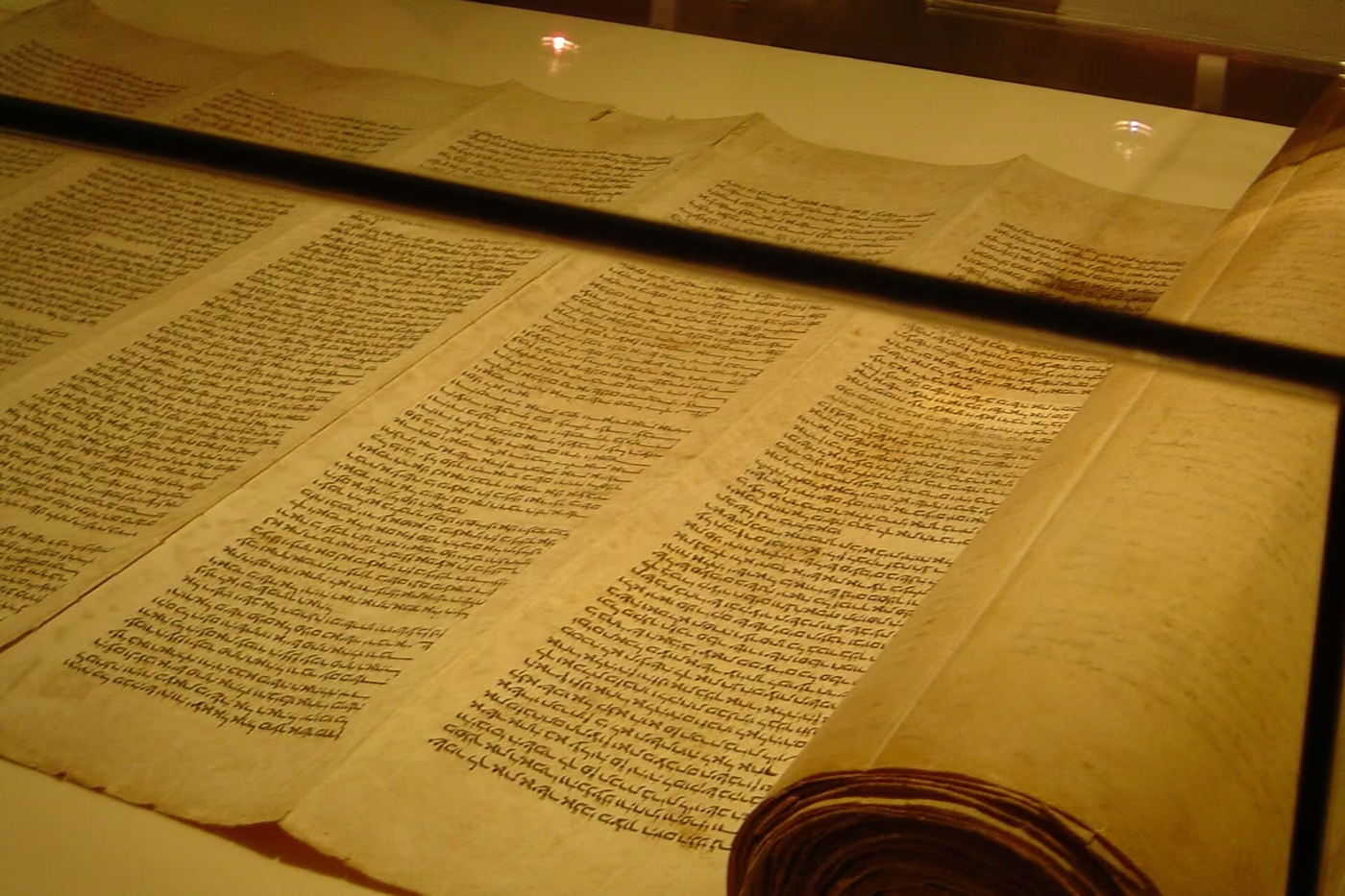
The Islamic dilemma argues that the Quran refutes itself. The Quran affirms the Torah and the Gospel, the argument runs, and the Torah and the Gospel in Christian and Jewish hands contradict the Quran, so the Quran cannot be from God.[1] Whatever one makes of that argument, it has a shape, and a shape can be tested on other books.
These seven points hold the same test up to the New Testament. The New Testament affirms the Hebrew Bible, and Christian doctrine departs from it in several places. The question is whether Christians face a twin of the dilemma, and what follows if they do. Each entry says how strong it is. The case for the Muslim side of the question is in The Islamic Dilemma, and the evidence for taḥrīf is graded in Did Islam teach that the Bible was corrupted?. This article makes one narrower claim, and the last two entries say how far it reaches and where it stops.
Number 1: The New Testament affirms the Hebrew Bible and departs from it
The affirmation is strong. In Matthew 5:17–18 Jesus says that he did not come to destroy the law or the prophets, and that not the smallest letter of the law will pass away until all things are accomplished. Luke 16:17 says it is easier for heaven and earth to pass away than for one stroke of the law to fall. In Matthew 23:2–3 he tells the crowds that the scribes and Pharisees sit on the seat of Moses عليه السلام, so that all they tell them to observe they should observe and do.[2]

The departures are also in the text. Many translations of Mark 7:19 add that Jesus thereby declared all foods clean, which sets aside the dietary laws. Galatians 3:10–13 says that those who rely on the works of the law are under a curse. Acts 15:28–29 lays only four requirements on non-Jewish believers, and circumcision is not among them. Hebrews 8:13 says that by speaking of a new covenant God has made the first one old, while Exodus 31:16–17 calls the Sabbath a perpetual covenant, a sign for ever.[3]
Christians answer that the departures are the fulfilment Jesus spoke of, and that the law was a tutor leading to Christ (Galatians 3:24). That answer is a way of reading the two sets of texts together. It is not a claim that the texts say the same thing. Strength: firm. Both the affirmation and the departure are plain on the page, and the Christian answer to them is a reading of the page.
Number 2: The early church saw the gap, and some Christians answered it by cutting the text
Marcion taught in the second century that the God of the law and the prophets was not the Father of Jesus. Irenaeus says Marcion built on the teaching of Cerdo, who held that the one was just and the other good, and that Marcion trimmed the Gospel of Luke and cut from the letters of Paul the passages that tied the Creator to the Father of Jesus.[4] Irenaeus also passes on a story that Polycarp, meeting Marcion, called him the firstborn of Satan.[5] The church condemned him. The point here is not whether Marcion was a Christian. It is that the distance between the two testaments was visible within a century of the apostles, and that one man chose to close it by discarding the older book.
Others closed it by saying the older book was mixed. The Pseudo-Clementine Homilies, a Jewish-Christian work usually dated to the fourth century, say that many falsehoods against God were joined to the Scriptures, that the law was written after Moses by other hands, and that the reader must sort the true from the false by the teaching of the True Prophet.[6] That is close to the Muslim account of a mixed text, and it came from inside the Christian world.
Strength: firm. The sources are plain. Their authors differ from the church that won, and nothing in the entry says they were right. It only shows that Christians themselves met the problem early and answered it in more than one way.
Number 3: The New Testament reads the Hebrew Bible in ways its first readers would not have expected
Matthew 2:23 says that Jesus lived at Nazareth so that what was spoken through the prophets might be fulfilled: “He will be called a Nazarene.” No book of the Hebrew Bible contains those words. Commentators suggest a play on the word for a shoot in Isaiah 11:1, and that is a suggestion, not a quotation.[7] Matthew 2:15 applies Hosea 11:1, “out of Egypt I called my son”, to the child Jesus, although Hosea speaks of Israel in the past.[8] Matthew 1:23 reads Isaiah 7:14 as a virgin who will conceive. The Hebrew word is ʿalmāh, a young woman, and the Greek translation of the Hebrew Bible renders it parthenos, which can mean virgin.[9]

Paul does the same with the law. Galatians 3:10 uses Deuteronomy 27:26, “cursed is he who does not uphold the words of this law by doing them”, to show that the law cannot justify. Galatians 3:13 quotes Deuteronomy 21:23 as “cursed is everyone who hangs on a tree” and leaves out the closing words “of God”.[10]
None of this makes the New Testament false, and a Christian will say that the apostles read the older texts in the light of what they had seen. That is the point of the next entry. Strength: firm as a description of what the texts do, and open as to what it means.
Number 4: Reading earlier scripture by later revelation is an old practice
Jeremiah 25:11–12 and 29:10 give a period of seventy years for Babylon. In Daniel 9:2 Daniel reads those books and understands the number of the years. Then Gabriel عليه السلام comes with an explanation, and the seventy years become “seventy weeks” (Daniel 9:21–24). The later text gives the earlier one a meaning that its first readers did not have, and it does so on the authority of a revelation.[11]
The community at Qumran, by the Dead Sea, did this on purpose. Their commentary on Habakkuk says that God told the prophet to write down what would happen to the last generation, but did not tell him when the time would end, and that God made known to the Teacher of Righteousness all the mysteries of the words of the prophets.[12] On that view the prophet did not know the full meaning of his own words, and the later inspired interpreter did. Scholars call the method pesher.

The practice shows that a later authority can say what an earlier text means without calling the earlier text corrupt. Strength: firm. The examples are in the texts. Whether the method is legitimate is a different question, and the next entries ask it of the Quran.
Number 5: The Quran claims a similar role, and the classical commentators describe it
The Quran says that Jesus came “confirming what was before me of the Torah and to make lawful for you some of what was forbidden to you” (3:50), and that the Prophet ﷺ relieves people “of their burden and the shackles which were upon them” (7:157). It says of itself that it confirms what preceded it of the Scripture “and as a criterion over it” (5:48). The word usually rendered “criterion” in that verse is muhaymin.[13]
Ibn Kathir gathers the early glosses of muhaymin. Ibn ʿAbbās said it means a trustee, and also a witness, and also a judge over the earlier books, and Ibn Kathir adds that what agrees with the Quran in them is true and what disagrees is false.[14] That is the language of a touchstone. It does not say that every earlier wording was exactly preserved, and it does not say that all of it was worthless.

A Muslim can therefore say what a Christian says of the Hebrew Bible: the earlier book is respected, and a later revelation tells the reader how to read it. Strength: moderate. The verses are plain and so are the classical glosses. Calling this “revelatory exegesis” is a modern label, and the classical authors speak of a witness and a judge rather than of fulfilment alone.
Number 6: The twin has real weaknesses, and the Christian reply deserves a hearing
First, the claim of continuity is made by Jesus himself in Matthew 5:17–18, and it is made among people who knew him. The Quran addresses a later community, six centuries on, and it also tells the People of the Gospel to judge by what God revealed in it (5:47). A Christian can say that this puts the Quran in the position of the one being measured. The Muslim answer in The Islamic Dilemma is that the Quran refers to what God gave to Jesus and not to the later canon, and that is a claim about history to be argued.
Second, a Jewish reader will say that both fail. Deuteronomy 4:2 says that nothing is to be added to the commandment or taken from it, and Exodus 31:16–17 calls the Sabbath a perpetual covenant. A Jewish reader holds that both the New Testament and the Quran add and take away.
Third, the Christian side does not accept the Quran as a later revelation, so the reading of the previous entry will not move them. It was never meant to. Strength: serious. These replies do not remove the earlier entries. They set the limits of what the twin can show.
Number 7: A test that sinks both books is no test of either
If the dilemma worked, it would work on the New Testament too. The New Testament affirms the Hebrew Bible, the Hebrew Bible differs from Christian teaching in the places named in the first entry, and the same two-horned conclusion would follow: the New Testament is false either way. Christians do not accept that conclusion, and they have a way out. Reading earlier scripture by later revelation is the way out, and it is open to anyone who claims a later revelation.
So the twin does not prove the Quran true. It shows that the Islamic dilemma, as a refutation, proves too much. Whether the Prophet ﷺ received a revelation is settled on other ground: the Quran itself, its transmission and the life of the man who brought it. A Muslim who offers the twin as a proof of Islam misuses it, and a Christian who offers the dilemma as a proof against Islam misuses it in the same way. Strength: firm as logic, and silent on the truth of either book.
The bottom line
The twin is real at the level of structure. Five points are firm: the New Testament affirms the Hebrew Bible and departs from it, early Christians saw the gap and answered it in different ways, the New Testament re-reads older texts in unexpected ways, reading earlier scripture by a later authority is an old practice (Daniel on Jeremiah, the Qumran commentary on Habakkuk), and a test that sinks both books tests neither. One point is moderate: the Quran describes its own role in terms the commentators gloss as trustee, witness and judge. One is serious: the replies that weigh against the twin.
The twin also has limits. It cannot show that the Quran is true, and it leaves the Christian and Jewish replies standing. The Muslim position, as Ismail al Faruqi put it, honours the revelation behind each earlier book and examines the record of how it was written down.[15] Allāhu aʿlam.
Notes
- The dilemma is stated and answered at length in The Islamic Dilemma. This article follows the shape of the argument and does not name those who make it.
- Matthew 5:17–18, Luke 16:17 and Matthew 23:2–3, quoted from the World English Bible, which was read on bible-api.com. Other translations differ in small wording.
- Mark 7:19 (the closing clause is a note by the narrator in the Greek and is translated differently in different Bibles); Galatians 3:10–13 and 3:24; Acts 15:28–29; Hebrews 8:13; Exodus 31:16–17. World English Bible, read on bible-api.com.
- Irenaeus, Against Heresies 1.27.1–2, in the Roberts–Donaldson translation (Ante-Nicene Fathers, vol. 1; text read on newadvent.org, no page number checked).
- Irenaeus, Against Heresies 3.3.4, same translation and source. Irenaeus reports the story as something “those who heard” Polycarp told.
- Pseudo-Clementine Homilies 2.38–39 (falsehoods joined to the Scriptures), 3.47 (the law written by others after Moses) and 3.48–50 (sorting true from false), Roberts–Donaldson translation (Ante-Nicene Fathers, vol. 8; text read on newadvent.org, no page number checked). The usual date and the Jewish-Christian setting of the Homilies are the common scholarly view and were not checked against a printed work for this article.
- Matthew 2:23 and Isaiah 11:1, World English Bible. The suggestion of a play on the word for a shoot is a commentators’ suggestion and is not checked here against a named commentary.
- Matthew 2:15 and Hosea 11:1, World English Bible.
- Matthew 1:23 and Isaiah 7:14, World English Bible. The Hebrew ʿalmāh and the Greek parthenos in the Greek translation of Isaiah 7:14 are stated from general knowledge and were not checked against a printed lexicon for this article.
- Galatians 3:10 and 3:13, Deuteronomy 27:26 and 21:23, World English Bible.
- Jeremiah 25:11–12 and 29:10; Daniel 9:2 and 9:21–24, World English Bible.
- Commentary on Habakkuk from Qumran (1QpHab), column 7, lines 1–5. The paraphrase follows English translations read on intertextual.bible (text/habakkuk-2.2/1qphab-7) and philipharland.com; translators render the Hebrew razim (“mysteries”) differently, and no printed edition was checked.
- Quran 3:50, 5:48 and 7:157, Saheeh International translation, read on the Quran.com API.
- Ibn Kathir, Tafsīr, vol. 3, pp. 127–128, on 5:47–48 (Shamela text, shamela.ws/book/8473/1392 and 1393). Ibn ʿAbbās is cited there for “trustee”, “witness” and “judge”.
- Ismail R. al Faruqi, Essential Writings, ed. Imtiyaz Yusuf (Leesburg, Va.: Center for Islam in the Contemporary World, and Petaling Jaya: Islamic Book Trust, 2021), “Islam and Other Faiths: The History”, p. 46.


Leave a Reply