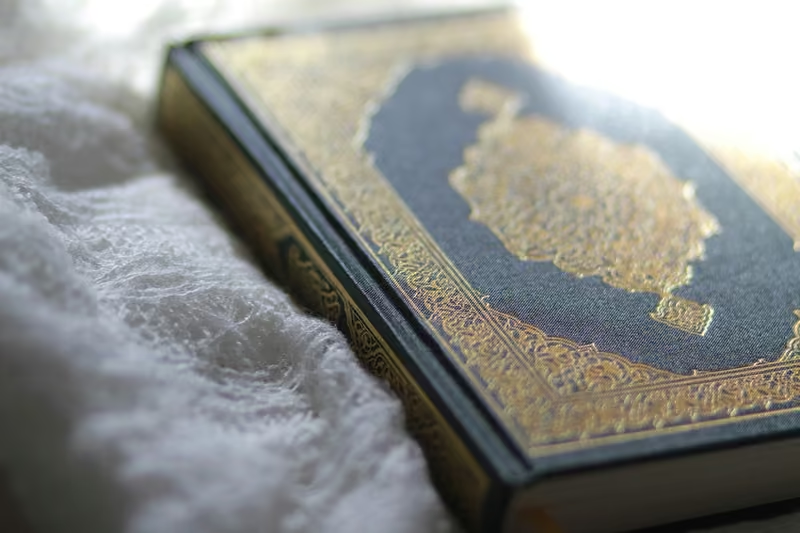
مصحف
Muṣḥaf
A written copy of the Quran bound between two covers.
What it means
From ṣaḥīfa, “a leaf”. In the Prophet’s lifetime the Quran was written on whatever was at hand and memorised in full by many. After his death the leaves were collected, and in the time of Uthman copies in one agreed spelling were sent to the main centres. The standard copy is often called the Uthmanic mushaf.
A mushaf is handled with respect, and Muslims traditionally wash before touching it.
Often misunderstood as
That Uthman “burned the rival Qurans”, destroying the true text.
What the sources say
Sahih al-Bukhari records that Uthman had the leaves copied, ordered the standard copies sent out, and asked that other individual leaves be destroyed to avoid disputes. Muslims read this as protecting one text for the whole community, and note that no major dispute over it was recorded in the early centuries.
Term and Arabic as listed in Ismail al Faruqi, Toward Islamic English (International Institute of Islamic Thought, 1995), p. 54, listed as MUṢḤAF. The definition is restated here.