A student who solves an equation or looks up at the night sky is using Arabic without knowing it. The words arrived in Europe with the books that carried them, mostly through translations made in Spain in the 12th and 13th centuries, when scholars in cities such as Toledo turned Arabic works into Latin.
Here are six of those words, and the route each one took. Some came through a title, one through a person, one through a scribe’s mistake. Each shows the same thing: the science came first, and the vocabulary followed it across the border.
Number 1: Algebra
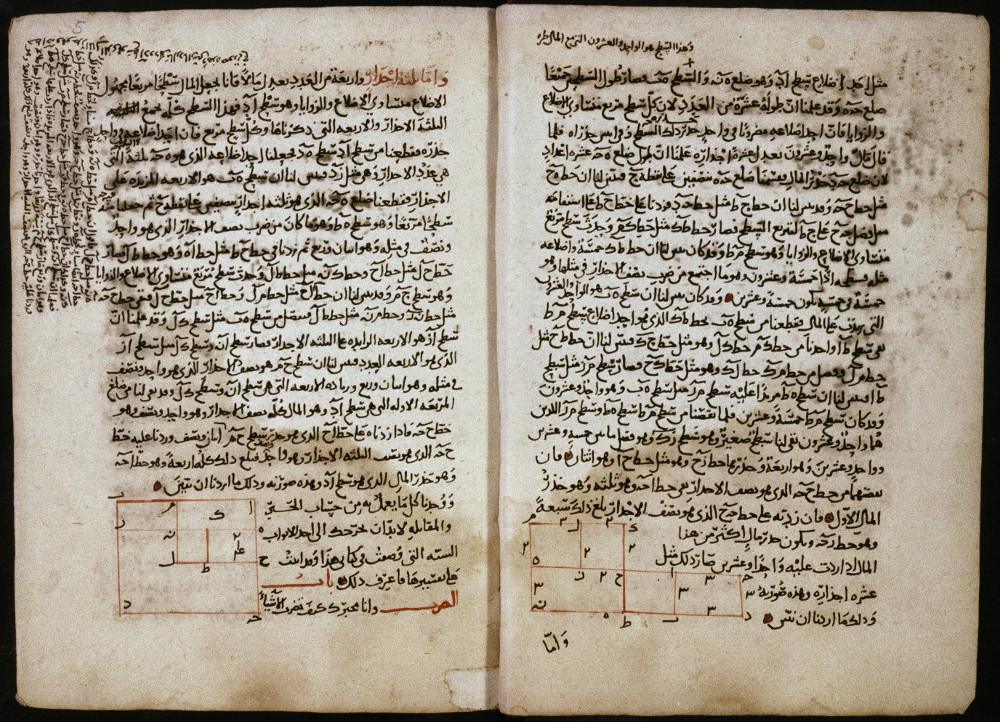
Al-jabr means the restoring, or the setting of what is broken. It named one of the two operations in a 9th-century treatise by the mathematician al-Khwārizmī in Baghdad, a book that taught how to balance and solve equations. The full title pairs al-jabr, moving a subtracted quantity to the other side of an equation to restore it, with al-muqābala, the balancing of like terms.[1]
The book was written for practical use, in a city that needed methods for inheritance shares, trade and land measurement. It treated the solving of equations as a subject in its own right, with its own rules, which is why later readers regarded it as the start of the discipline.
When the treatise was translated into Latin in the 12th century, the operation gave its name to the whole discipline. A surgeon who set bones was once called an algebrist in Spanish for the same reason, because the word kept its first sense of restoring what is broken.
Number 2: Algorithm
This one is a man’s name. Al-Khwārizmī’s work on Indian numerals, which explained how to calculate with the nine digits and the zero, survives chiefly in Latin. The Latin text opens by quoting its author as Algoritmi, the Latinised form of his name, and the name came to stand for the method he taught: a fixed sequence of steps that produces a result.

The name itself points to his origin. Al-Khwārizmī means the man from Khwarazm, a region south of the Aral Sea in Central Asia. He worked in Baghdad, in the House of Wisdom, under the caliph al-Maʾmūn, among scholars who gathered the mathematics of Greece and India and extended it.
Search engines and sorting routines run on algorithms, and each use of the word names a mathematician from Khwarazm.
Number 3: Zenith
The point directly overhead was called in Arabic samt ar-raʾs, the way over the head. A medieval Latin scribe misread the letter m in samt as ni, and the error was copied until it became the word.[2] The Arabic script joins its letters in short strokes, and in a hasty or damaged manuscript the strokes of an m can look like two letters, so the slip is easy to picture.
Zenith is, in the strictest sense, a mistake. It has named the top of the sky for more than 600 years. The Arabic phrase meant something plain, the direction a person faces when looking straight up, and the scribe’s error left English with a word that has no meaning of its own beyond that one.
Number 4: Azimuth
The same Arabic root came through correctly the second time. As-sumūt, the ways or directions, plural of samt, entered Latin as azimut.[2] Astronomers and navigators use it for the horizontal angle of an object measured round from the north.

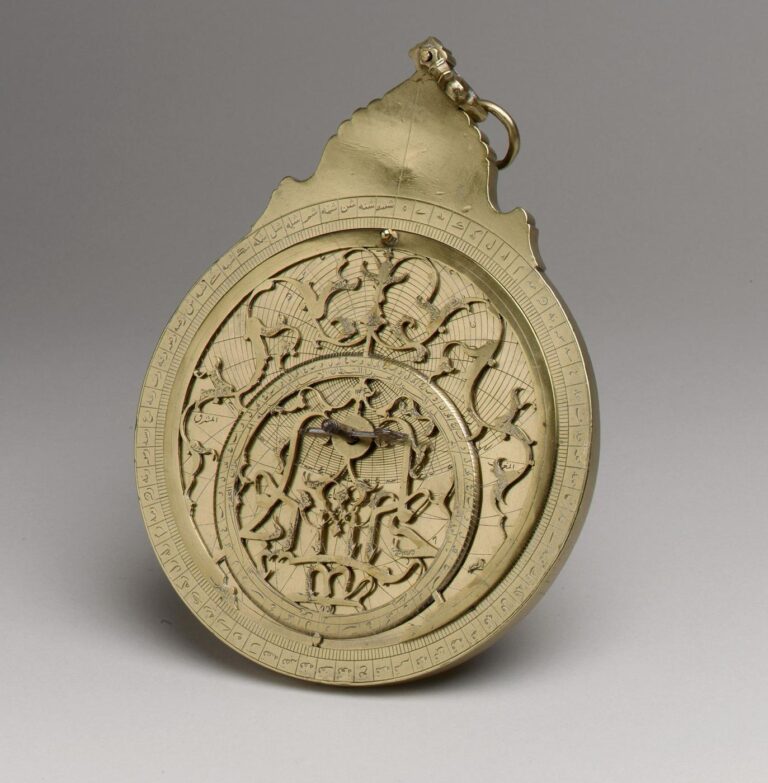
The term matters in practice. A sailor with an astrolabe, a surveyor with a theodolite and a person aiming a satellite dish all fix a direction by the same angle, measured along the horizon. Arabic astronomers developed the instruments and the vocabulary for this kind of measurement, and Europe took over both.
Zenith and azimuth are siblings from one root. One arrived by accident, the other intact.
Number 5: Nadir
The point directly below the observer, opposite the zenith, was naẓīr as-samt, the opposite of the way.[2] Latin kept the first word. English later borrowed it for the lowest point of anything, including a career or a season.
Together with zenith and azimuth, this makes a set of three terms for positions in the sky, all rooted in the word samt. They belong to the vocabulary of positional astronomy that Arabic-writing astronomers refined and that Latin translators carried north.
The word has an odd history of meaning. It began as a position in a diagram, the place on the celestial sphere that no observer on the ground can see. English speakers now use it for any low point, so a word invented to describe geometry ended up describing moods and markets.
Number 6: Alcohol
Al-kuḥl was kohl, a fine powder ground from a mineral and used as eye cosmetic. The word came to mean any substance refined to its essence, and then the essence drawn off by distillation, the process carried out with the alembic, another word from Arabic.[3]
The path of the meaning is a chain of small steps. First a finely ground powder, then any very fine or pure substance, then the spirit obtained by distilling. European writers of the 16th century used the term for that spirit, and chemists later applied it to the whole family of compounds that includes ethanol.
By the time chemists named ethanol, the word had travelled from an eyelid to a laboratory. Arabic-writing alchemists and chemists refined the practice of distillation, which is why much of the vocabulary of the craft, including the alembic, is Arabic.
The bottom line
Two of these words trace back to one scholar in Baghdad, and three to one Arabic word for a path. The sixth began as a cosmetic and ended as a chemical term. In each case the word crossed into Latin along with the work that gave it meaning.
The vocabulary is the easiest evidence to check, and the hardest to explain away. Science learned these words because it learned the work they described, and it learned that work in Arabic. None of this makes the Arabic writers the only authors of the story, since they built on Greek and Indian sources. It does show that they were the link through which those sources, and their own additions, reached Europe.
Notes
- Al-Khwārizmī, The Compendious Book on Calculation by Restoring and Balancing.
- Online Etymology Dictionary, s.v. “zenith”, “azimuth” and “nadir”.
- On al-kuḥl and its passage into chemistry, see the Online Etymology Dictionary, s.v. “alcohol”.


Leave a Reply