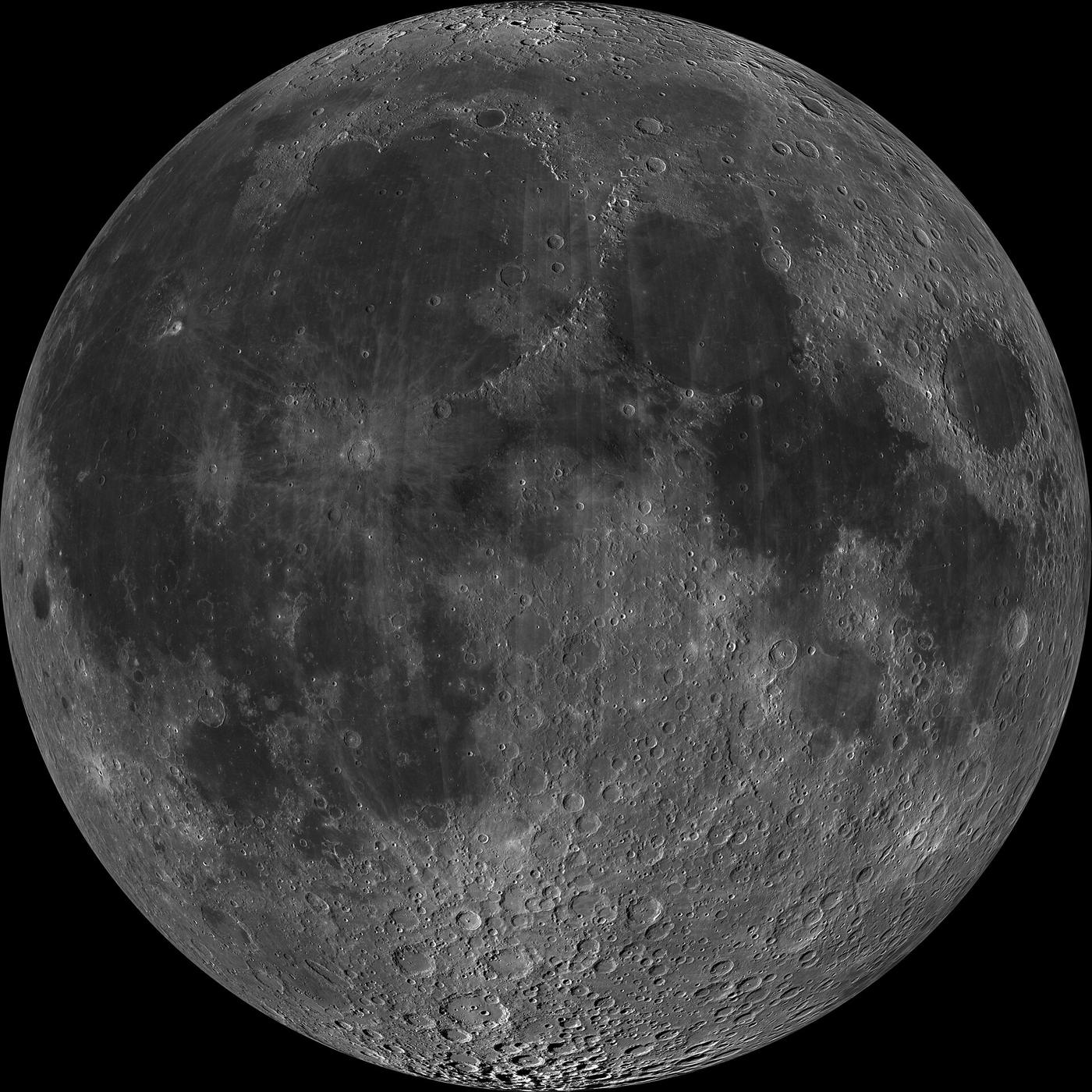
The names on the Moon read like a roll of honour for the history of astronomy. Most of the traditional crater names were given in 1651 by the Italian astronomer Giovanni Riccioli,[1] and when the International Astronomical Union formally adopted the lunar names in 1935, a striking number of them belonged to astronomers who had worked in Arabic, most of them under the Latin names by which medieval Europe knew them.[2]
Here are 6 of them, and what each one did to earn a place in the sky. Each entry gives the crater, the person, and the work that Latin Europe later read, copied and built upon.
Number 1: Albategnius, for al-Battani
A large walled plain near the centre of the Moon’s visible face carries the Latin name of al-Battani, who worked at Raqqa and died in 929.[2] His measurement of the solar year was remarkably close to the modern value, within a few minutes, and his figures for the tilt of the Earth’s axis and the slow drift of the equinoxes served astronomers for centuries.[3]
His tables reached Latin Europe in a translation made in the twelfth century and were printed in 1537. Their accuracy encouraged Copernicus, who cites him by name in his great book, and Tycho Brahe, Kepler, Galileo and Halley all worked with his observations.[3][4] He also replaced the Greek geometrical methods with the sines and tangents of trigonometry.
Al-Battani corrected values in Ptolemy’s Almagest that had been accepted for a thousand years, among them the length of the year and the motion of the solar apogee. Observing steadily from one place over many years, and recording the results, made such corrections possible.
Number 2: Azophi, for al-Sufi
A mountain-walled crater in the southern highlands is named for ʿAbd al-Raḥmān al-Ṣūfī, a Persian astronomer of the 10th century.[5] His great work set out the stars constellation by constellation, recording the position, brightness and colour of each one, with every constellation drawn twice: once as it would appear from outside a celestial globe, and once from inside it.[6]

He wrote the book in Arabic around 964 and built it on Ptolemy’s star catalogue, which he checked against his own observations and corrected where the two disagreed.[7] In it he describes a small cloud in the constellation of Andromeda, which is the earliest known record of what we now call the Andromeda Galaxy.
Al-Sufi also set down the Arab star names that survive in the sky today. Names such as Aldebaran, Altair and Betelgeuse reached European charts through translations of work like his.
Number 3: Arzachel, for al-Zarqali
Arzachel honours al-Zarqālī of Toledo, who prepared the astronomical tables named after his city.[5] His work may have influenced Copernicus.[4]
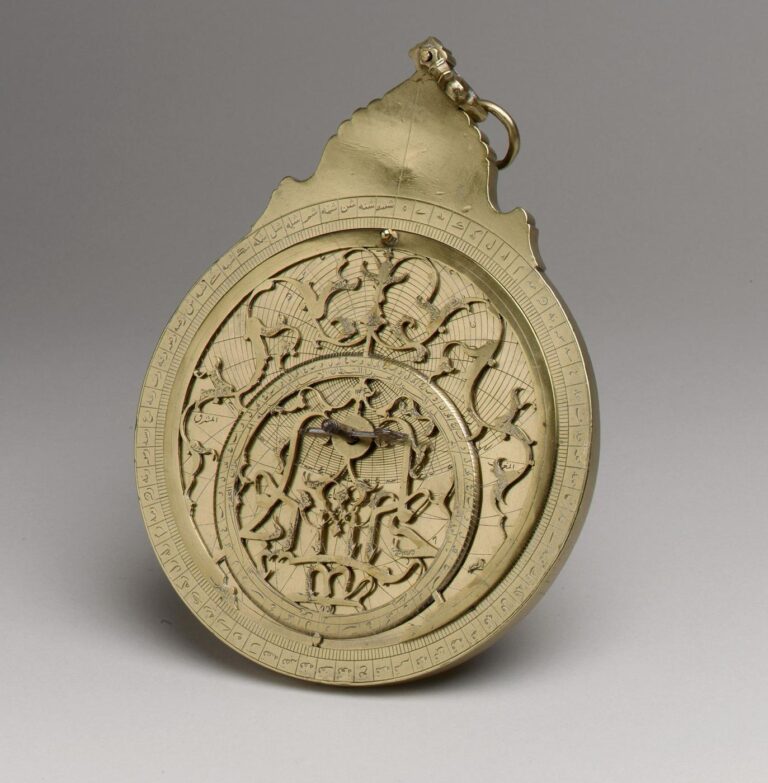
Al-Zarqālī lived in Muslim Spain in the eleventh century and was by trade a maker of instruments. He devised a form of astrolabe that could be used at any latitude, and Latin Europe knew it under a form of his name. His tables, translated into Latin in the twelfth century, gave Christian astronomers the positions of the planets, and they were reworked into the Alfonsine Tables that astronomers used until Copernicus’s time.
He also showed from his own observations that the Sun’s farthest point from the Earth moves slowly against the fixed stars, correcting an older figure. The crater that bears his name is a conspicuous one with a central peak, and it forms a line with Alphonsus and Ptolemaeus, a chain of three that links his name to the Greek astronomer and the Spanish king who sponsored the tables.
Number 4: Alhazen, for Ibn al-Haytham
Near the Moon’s eastern edge, beside the dark plain of Mare Crisium, lies a crater named for Ibn al-Haytham, the Arab scientist whom the Latin West knew as Alhazen.[8] The name was formally adopted in 1935.

His crater appears oblong from Earth only because it sits so close to the edge of the visible disc. Seen from above, its rim is nearly circular.[8]
Ibn al-Haytham wrote his Book of Optics in Cairo in the early eleventh century. He argued, with experiments, that vision occurs when light from an object enters the eye, which overturned the older theory that the eye sends out rays. He described the dark chamber, the camera obscura, and examined refraction and the curved mirror.[9] The book was translated into Latin and was read by Roger Bacon and Kepler.
Number 5: Al-Biruni, on the far side
Not every name was visible from Earth. Al-Biruni lies on the Moon’s far side, just beyond the eastern limb, and honours the astronomer, mathematician and geographer who worked in Afghanistan and India and died around 1048.[10]
He used the timings of lunar eclipses to work out the difference in longitude between cities, and he estimated the radius of the Earth by measuring the dip of the horizon from a mountain, applying spherical trigonometry centuries before Europe systematised it.[11]
His figure for the Earth’s radius, obtained on a hill in what is now Pakistan, came within a small fraction of the modern value.[12] The same book on the coordinates of cities sets out how to find the direction of Mecca from a given place, so a question of worship was turned into a problem of geometry. He also weighed the possibility that the Earth turns on its axis, and left the question open.
Number 6: Almanon, for al-Maʾmun
One crater honours a patron. Almanon is named for the caliph al-Maʾmūn, son of Hārūn al-Rashīd, who sponsored the House of Wisdom in Baghdad, where translators and astronomers worked side by side.[5] Al-Farghānī, whose own crater Alfraganus lies not far away, was one of the astronomers in his circle.
Al-Maʾmūn’s court supported observatories at Baghdad and Damascus, and his astronomers carried out a survey to find the length of a degree of the Earth’s meridian on the plains of Syria and Iraq, work that rested on the already accepted view that the Earth is a sphere.[6]
Al-Farghānī’s summary of astronomy, based on the Almagest, was translated into Latin in the twelfth century and was still being read when Dante wrote. A patron who pays for translations and instruments earns his place in the sky as surely as the observers do.
The bottom line
The Moon’s map was drawn by astronomers who knew exactly whose work they had inherited. Latin Europe learned its astronomy from these men, often before it learned their real names.
The six craters stand for a long chain of observers, instrument makers and patrons, who corrected Ptolemy, measured the Earth and handed on the results in books that Europe translated for several centuries. The names are a modest reminder of how continuous the history of science is.
Look up at a half Moon on a clear night. Near the line between light and shadow, the craters of al-Battani and al-Sufi may be catching the light.
Notes
- Giovanni Battista Riccioli, Almagestum Novum (Bologna, 1651), whose lunar map supplied most of the traditional crater names.
- International Astronomical Union, Gazetteer of Planetary Nomenclature, s.v. “Albategnius”; Ewen A. Whitaker, Mapping and Naming the Moon (Cambridge: Cambridge University Press, 1999).
- John J. O’Connor and Edmund F. Robertson, “Al-Battani”, MacTutor History of Mathematics Archive, University of St Andrews; Joseph A. Angelo, Encyclopedia of Space and Astronomy (New York: Infobase, 2014), p. 79.
- Nicolaus Copernicus, De revolutionibus orbium coelestium (1543), which cites Albategnius and Arzachel by their Latin names.
- Muslim Heritage, “Lunar Formations and Astronomers from Muslim Civilisation”.
- Salah Zaimeche, “An Overview of Muslim Astronomers”, Muslim Heritage.
- ʿAbd al-Raḥmān al-Ṣūfī, Kitāb Ṣuwar al-Kawākib al-Thābita (Book of the Fixed Stars), c. 964.
- International Astronomical Union, Gazetteer of Planetary Nomenclature, s.v. “Alhazen”; Patrick Moore, On the Moon (New York: Sterling, 2001), p. 166; Whitaker, op. cit., pp. 101, 218.
- Ibn al-Haytham, Kitāb al-Manāẓir (Book of Optics), written in Cairo in the early eleventh century.
- Bayt al-Fann, “Arabic and Islamic crater names on the Moon”; International Astronomical Center, list of Arabic and Islamic crater names.
- “Astronomical Methods and Instrumentation in the Islamic World: Past, Present, Future”, arXiv 2511.19559.
- Al-Bīrūnī, Kitāb Taḥdīd Nihāyāt al-Amākin (The Determination of the Coordinates of Cities).


Leave a Reply