
When Muslims say that the Bible was altered, a common reply points to three great manuscripts. Codex Sinaiticus and Codex Vaticanus date from the fourth century and Codex Alexandrinus from the fifth, so that, it is said, Christians possess three complete Bibles from beginning to end, written two centuries before Muhammad ﷺ, peace be upon him. Whatever the Bible was in his time, these books show it was the same before.
The three codices are among the most important manuscripts in the world, and the dates are right. The rest of the claim does not match what the codices contain. The eight facts below set out what they are, where they are, what is missing from them, what they include that modern Bibles do not, and what their pages show about the history of the text.
Number 1: They are early, and they do predate Islam
The dates are not in dispute. Codex Vaticanus is usually dated to about 300 to 350, Codex Sinaiticus to the middle of the fourth century, and Codex Alexandrinus to the first half of the fifth. All three are written in Greek capitals on parchment, in three or four columns to a page for the first two and two for the third.[1]
The codices contain the Old Testament in the Septuagint version and the New Testament. Codex Sinaiticus holds the oldest complete copy of the New Testament that survives. Some scholars have linked Vaticanus and Sinaiticus with the fifty Bibles that the emperor Constantine ordered from Eusebius of Caesarea in about 331, though the link cannot be proved.[2]
So the argument rests on something real. Three large Greek Bibles from before Islam do survive, and they show that the New Testament books were being copied together, in a recognisable form, by the fourth century. The questions are what kind of text they carry and whether they are complete.
Number 2: None of the three is complete
The claim of “three complete Bibles” is the first to fail.
Codex Vaticanus has lost the opening of Genesis up to 46:28, a section of the Psalms, and everything in the New Testament after Hebrews 9:14. That means it lacks the end of Hebrews, the letters to Timothy, Titus and Philemon, and the Book of Revelation.[3] The missing New Testament pages were supplied in the fifteenth century by a later hand.
Codex Sinaiticus has a complete New Testament, but most of its Old Testament is lost. Of the historical books from Genesis to 1 Chronicles, only fragments survive, and parts of the prophets are also missing.[4] Codex Alexandrinus lacks almost all of Matthew, up to 25:6, two leaves of John عليه السلام (6:50 to 8:52) and three leaves of 2 Corinthians (4:13 to 12:6).[5]
These losses do not reduce the value of the manuscripts. They do mean that no single fourth- or fifth-century Bible gives the whole of the Old and New Testaments, and that the phrase “complete from beginning to end” is wrong for all three.
Number 3: Sinaiticus is divided between four institutions
The argument places Sinaiticus and Alexandrinus in the British Museum and Vaticanus in the Vatican. Alexandrinus and Vaticanus are where it says. Alexandrinus was given to King Charles I of England in 1627 by Cyril Lucaris, Patriarch of Constantinople, and is now in the British Library. Vaticanus appears in the Vatican Library’s catalogue of 1475.[6]
Sinaiticus has a more complicated history. The German scholar Constantin von Tischendorf took 43 leaves of it from St Catherine’s Monastery at Mount Sinai in 1844, and they remain in the University Library at Leipzig. In 1859 he took most of the rest to St Petersburg, as a gift to the Russian tsar, on terms the monastery still disputes. In 1933 the Soviet government sold that part to the British Museum. Further fragments are in the National Library of Russia, and in 1975 monks at Sinai found more leaves in a sealed room, which remain at the monastery.[7] The manuscript is now united only in the digital edition published in 2009 by the four holders together.

Number 4: They contain books that are not in today's Bible
The argument treats the three codices as the same Bible that Christians read today. Their contents show otherwise.
After the Book of Revelation, Codex Sinaiticus contains two further books: the Epistle of Barnabas and the Shepherd of Hermas. Both were read in some churches in the second and third centuries, and neither is in any modern Bible.[8] Codex Alexandrinus contains, after Revelation, the First and Second Letters of Clement. Its table of contents also lists the Psalms of Solomon, though those pages are lost.[9]
In the Old Testament, all three include books that Protestant Bibles leave out. Sinaiticus has Tobit, Judith, 1 and 4 Maccabees, Wisdom and Sirach. Alexandrinus has 1 to 4 Maccabees and Psalm 151 as well. Vaticanus has no books of Maccabees at all.[10] So the three manuscripts differ from each other in their contents, and none of them matches the canon of any church today.
This matters for the argument. A Christian who points to the codices as proof that his Bible is unchanged has to explain why the oldest complete New Testament ends with Barnabas and Hermas. The codices show that the edges of the canon were still open in the fourth century, which is a point the historians of the canon also make.
Number 5: They lack passages that many modern Bibles still print
Both of the fourth-century codices end the Gospel of Mark at 16:8, with the women fleeing from the tomb “for they were afraid”. The twelve verses that follow in later manuscripts and in the King James Version, with the resurrection appearances, the commission and the signs of handling serpents and drinking poison, are not there. In Vaticanus the scribe left a blank column after 16:8, which some scholars read as a sign that he knew of a longer ending and left it out.[11]
Neither codex contains the story of the woman taken in adultery, John 7:53 to 8:11, which the oldest Greek manuscripts all lack. Neither contains the words about the three heavenly witnesses in 1 John 5:7, the doxology at the end of the Lord’s Prayer in Matthew 6:13, or the verse on the angel stirring the water in John 5:4.[12] Modern translations put the longer ending of Mark and the adultery story in brackets or footnotes, and leave out the rest.
These are the passages that an argument for an unchanged Bible usually admits to be uncertain, and the codices are the reason they are uncertain. In several places they show that the text of the King James Bible did not yet exist in the fourth century.

Number 6: Their pages are full of corrections
The most revealing feature of the codices is what was done to them after they were written.
Codex Sinaiticus carries the work of several correctors over many centuries. The team that published its digital edition counted about 23,000 corrections, from the original scribes’ own fixes to changes made in the sixth and seventh centuries that bring the text closer to the later standard Byzantine form.[13] In a number of places a word or passage was changed, changed back and changed again. At Matthew 13:35, for example, the first hand of Sinaiticus wrote that the saying fulfilled what was spoken “through Isaiah the prophet”, although the words quoted come from Psalm 78; a corrector struck out the name. Jerome knew of the same reading in his day and remarked that it had been removed because it caused difficulty.[14]
Codex Vaticanus was retraced in ink by a scribe of the tenth or eleventh century, who left untouched the letters he thought wrong. In the margin at Hebrews 1:3, where an earlier corrector had altered a word, a later reader wrote a note that is still visible: “Fool and knave, leave the old reading alone and do not change it.”[15]
The two great fourth-century manuscripts also disagree with each other. The textual critic Herman Hoskier counted more than three thousand differences between Sinaiticus and Vaticanus in the Gospels alone, leaving aside spelling.[16] Most are minor, and textual critics use the agreement of the two to reconstruct an early form of the text. They are still two witnesses that differ, and neither is the text a modern reader holds.
Number 7: Older papyri show the same mixture of stability and change
The three codices are not the oldest New Testament manuscripts. Papyri from the late second and third centuries, mostly found in Egypt, preserve parts of the Gospels and Paul’s letters a century or more earlier. The Chester Beatty papyri, P45 and P46, contain much of the Gospels and Acts and most of Paul’s letters. The Bodmer papyri, P66 and P75, contain most of John and large parts of Luke.[17]
These papyri cut both ways, and both sides of the argument should be heard. P75, usually dated to around 200, agrees so closely with Codex Vaticanus that textual critics take it as proof that the text Vaticanus carries already existed a century and a half earlier. That is a strong point for the stability of at least one line of transmission. P66, of about the same date, shows the other side. Its scribe corrected his own work some four hundred and fifty times, and many of his first readings were careless or harmonised with other passages.[18] P46, the earliest collection of Paul’s letters, places Hebrews among them directly after Romans, and its text of the letters differs from the later standard text in hundreds of places, most of them small.[19]
The earliest papyri also show the canon still forming. They contain groups of books: P45 the four Gospels with Acts, P46 the letters of Paul, and P72, from the third or fourth century, the letters of Peter and Jude bound with other writings that are not in the New Testament, among them a hymn, a homily on the Passover and an apocryphal correspondence between Paul and the Corinthians. A single volume holding all twenty-seven books of the New Testament appears for the first time with the codices discussed here.[20]
The evidence of the papyri therefore supports a careful conclusion. Some lines of the text were copied faithfully from very early. Others were copied freely, and the scribes themselves corrected and altered what they wrote.
Number 8: The manuscripts support careful study, and that study admits change
The codices settle a narrower question than the one they are cited for. By the fourth century the New Testament books were copied together, and their text was close to what textual critics reconstruct today. The same manuscripts show the text being corrected, expanded and contested, a canon whose edges included Barnabas, Hermas and Clement, and passages that later Bibles printed and these did not.
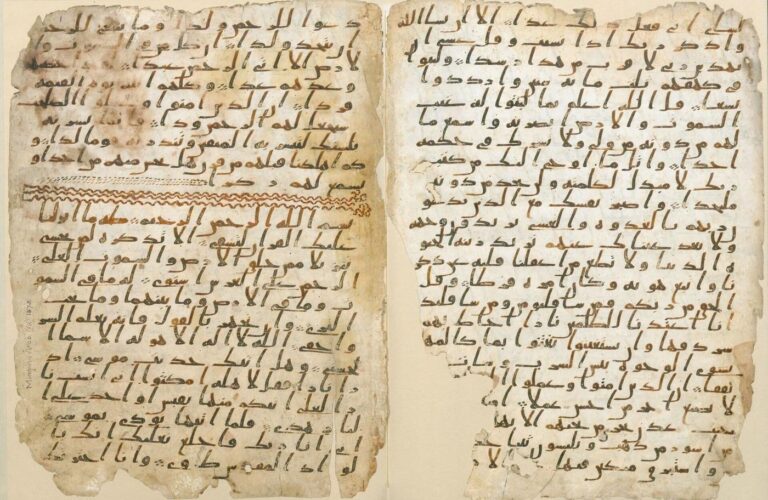
Muslims are sometimes told to compare these codices with the earliest manuscripts of the Quran, and the comparison is worth making honestly. No complete Quran survives from the seventh century either; the Birmingham leaves, the Sana’a palimpsest and the Codex Parisino-Petropolitanus are partial. The lower text of the Sana’a palimpsest also differs from the standard text in many small readings, a fact Muslim and non-Muslim scholars both discuss. The difference Muslims point to lies elsewhere. The Quran was carried by recitation from the start, memorised in full and recited daily, and the written copies were checked against that recitation. The site’s article on manuscript transmission sets out that comparison in detail.[21] The codices discussed here can stand as they are in that comparison, provided they are described accurately.
The bottom line
Codex Sinaiticus, Codex Vaticanus and Codex Alexandrinus are genuine Bibles from before Islam. None of them is complete. Sinaiticus is divided between London, Leipzig, St Petersburg and Sinai. Sinaiticus ends with Barnabas and Hermas and Alexandrinus with two letters of Clement. Both fourth-century codices end Mark at 16:8 and lack the adultery story, Sinaiticus carries some 23,000 corrections, and the two disagree with each other thousands of times in the Gospels.
The papyri a century earlier show one line of the text copied with great care and others copied freely, with the scribes correcting as they went.
The codices are the best evidence for the early text of the Bible, and they are evidence that the text moved. A reader can hold both facts at once: the New Testament of the fourth century is recognisably the New Testament of today, and the manuscripts that prove it also show where it changed.
Notes
- Bruce M. Metzger and Bart D. Ehrman, The Text of the New Testament: Its Transmission, Corruption, and Restoration, 4th ed. (New York: Oxford University Press, 2005), pp. 62–69.
- Eusebius, Life of Constantine 4.36–37; T. C. Skeat, “The Codex Sinaiticus, the Codex Vaticanus and Constantine”, Journal of Theological Studies 50 (1999), pp. 583–625.
- Metzger and Ehrman, Text of the New Testament, pp. 67–69.
- D. C. Parker, Codex Sinaiticus: The Story of the World’s Oldest Bible (London: British Library, 2010), chapter 2.
- Metzger and Ehrman, Text of the New Testament, pp. 67–68.
- Metzger and Ehrman, Text of the New Testament, pp. 67–68.
- Parker, Codex Sinaiticus, chapters 5–6; Codex Sinaiticus Project, “History of the Codex”, codexsinaiticus.org.
- Parker, Codex Sinaiticus, chapter 3; Eusebius, Ecclesiastical History 3.25, listing Barnabas and Hermas among the disputed books.
- Metzger and Ehrman, Text of the New Testament, p. 67.
- Henry Barclay Swete, An Introduction to the Old Testament in Greek (Cambridge, 1900), pp. 201–202, the table of contents of the uncial codices.
- Mark 16:8–20; Bruce M. Metzger, A Textual Commentary on the Greek New Testament, 2nd ed. (Stuttgart: Deutsche Bibelgesellschaft, 1994), pp. 102–106.
- John 7:53–8:11, 1 John 5:7–8, Matthew 6:13 and John 5:3–4; Metzger, Textual Commentary, at each passage.
- Codex Sinaiticus Project, “The Corrections”, codexsinaiticus.org; Parker, Codex Sinaiticus, chapter 4.
- Matthew 13:35 and Psalm 78:2; Metzger, Textual Commentary, p. 27; Jerome, Commentary on Matthew, on 13:35.
- Codex Vaticanus, folio 1512, margin at Hebrews 1:3; Metzger and Ehrman, Text of the New Testament, p. 68.
- Herman C. Hoskier, Codex B and Its Allies: A Study and an Indictment, vol. 2 (London: Bernard Quaritch, 1914), p. 1.
- Metzger and Ehrman, Text of the New Testament, pp. 53–61.
- Gordon D. Fee, “The Corrections of Papyrus Bodmer II and Early Textual Transmission”, Novum Testamentum 7 (1965), pp. 247–257; Philip W. Comfort, Encountering the Manuscripts (Nashville: Broadman and Holman, 2005), on P66; on P75 and Vaticanus, Carlo M. Martini, Il problema della recensionalità del codice B alla luce del papiro Bodmer XIV (Rome, 1966).
- Günther Zuntz, The Text of the Epistles (London: British Academy, 1953), on P46.
- Harry Y. Gamble, Books and Readers in the Early Church (New Haven: Yale University Press, 1995), chapter 2.
- See the site’s articles on manuscript transmission and on Uthman’s copies.


Leave a Reply