
Walk into a mosque and you will see no pictures of God, and walls covered in pattern that seems to go on past its edges. The common explanation is that Islam “forbids images”, and that the pattern is what artists did instead. The scholar Ismail al Faruqi argued that this has the order wrong. The pattern is not a substitute. It is a positive statement of belief, worked out in line and colour.[1]
Here are five ideas from his account, each with the text or the monument behind it. The arabesque entry also states the objection that art historians raise, since a theory of meaning deserves to be tested against the people who study how these objects were actually made.
Number 1: Nothing in creation can stand for God
The first article of Islamic faith is that there is no god but God, the doctrine of tawhid, the oneness of God, and the Quran adds that “nothing is like Him.”[2] The short chapter 112 closes the same way: there is none comparable to Him. An image works by likeness, and so no image can be of Him.
Faruqi’s point is that the Muslim artist took this seriously. Greek and Roman art made its gods by perfecting nature, so that the god was nature at its best. Islam holds that God is wholly other than nature, so nature cannot be used to show Him.[3] Muslim theologians have a word for this belief, tanzīh, the declaration that God is above every likeness.
The contrast with the older Mediterranean tradition makes the claim concrete. A Greek sculptor carved a god as a human body in ideal proportion, and the viewer was meant to see the divine in that perfection. A Muslim craftsman had no such option, because on this view any ideal human or natural form would still be a created thing, and the Creator is of another kind.
Number 2: Stylisation says no to nature
When the Muslim artist draws a vine, a leaf or a flower, he does not copy it and does not perfect it. He simplifies it until it is a shape. Faruqi called this the artist’s way of saying “no” to nature: nothing in it is a fit vehicle for the divine, neither the actual flower nor its ideal form.[3] The same treatment is given to the rare human and animal figures in Islamic art, as in manuscript painting, which are drawn flat and emptied of the drama that the Western tradition prizes.

A word on the images themselves. The Quran condemns idols but contains no verse that bans pictures as such. The prohibition rests on hadith, among them the report that the makers of images will be told on the Day of Resurrection to give life to what they made.[4] Jurists differed on how far it reached. Some applied it to any picture of a living creature, and others confined it to pictures made to be honoured or to statues.
The Quran itself speaks of the jinn making statues for Solomon,[5] and Muslim courts did commission figural painting, in Persian, Ottoman and Mughal books and in the Umayyad bathhouse at Qusayr Amra. Faruqi’s claim covers what the dominant religious art did with the material, and the exceptions confirm how deliberately it flattened its figures.
Number 3: Geometry goes further
Stylisation, followed to its end, reaches the geometrical figure: the circle, the star, the polygon. These are the opposite of nature as the senses give it. A design built on them makes no reference to anything in the world, which suits the statement that nothing in the world is God.[3] This is why so much Islamic decoration is geometric, from tile to carpet to carved wood.
The craft behind it was sophisticated. In the 10th century the mathematician Abu al-Wafa al-Buzjani wrote a treatise on the geometric constructions that artisans need, and later pattern books and scrolls show how builders drew stars and polygons with a straightedge and compass.[6] By the 15th century craftsmen were laying tiles in interlocking decagons and stars whose patterns, as physicists Peter Lu and Paul Steinhardt showed in 2007, come close to what mathematicians would later call quasi-crystalline tilings.[7]
Geometry also served a theological point, since a figure whose rules can be known and repeated has an order that comes from outside the maker. That fits the Quran’s statement that God created everything with measure (54:49).
Number 4: The arabesque is built to suggest infinity
The Muslim designer developed a pattern in which each figure leads into the next. Repeated and symmetrical, it has no centre and no end, and it is cut off at the edge of the object, so that the eye keeps moving past it. Faruqi argued that the viewer’s imagination tries to carry the pattern on, and fails, because it cannot be done. The failure is the point: it gives a sense of the infinite, and the infinite is what transcendence means.[3]

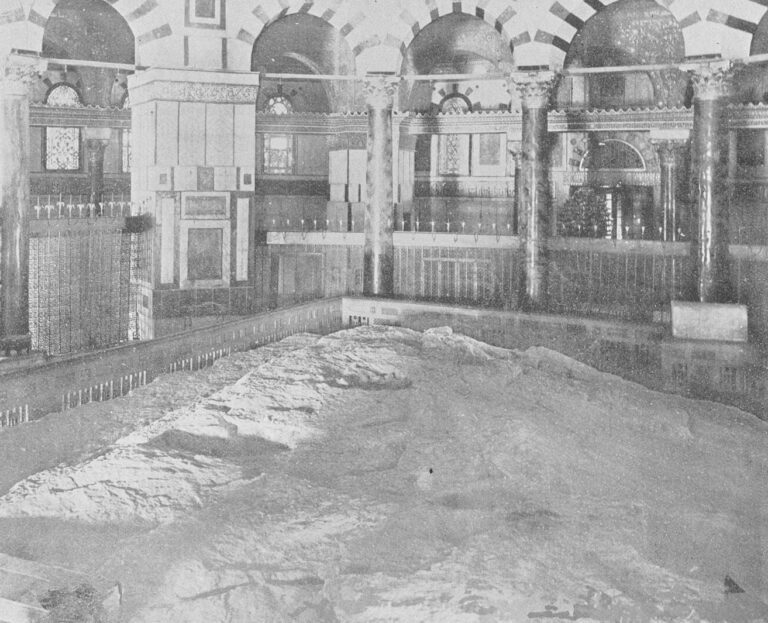
This, he said, is why calling the arabesque mere “decoration” misses it. The earliest examples he cites, from the Umayyad palaces of Jordan, the Dome of the Rock and the Great Mosque of Damascus, date from the first Islamic century, and the craftsmen were still often Christian or converts working in the Byzantine tradition.[3]
Here the objection is strongest. Oleg Grabar and other art historians have shown that early Islamic art drew on Byzantine and Sasanian models and on the tastes of its patrons, and that no single doctrine accounts for its forms.[8] Patterns of repeating vines also exist outside Islam. His reading can accept both points, since the claim concerns the meaning these forms came to carry for Muslims and the principle that governed their use, and a history of borrowing does not touch that.
Number 5: The pattern echoes the Quran
Faruqi traced the design to the Quran itself. Its text has no beginning, middle and end in the usual sense: a reader may open it anywhere and the recitation is complete in itself. Its rhythm carries the listener on, and the wish to go on is built in. The arabesque does with line what the Quran does with sound.[9] A Muslim who reads the Quran and looks at a mosque ceiling is meeting the same idea twice. Calligraphy, in which the words of the Quran become the design, joins the two.
Ismail al Faruqi and Lois Lamya al Faruqi, in The Cultural Atlas of Islam, later set out the argument in full. They name six characteristics found in every Islamic art: abstraction, modular structure, successive combinations, repetition, dynamism and intricacy. A pattern is built from small units, each complete in itself; the units combine into larger ones that keep their own identity, so the design has many centres of interest and no single point where it begins or ends.[10] They trace each characteristic to the Quran. Its verses are units complete in themselves, divided in recitation by pauses, and combined into ever larger sections: groups of ten verses, quarters, the sixty hizb and the thirty juz (parts) of the whole.[11]
The Quran describes itself in terms that fit this reading. In 39:23 it calls itself a consistent scripture whose parts repeat one another, and the repetition is part of how it works on the listener.[12] It also honours writing: the first revelation says that God taught by the pen (96:4), and chapter 68 opens with an oath by the pen.
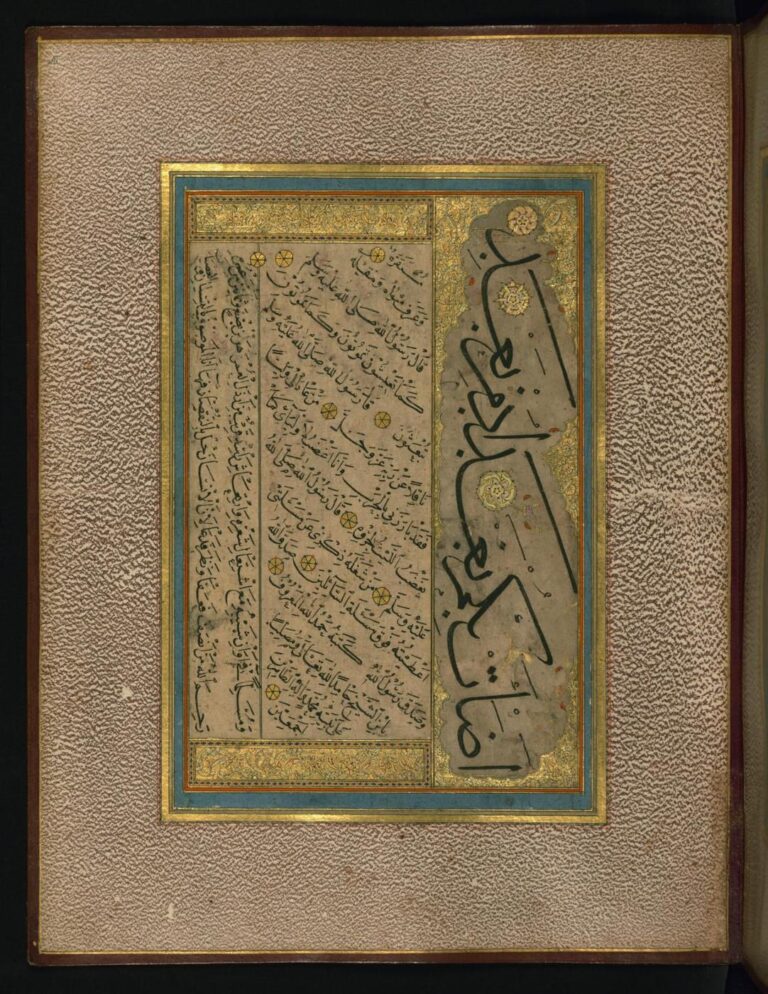
Al-Faruqi describes how the Arabic script itself became a design. Within two generations, he writes, “the Islamic artist transformed the Arabic word into a visual work of art”. On his account the calligrapher joined the letters so that the eye could take in the whole word or phrase at one glance, and then stretched, bent and divided them until the writing became an arabesque in its own right. Cursive scripts such as Nabataean and Syriac already linked letters, so the claim to rest on is his point about the art: the Arabic script was developed as a design as well as a means of writing.[13] The result, he adds, was a public art found “in stone, stucco or wood, on paper, skin or cloth”, and so valued that “kings and plebeians entertained one supreme hope for their whole lives: to be able to copy a whole Qur’an—and die!”[14] He also faults the Western historians of Islamic art, whose fastidious cataloguing he praises, for having “judged that art by standards of Western aesthetics” and standing bewildered before the absence of figures and drama.[15] That last judgment is his own and is a sweeping one; the article’s account of figural painting at Muslim courts shows that the picture was more varied.
The result was an art of the written word. Scripts such as Kufic, naskh and thuluth were developed into forms that can fill a wall or a dome, so that a mosque presents the divine speech in the shape of the building itself.
The bottom line
Faruqi gives a coherent account in which one belief, that God is beyond every likeness, produces a set of artistic habits: stylised plants, geometric figures, endless pattern and the written word. The texts he relies on say what he says they say, and the monuments show the habits he describes.
It is an interpretation, and art historians are right that borrowed forms and royal taste shaped Islamic art as well. A fair reading takes both. The theology does not explain every tile, and it does explain why a civilisation with all these resources of skill chose, century after century, to leave God without a picture.
Notes
- Ismail R. al Faruqi, Divine Transcendence and Its Expression (Kuala Lumpur: Muslim Youth Movement of Malaysia, 1983), III.C.
- Quran 42:11; compare Quran 112:4.
- Faruqi, Divine Transcendence and Its Expression, III.C.
- Sahih al-Bukhari, Book of Clothing, on the makers of images. Sahih al-Bukhari 5950 (Book of Dress, “The punishment of the picture-makers on the Day of Resurrection”), report of Abdullah ibn Masud, checked on sunnah.com; Ibn Hajar al-Asqalani, Fath al-Bari (Salafiyya edition), vol. 10, p. 382 (Shamela text).
- Quran 34:13.
- Gülru Necipoğlu, The Topkapı Scroll: Geometry and Ornament in Islamic Architecture (Santa Monica: Getty Center, 1995), on geometric treatises for artisans.
- Peter J. Lu and Paul J. Steinhardt, “Decagonal and Quasi-Crystalline Tilings in Medieval Islamic Architecture”, Science 315 (2007).
- Oleg Grabar, The Formation of Islamic Art (New Haven: Yale University Press, 1973).
- Faruqi, Divine Transcendence and Its Expression, III.D, on the non-developmental form of the Quran and its momentum.
- Ismail R. al Faruqi and Lois Lamya al Faruqi, The Cultural Atlas of Islam (New York: Macmillan, 1986), pp. 164–168.
- Al Faruqi and al Faruqi, The Cultural Atlas of Islam, p. 171.
- Quran 39:23, 96:4 and 68:1.
- Ismail R. al Faruqi, Essential Writings, ed. Imtiyaz Yusuf (Leesburg, Va.: Center for Islam in the Contemporary World, and Petaling Jaya: Islamic Book Trust, 2021), “Islam and Art”, pp. 145–146, from “Islam and Art”, Studia Islamica, no. 37 (1973), pp. 105–106.
- Ismail R. al Faruqi, Essential Writings, ed. Imtiyaz Yusuf (Leesburg, Va.: Center for Islam in the Contemporary World, and Petaling Jaya: Islamic Book Trust, 2021), “Islam and Art”, p. 147, from Studia Islamica, no. 37 (1973), pp. 106–107.
- Ismail R. al Faruqi, Essential Writings, ed. Imtiyaz Yusuf (Leesburg, Va.: Center for Islam in the Contemporary World, and Petaling Jaya: Islamic Book Trust, 2021), “Islam and Art”, p. 139, from Studia Islamica, no. 37 (1973), p. 83.



Leave a Reply