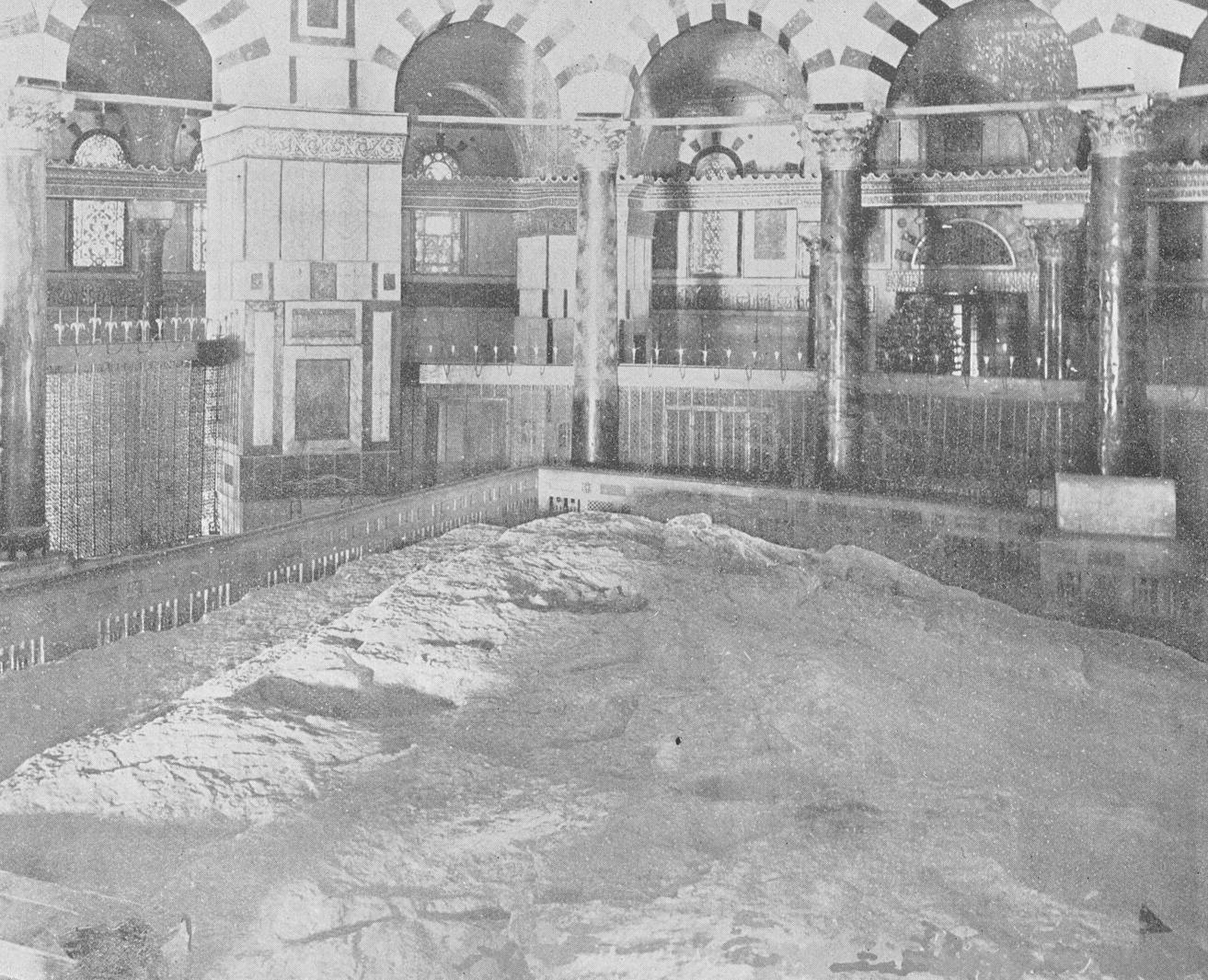
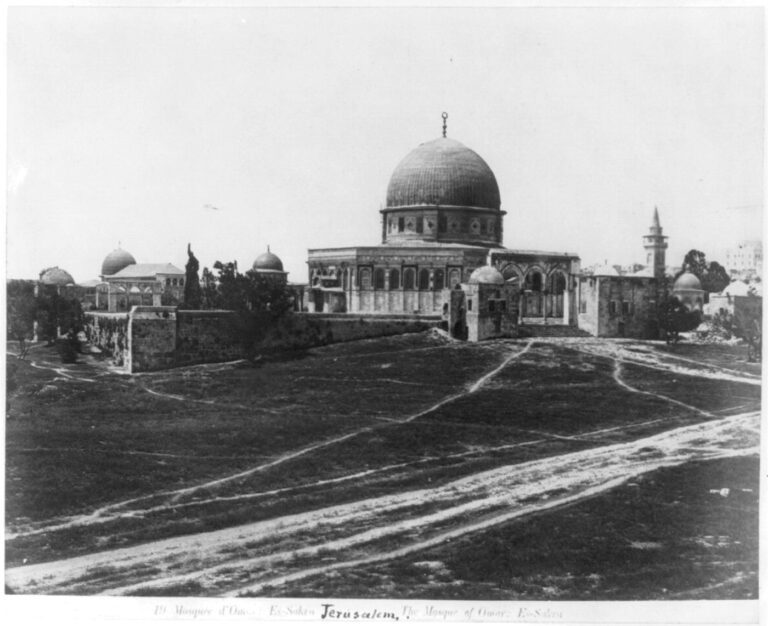
The Dome of the Rock in Jerusalem was built for the Umayyad caliph ʿAbd al-Malik and carries a foundation date of 72 AH, which is 691 to 692 CE. Its inscriptions run in two long bands of blue and gold glass mosaic around the inner and outer faces of its octagonal arcade, with two more on copper plaques over its eastern and northern doors.[1]
They are among the earliest dated texts in Arabic that quote the Quran, set up about sixty years after the Prophet’s death. Here is what they show, and where historians have argued about what they show.
Number 1: The date survived an attempt to rewrite it
More than a century after the building went up, the ʿAbbasid caliph al-Maʾmun, who reigned from 813 to 833, had his own name set into the foundation notice in place of ʿAbd al-Malik’s. His craftsmen left the date untouched.[1]
That oversight is a gift to historians. A caliph who died in 833 could not have built a dome dated 72 AH, so the substitution itself proves that the inscriptions belong to ʿAbd al-Malik’s reign. The strongest objection is that the episode shows a text in a major shrine being altered by a later ruler, and that other alterations might have gone unnoticed. The answer is that the change here is visible, limited to a single name, and detectable precisely because the original date contradicted it. A forger covering his tracks would have changed both.
Number 2: They quote the Quran as Muslims recite it today
The mosaic bands quote whole passages that stand in the Quran now: the verses addressing the People of the Book in the fourth surah (sūrah, “chapter”), the verses on Jesus in the nineteenth, the witness to God’s oneness in the third, the whole of the one hundred and twelfth, and more.[2]

The historian Estelle Whelan, in the fullest study of the inscriptions, found that with minor variations the passages reflect the standard printed text of Cairo.[1] The variations are of a known kind: a change of person, a phrase omitted, two passages joined to fit the sense. Islamic inscriptions of every later century do the same, long after no one doubts that the text was fixed.[1]
A sceptic may say that any variation at all shows a fluid text. The reply is in the pattern. Each difference is the kind a craftsman or a patron makes when fitting a familiar passage to a curved wall and a chosen message, and none alters a doctrine or introduces a verse that the Quran does not contain.
Number 3: They address Christians in the city of the Christian holy places
The main inscription, on the inner face of the arcade, speaks to one audience. It opens with the declaration of faith (shahādah, “witness”) and then quotes the Quran’s words to the People of the Book: “The Messiah, Jesus son of Mary, was only a messenger of God”, and “say not ‘Three’”.[1]
Whelan describes its single theme as a challenge to Christian dogma in the main Christian pilgrimage city.[1] Many art historians add that the Dome stands close to the Church of the Holy Sepulchre and rivals it in scale and splendour, a reading associated with Oleg Grabar, though scholars also stress the sanctity of the Temple Mount itself.[3] The Quran was already the text a caliph reached for when he wished to state what Islam believes about Jesus, in public and in permanent form.
One objection runs that the selection shows what the caliph wished to say, and says nothing about whether a complete written Quran existed. That is fair. But a patron can quote exact wording in stone only when that wording is fixed and known to his readers.
Number 4: The copper plaques were rewritten too, and kept their first lines
The plaques over the doors tell the same story on a smaller scale. Seven lines of the original text survive on one and four on the other; the rest of each was covered by a new sheet of copper inscribed in al-Maʾmun’s name.[1] The replacement over the eastern door is dated to the month of Rabīʿ al-Ākhir in the year 216, in 831 CE.[4]
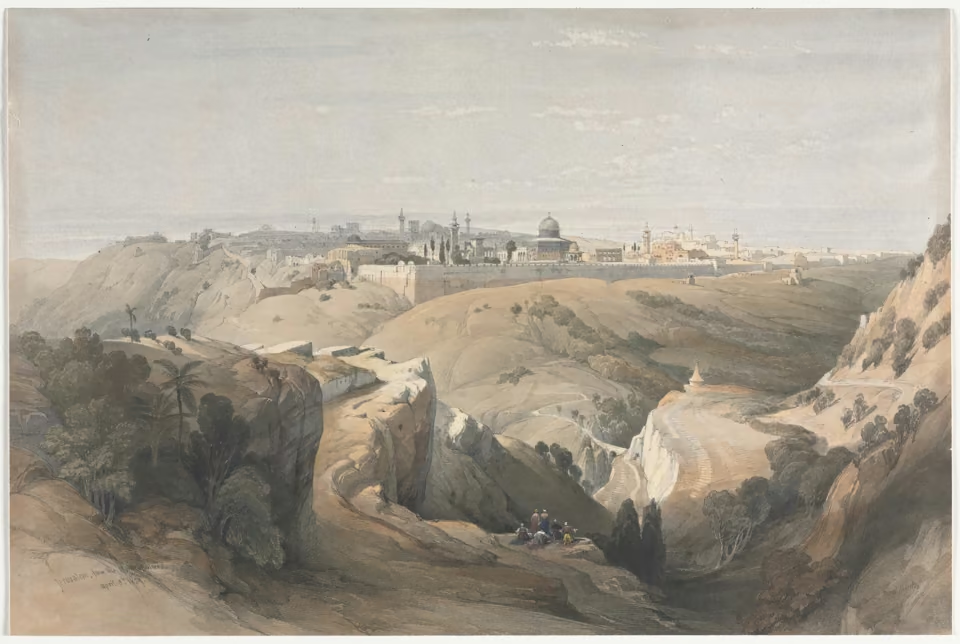
The surviving lines are original. They open with the phrase that begins every surah but one (basmalah, “In the name of God”), and they echo the Quran’s one hundred and twelfth surah: “He begetteth not nor was begotten”.[1]
The ninth-century replacement is dated openly to its own year, while the older foundation date was left in the mosaic. Two sets of dated texts, about 140 years apart, therefore sit on one building, and each is open about its own date.
Number 5: What critics called deviations read as sermons
The historians Patricia Crone and Michael Cook accepted that the mosaics agree extensively with the Quran, but they pointed to “extensive deviance” in the copper plaques as a reason to doubt that the text was settled.[5] Their book argued more broadly that the early Islamic sources were late and unreliable, so the plaques mattered to their case.
Whelan answered that one plaque is not primarily Quranic in character, and that the other weaves Quranic fragments and paraphrases together in a way that makes sense only as the handling of a text everyone recognised. A preacher who alludes to scripture assumes that his hearers know it. On her reading, the Quran was already the common property of the community in the last decade of the seventh century.[1] A plaque that mixes scripture with praise formulas is a sermon in metal, and comparing it with a transcription of the Quran misjudges its genre.
Number 6: Twenty years later, Madinah carried the last surahs in order
When ʿAbd al-Malik’s son al-Walid rebuilt the Prophet’s mosque at Madinah, between 706 and 710, its wall facing the direction of prayer (qiblah, “direction of Mecca”) was inscribed with the Quran’s first surah and then its last twenty-four, from the ninety-first to the one hundred and fourteenth. A traveller described the inscription in 903, and a second visitor confirmed it between 920 and 929.[1]
That shows the order of the short surahs already fixed by 710, including the first and the last two. The Muslim tradition says that the third caliph ʿUthman had Zayd ibn Thabit and others copy the Quran into a standard text and send copies to the main cities.[6] Whelan’s conclusion from the whole body of evidence is that the Muslim tradition is reliable, at least in broad outline, in attributing the first official copy of the Quran to ʿUthman and his commission.[1]
The evidence is partial, since it covers one wall and a late report of it. It is strong in combination with the Dome and the manuscripts.
The bottom line
The Dome of the Rock shows a text already fixed and familiar within sixty years of the Prophet’s death: quoted in public, adapted for a message, and recognised by the people who read it. The date of the first written copy is a question for the manuscripts.
The inscriptions cannot settle everything, and the best sceptical objections concern what they leave unsaid. What they do settle is that a caliph in 691 to 692 expected the people who read his inscriptions to recognise his quotations. That agrees with the earliest manuscripts, which the site examines in its pieces on the Birmingham leaves and on ʿUthman’s copies.
Notes
- Estelle Whelan, “Forgotten Witness: Evidence for the Early Codification of the Qur’an”, Journal of the American Oriental Society 118, no. 1 (1998), pp. 1–14.
- Quran 4:171–172; 19:33–36; 3:18–19; 112; see also 33:56 and 17:111, all quoted in the mosaic bands, as identified in Whelan, op. cit.
- Oleg Grabar, The Shape of the Holy: Early Islamic Jerusalem (Princeton, 1996).
- Max van Berchem, Matériaux pour un Corpus Inscriptionum Arabicarum, part 2, Jérusalem Haram, vol. 2 (Cairo, 1927), nos. 216–217, pp. 247–253, as cited in Whelan, op. cit.
- Patricia Crone and Michael Cook, Hagarism: The Making of the Islamic World (Cambridge, 1977), p. 18 and p. 167, n. 18; cited in Whelan, op. cit.
- Sahih al-Bukhari, Book of the Virtues of the Quran, the report of Zayd ibn Thabit and ʿUthman’s copies. Bukhari 4987, verified on sunnah.com (Anas ibn Malik; chapter on the collection of the Quran); Ibn Hajar, Fath al-Bari (Salafiyya edition, Shamela text), vol. 9, p. 11.



Leave a Reply