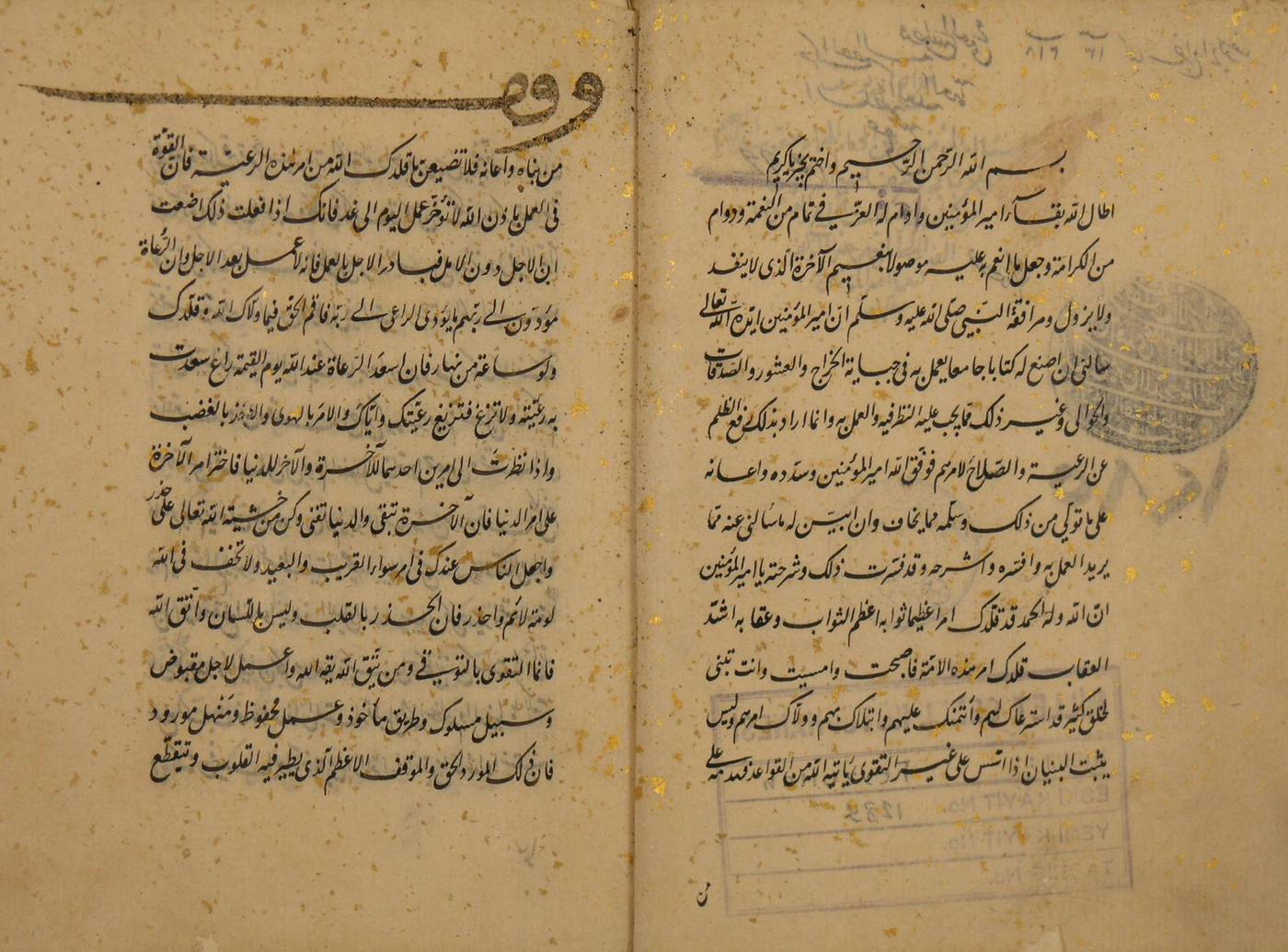
Few words from Islamic history are used against Islam as often as jizya (jizyah, the poll tax on non-Muslim subjects). Critics call it a penalty for unbelief; defenders call it a fee for protection and exemption from military service. Both descriptions circulate widely online, and each usually leaves out the half that does not suit it.
The sources support parts of both accounts. Here are eight facts, drawn from the Quran, the early legal manuals, later history and the present day, with the critics’ strongest points stated plainly and answered where the evidence allows.
Number 1: It was a graduated tax on adult non-Muslim men
An early and influential manual of Islamic taxation was written around 790 by Abū Yūsuf, chief judge to the caliph Hārūn al-Rashīd. It lays the jizya on the men among the non-Muslim subjects, sparing women and children, and sets it in three annual rates: forty-eight dirhams for the wealthy, twenty-four for those of middling means, and twelve for the needy, the labourer and the workman.[1]
The Hanafi jurists, whose school Abū Yūsuf helped to found, kept this sliding scale. Other schools followed the report that the Prophet (peace be upon him), when he sent Muʿādh ibn Jabal to Yemen, told him to take one dinar from each adult.[2] The Shāfiʿī school generally treated that dinar as the standard sum, so the jurists were not agreed on the figure.
A graduated rate by ability to pay was typical of the tax as the jurists described it, though practice varied across centuries and regions.
Number 2: The Quran commands it in a single verse
The obligation rests on one verse, revealed in the ninth year after the migration to Medina, when the Muslim community was facing the Byzantine frontier. It commands Muslims to fight those among the People of the Book who do not believe in God and the Last Day, “until they give the jizyah willingly while they are humbled”.[3] The final word, ṣāghirūn, is the centre of the dispute: other translations render it “being brought low”.[3]

Classical scholars read it in opposite ways. The commentator al-Zamakhshari described a collection meant to humiliate the payer, while Abū Yūsuf, in the same tax manual, ruled that no payer should be beaten or mistreated to extract it, and that collectors should be lenient.[4] Al-Shāfiʿī is generally reported to have read the word as submission to the authority of Muslim law.[5] The verse itself settles the obligation; how the payer was to be treated was argued among Muslims from the start.
The jurists also differed over who could pay. The Shāfiʿī school limited the choice to the People of the Book and the Zoroastrians, while the Mālikī school accepted it from a wider range of non-Muslims.
The question became practical when Muhammad ibn al-Qasim took Sind in 711 and the Muslims met Hindus and Buddhists for the first time. Ismail al Faruqi and Lois Lamya al Faruqi, in The Cultural Atlas of Islam, record the ruling sought from Damascus: as long as they did not fight the state and paid the jizya, they were free to worship as they pleased, to keep their temples and to live by their own law, with the same standing as Jews and Christians.[6] The early accounts, in al-Balādhurī and the later Persian Chachnama, set the decision in letters between Muhammad ibn al-Qasim and the governor of Iraq, al-Ḥajjāj.[7]
Number 3: The exemptions were real, and narrower than defenders often say
Women, children, monks devoted to worship, and those unable to work were exempt across the major schools of law.[1][8] Abū Yūsuf also records a letter of the commander Khālid ibn al-Walīd to the people of al-Ḥīra in Iraq, which promised that an old man unable to work, or one struck by calamity, would be freed from the tax and maintained from the public treasury.[1]
Critics are right, however, that poverty alone did not exempt a man. The Hanafi and Hanbali manuals held able-bodied poor men who could earn a living, such as labourers and artisans, liable for the lowest rate; exemption was reserved for those unable to work at all.[8]
The same manual tells of the caliph ʿUmar seeing an aged non-Muslim begging at a door. He said that the community had not done justice to the man if it took the tax from him in his youth and left him to beg in old age, and he ordered him supported from the treasury.[1] The story is about a recognised rule, and also about the hardship the tax could cause where the rule was not applied.
Number 4: It was tied to protection, and returned when protection failed
Abū Yūsuf records that when the Muslim commander Abū ʿUbaydah could no longer guarantee the protection of towns in Syria, he returned the jizya he had collected from them.[8] The geographer al-Balādhurī reports the same event at Homs, in the year of the battle of Yarmuk in 636, when a Byzantine army was gathering against the Muslim forces.[9] Even critics of the tax acknowledge the account.[8]

The episode shows that at least some early Muslim authorities understood the tax as one side of a bargain, with the state’s protection as the other. Abū ʿUbaydah told the townspeople that the Muslims could no longer defend them, so the payment had to go back.
Ismail al Faruqi reproduces the charter that ʿUmar granted to Jerusalem (Aelia) in 15 AH as the model of the arrangement. It grants the people “security for their persons and their properties, for their churches and their crosses”, and says that “they shall not be coerced in any matter pertaining to their religion, and they shall not be harmed”. It then sets the payment: “Upon the people of Aelia falls the obligation to pay the jizyah; just as the people of Mada’in (Persia) do”.[16] The same charter, as he prints it, also says that no Jews will be permitted to live in Aelia. Critics cite that clause, and it belongs in any fair account of the document.
A critic may reply that one story from a time of war is a thin basis for a general principle. The reply has force, and the jurists did not rest the principle on the story alone: they described the payer as a person under a covenant of protection, and the loss of protection as a breach on the ruler’s side.
Number 5: It was tied to military service, though critics dispute the link
Later practice made the connection explicit. The Jewish Encyclopedia of 1906 describes the Ottoman poll tax as the one “which took the place of military service”.[10] In the reforms of 1856 the Ottoman state abolished the jizya and replaced it with a tax for exemption from military service, the bedel-i askerî, which non-Muslim men paid in place of serving.[11]
Critics reply that conquerors would never have wanted conquered unbelievers in their armies, so the exemption explains little.[12] Both points can stand: the tax marked a subject who did not bear arms for the state.
The link between the two was real in the other direction as well. Some early surrender treaties are reported to have excused a community from the tax in return for serving alongside the Muslim army. That arrangement treats the payment and the service as alternatives, though the surviving reports of it are few and come mostly from historians writing generations later.
Ismail al Faruqi, describing the Islamic state as he understood it, states the link directly. The duty of defensive war falls on Muslims alone; non-Muslim citizens may volunteer, and those who do are exempt from the jizya and treated exactly as Muslims, but the state may not conscript them.[13] In his essay on the nature of da’wah he puts the rule in one sentence: should a non-Muslim wish to serve, “his services cannot be rejected and he must be refunded the jizyah tax he paid for the security of the community guaranteed by the state”.[17]
Number 6: It also marked a difference of religion, as critics say
The tax fell on non-Muslims because they were non-Muslims, and a man who became Muslim ceased to owe it.[8] It was therefore a mark of religious status as well as a charge for services, and an honest defence should say so.
Muslims, for their part, owed the zakat (zakāh, the obligatory alms), a religious levy of their own; some scholars see the two as parallel obligations falling on the two communities.[14] Zakat took a fixed share of wealth above a minimum, whereas jizya was assessed on the adult man. Al-Faruqi goes further and calls the jizya “a far lesser economic and financial burden than the zakah imposed upon Muslims”, a judgment that rests on his own reading of the sources and that the jurists’ differing rates do not settle.[18]
The strongest form of the objection is financial pressure to convert. Historians of the early Umayyad period record that governors sometimes kept charging the tax to new converts because the revenue was needed, and that the caliph ʿUmar ibn ʿAbd al-ʿAzīz ended the practice early in the eighth century.[15] The answer is that the Quran declares there is no compulsion in religion (2:256), and that Christian, Jewish and other communities lived under Muslim rule for centuries, which would not have happened if the tax had worked as a device for conversion.
Al-Faruqi adds a fiscal argument. He writes that the state’s income from the jizya, which he describes as the poll tax paid by all able, lay, adult, male non-Muslims in place of zakah and military service, fell in the first fifty years after the conquests “from numerous millions of dinars to a trifle” because of mass conversions.[19] That claim sits uneasily with the reports of governors who kept charging converts, and the two accounts may describe different provinces and decades.
Number 7: The dhimma pact also restricted religious practice, not only tax status
Jizya was one part of a wider arrangement, the dhimma, and the arrangement included restrictions beyond the tax. The terms most often cited come from a text called the Pact of Umar, preserved by the Damascus jurist Ibn Asakir and later copied by Ibn al-Qayyim and al-Turtushi, in which the Christians of Syria are said to have agreed not to build new churches or monasteries, not to restore any that fell into ruin in Muslim quarters, not to display crosses or hold processions on Muslim streets, and not to raise their voices in prayer or at funerals where Muslims could hear.[26]
The pact’s attribution to the caliph Umar ibn al-Khattab himself is disputed. Several scholars of the text’s transmission, including Albrecht Noth and the historian Milka Levy-Rubin, argue it was compiled later, drawing on earlier Byzantine and Sasanian precedents for regulating minority communities, and formalised under the Umayyads or early Abbasids rather than written at the conquest itself.[27] Whatever its date, jurists across the schools of law treated versions of it as binding guidance for centuries, and it was applied with real variation: some governors enforced the building restrictions strictly, long-established churches in cities such as Damascus and Cairo continued functioning and were at times repaired with official permission, and other periods saw new waves of demolition tied to specific political crises rather than routine practice.[28]
So the charge that dhimmi communities faced real limits on practising their religion in public, not only a tax, is accurate as a matter of classical law and recorded history. It sits alongside, not against, the charter language quoted above protecting churches and persons from harm: the dhimma guaranteed survival and property, while narrowing what public religious life was allowed to look like, and the balance between those two halves shifted with the ruler, the province and the century.
Number 8: Christian communities under Muslim-majority states today face real, documented pressure
The dhimma framework above is a bargain: protection for the tax. The live question is whether Muslim-majority states still deliver the protection half, and several plainly do not. Open Doors’ 2026 World Watch List counts 388 million Christians under high levels of restriction or violence worldwide, with 15 countries now rated “extreme.”[20] Of the 4,849 Christians it says were killed for their faith, 3,490 died in Nigeria, mostly to Boko Haram and armed Fulani militants in the Middle Belt.[20] Pakistan has been a USCIRF country of particular concern since 2002, with 184 documented blasphemy prosecutions between 2014 and 2018, a law also used against dissenting Muslims.[21] Iraq’s Christian population has fallen from an estimated 850,000 to 1.2 million before 2003 to under 250,000 today, largely through the sectarian violence of the 2000s and the Islamic State’s 2014 campaign.[22] Egypt restricts church building and is slow to prosecute sectarian attacks on Copts.[23] Iran criminalises apostasy and bans evangelism to Muslims, pushing converts underground.[24]
This is documented, and minimising it would not be honest. It is also not one story: Nigeria’s is an insurgency, Pakistan’s a weaponised colonial-era statute, Iran’s a theocracy policing its own citizens, Iraq’s a population scattered by war and occupation. The same mechanisms fall on Muslim minorities too. Pakistan has declared Ahmadis non-Muslim by law since 1974 and barred them from calling themselves Muslim; about 245 have been killed in sectarian attacks since 1984, under the same blasphemy law used against Christians.[25] Handed the tools of religious coercion, a state tends to use them on whoever sits outside the enforced orthodoxy, Muslim or not.
One caution: Open Doors is an evangelical ministry and USCIRF a US government body, and both have their own institutional incentives. The killings, convictions and church closures stand regardless. Weigh each number against the source that produced it, exactly as this article weighs the classical charters above.
The bottom line
The jizya was a graduated annual tax on adult non-Muslim men, with real exemptions and real limits to them. It was linked to protection and to service in arms, and it marked a difference of religion; Muslims argued among themselves over how its payers should be treated.
Neither slogan survives the sources. A pure fee for services would not have fallen on people for their religion, and the Quran speaks of the payers as humbled. A pure penalty would not have come with manuals that protect the payer from abuse, exempt the helpless and tie the payment to a promise of defence. In the Ottoman lands it ended with the reforms of 1856. A fair account holds all of this together, which is more persuasive than either the critic’s caricature or the defender’s simplification.
Notes
- Abū Yūsuf, Kitāb al-Kharāj, on the jizya of the people of the covenant; French translation in Culture d’Islam, “Abû Yûsuf Ya’qûb, Kitâb al-Kharâj (Livre de l’Impôt)”.
- The report of the Prophet’s instruction to Muʿādh ibn Jabal to take a dinar from each adult in Yemen, in the Sunan collections (for example Sunan Abi Dawud, chapter on jizya); its chain is discussed by the hadith critics.
- Quran 9:29, in the translations of Sahih International and Marmaduke Pickthall.
- Al-Zamakhshari and Abū Yūsuf, as quoted in the encyclopedia entry “Jizya”, Academic Kids.
- Al-Shāfiʿī, Kitāb al-Umm, on the jizya, as generally reported.
- Ismail R. al Faruqi and Lois Lamya al Faruqi, The Cultural Atlas of Islam (New York: Macmillan, 1986), p. 199.
- Al-Balādhurī, Futūḥ al-Buldān, on the conquest of Sind; the Chachnama, on the settlement at Brahmanabad.
- Middle East Forum, “Confronting the Legacy of Jizya as an Instrument of Subjugation” (2026), citing Abū Yūsuf and the Hanafi and Hanbali manuals.
- Al-Balādhurī, Futūḥ al-Buldān, on the conquest of Homs.
- The Jewish Encyclopedia (1906), s.v. “Abd-ul-Mejid”.
- “Non-Muslims and Military Service in the Late Ottoman Empire” (MA thesis, Sabancı University, deposited 2017).
- The Christian Post, “The Return and Extortion of Jizya (Payment)”.
- Ismail Raji al Faruqi, Islam: Religion, Practice, Culture and World Order (London and Washington: The International Institute of Islamic Thought, 2012), p. 83.
- Ziauddin Ahmad, “The Concept of Jizya in Early Islam”, Islamic Studies 14, no. 4 (1975), pp. 293–305.
- Daniel C. Dennett, Conversion and the Poll Tax in Early Islam (Cambridge, Mass., 1950).
- Ismail R. al Faruqi, Essential Writings, ed. Imtiyaz Yusuf (Leesburg, Va.: Center for Islam in the Contemporary World, and Petaling Jaya: Islamic Book Trust, 2021), “Islam and Other Faiths: The History”, pp. 47–48, from Islam and Other Faiths (Leicester: The Islamic Foundation, 2007).
- Al Faruqi, Essential Writings, “On the Nature of Islamic Da’wah”, p. 133.
- Al Faruqi, Essential Writings, “Islam and Other Faiths: The History”, p. 61.
- Al Faruqi, Essential Writings, “Islam: Religion, Practice, Culture and World Order”, p. 166, from Islam: Religion, Practice, Culture and World Order (IIIT, 2012), pp. 20–21.
- Open Doors, World Watch List 2026 (January 2026), headline findings on global persecution levels and the Nigeria killings figure, as reported by AsiaNews, “Open Doors: 388 million Christians persecuted worldwide, including two out of five Christians in Asia” (14 January 2026).
- US Commission on International Religious Freedom, Pakistan country recommendations and reporting on 184 documented blasphemy-law prosecutions, 2014–2018.
- Herman Teule, estimate of a decline from roughly 850,000 pre-war to roughly 250,000 Christians in Iraq, cited in Christian Today, “Iraq’s Christian Population Halved Since 2003”; Caritas Iraq’s 2015 estimate of 200,000–230,000 following the Islamic State’s 2014 campaign, reported by ANSA, “Number of Christians in Iraq fallen dramatically.”
- US Department of State, International Religious Freedom Report, Egypt, on church-building restrictions and the handling of sectarian incidents.
- US Department of State, International Religious Freedom Report, Iran, on apostasy law and restrictions on evangelism directed at Muslims.
- Human Rights Watch, “Pakistan: Pandering to Extremists Fuels Persecution of Ahmadis” (2007); Radio Free Europe/Radio Liberty reporting on Ahmadi persecution in Pakistan since 1984.
- Ibn Asakir, Tarikh Dimashq, the report of the terms offered by the Christians of Syria to Umar ibn al-Khattab; reproduced by Ibn al-Qayyim, Ahkam Ahl al-Dhimma, and by al-Turtushi, Siraj al-Muluk.
- Albrecht Noth, “Problems of Differentiation between Muslims and Non-Muslims,” in Robert Hoyland, ed., Muslims and Others in Early Islamic Society (Ashgate, 2004); Milka Levy-Rubin, Non-Muslims in the Early Islamic Empire: From Surrender to Coexistence (Cambridge University Press, 2011), on the pact’s likely later compilation from earlier regional precedent.
- On uneven enforcement and the continued operation and occasional restoration of older churches under Muslim rule, see Levy-Rubin, Non-Muslims in the Early Islamic Empire, and the case histories collected by Mark R. Cohen, Under Crescent and Cross: The Jews in the Middle Ages (Princeton University Press, 1994), on comparable dhimmi restrictions and their variable application.


Leave a Reply