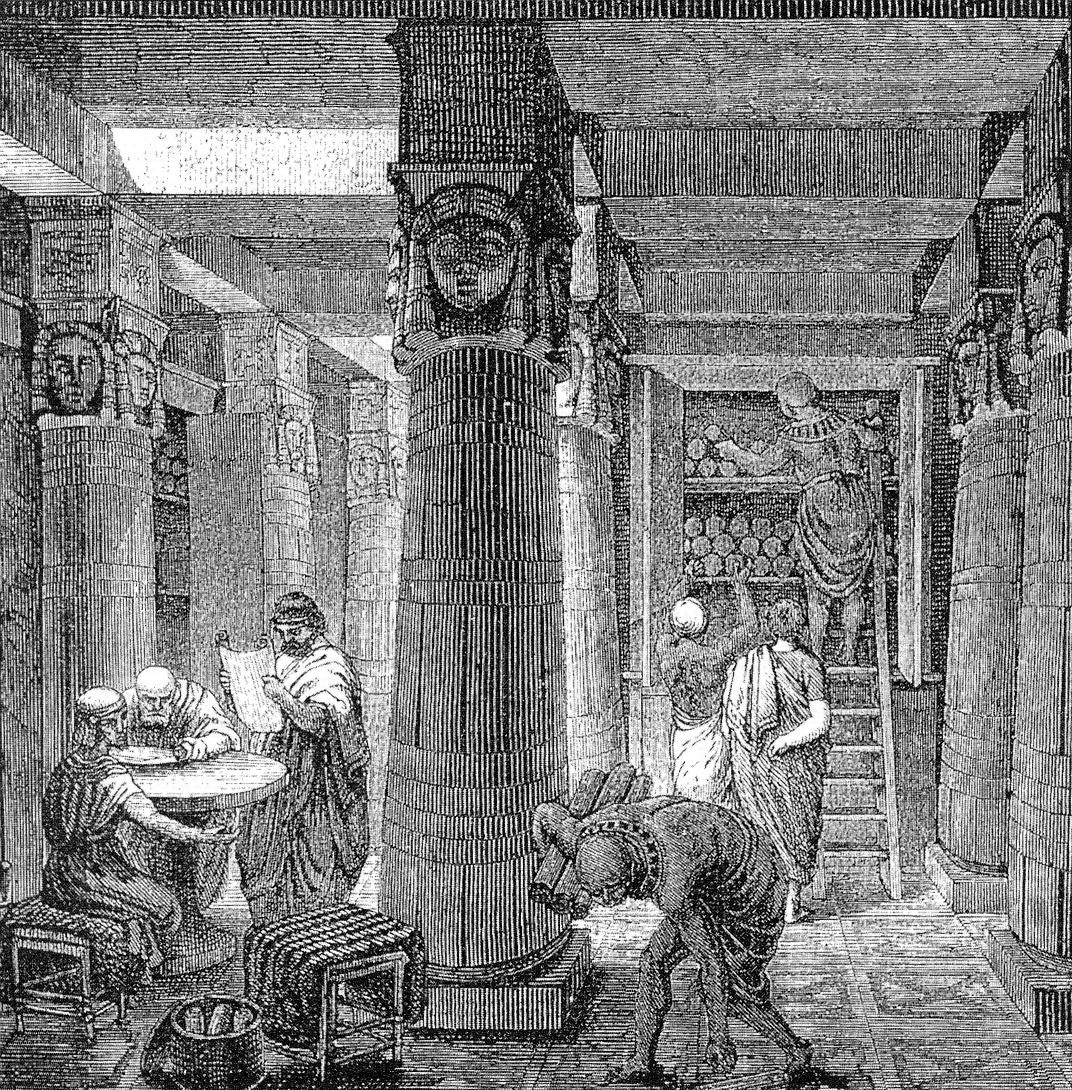
A popular story holds that when Muslim armies took Alexandria in the 640s, the caliph ʿUmar ordered its great library destroyed, reasoning that books agreeing with the Quran were unnecessary and books disagreeing with it were harmful. The books, the story goes, heated the city’s bathhouses for six months.
Historians who have examined the sources, Muslim and non-Muslim alike, have concluded that the story is a legend. Here are the five facts behind that conclusion: when the tale first appears, what earlier writers leave out, what had already happened to the library, how the details fail, and who first rejected it.
Number 1: The story first appears nearly six centuries after the event
The conquest of Alexandria took place in 641 or 642. The earliest surviving mention of the burning comes from ʿAbd al-Laṭīf al-Baghdādī, a physician from Baghdad who visited Egypt in 1203 and referred to it in a single passing phrase.[1]
The full story, with ʿUmar’s reasoning and the six months of bathhouse fires, first appears in a history of learned men written by the Egyptian scholar Ibn al-Qifṭī around 1227. In his version the Christian scholar John the Grammarian asks the Muslim commander ʿAmr ibn al-ʿĀṣ for the books, ʿAmr writes to ʿUmar for instructions, and ʿUmar sends back the famous reply. The later Christian historian Barhebraeus copied Ibn al-Qifṭī’s account.[1]
A story that surfaces six centuries after the fact, with a speech attributed to the principal figure, stands on very weak ground. Historians treat reports of that kind with caution, whatever religion the report concerns.
Number 2: No earlier source mentions it
The Muslim conquest of Egypt is recorded in a rich historical literature. None of it, for nearly six hundred years, notices the destruction of the most famous library in the ancient world.[1] The silence includes the Muslim chroniclers of the conquest, who recorded far smaller matters, and the Christian chronicler John of Nikiu, who wrote in Egypt in the late seventh century and had no reason to spare the conquerors.[2]

The historian Bernard Lewis, who studied the question closely, put the difficulty plainly: anyone who accepts the story must explain how so dramatic an event went unmentioned and unnoticed by every earlier writer.[1]
An argument from silence is not conclusive by itself, and this one is not asked to be. It gains its weight from the number and variety of the writers who are silent, together with the fact that the story first appears in a form that is full of its own difficulties.
Number 3: The library was largely gone long before 641
The library’s decline began under its own rulers, who drove out many of its scholars in 145 BC, and continued under Rome.[3] Part of it burned in 48 BC, in the fire that spread from the harbour during Julius Caesar’s war in the city.[3] Between 270 and 275 a Palmyrene invasion and the imperial counterattack probably destroyed whatever remained of the main library.[4] In 298 the emperor Diocletian set fire to the city after an eight-month siege.[5]
The library’s daughter collection at the Serapeum, a temple of the god Serapis, lasted longer. The temple was demolished in 391 under a decree of Theophilus, bishop of Alexandria; whether it still held books by then is unknown.[4][6] By the time the Arabs arrived, two and a half centuries later, there was almost certainly no great library left to burn.
Each of these events is attested by ancient writers who lived close to it, which gives the sequence a far firmer base than the single tale of 641. Ancient accounts differ over how much was lost in 48 BC, and scholars still debate the details. The overall picture of a collection worn away across centuries is not in dispute.
Number 4: The story's own details strain belief
The tale ends with the library’s books feeding the furnaces of Alexandria’s bathhouses for six months. Ibn al-Qifṭī himself closed his account with a note of wonder, and admitted that he had been told the number of bathhouses and had forgotten it.[1]

The numbers do not survive scrutiny either. The count of bathhouses that later retellings supply comes from other Arabic sources, in quite different contexts.[1]
There is a further problem with the cast. The John the Grammarian of the story is usually identified with the philosopher John Philoponus, who is thought to have died around 570, some seventy years before the conquest. The man who is supposed to have pleaded for the books could not have been alive to do it.
Number 5: Its sources were Muslim, and Muslim scholars refuted it
It is sometimes said that the story was invented to blacken Islam. Lewis rejected that explanation: the story’s original sources are Muslim writers, and its one Christian source copied from a Muslim author. He thought it more likely that those writers adapted folklore already in circulation.[1][7]
Muslim scholarship was also among the first to take the story apart. In 1892 the Indian historian Shibli Nomani published a full examination of the charge against ʿUmar and concluded that the library had been lost centuries earlier.[8]
The story also sits badly with what is known of the early caliphate. Within two centuries of the conquest, caliphs such as al-Maʾmūn were paying translators to bring the works of the Greek philosophers and physicians into Arabic, and the first word of the Quran revealed to the Prophet (peace be upon him) is an instruction to read.[9] Its record on books has to be judged on the evidence, and the evidence of the translation movement points the other way.
The bottom line
The Library of Alexandria declined over centuries, through fire, war and neglect, and whatever remained of it had almost certainly vanished long before the Arab conquest.
The story of ʿUmar’s order appears six centuries after the event, in sources that cannot bear its weight, and it contains a cast member who died decades before the scene. The honest verdict, reached by Muslim and Western historians alike, is that it is a legend. Anyone who repeats it as fact is repeating a medieval anecdote, and anyone who wishes to defend Islam against it needs no more than the dates.
Notes
- Bernard Lewis, “The Vanished Library”, The New York Review of Books, 27 September 1990.
- John of Nikiu, Chronicle, an account of the conquest of Egypt written in the late seventh century and preserved in an Ethiopic translation.
- History.com, “What Destroyed the Library of Alexandria?”, on the expulsion of 145 BC and the fire of 48 BC.
- Edward J. Watts, City and School in Late Antique Athens and Alexandria (Berkeley: University of California Press, 2008), p. 150; Lionel Casson, Libraries in the Ancient World (New Haven: Yale University Press, 2001), p. 47.
- James Grout, “The Great Library of Alexandria”, Encyclopaedia Romana, University of Chicago.
- World History Encyclopedia, s.v. “Library of Alexandria”.
- Bernard Lewis, “The Arab Destruction of the Library of Alexandria: Anatomy of a Myth”, in Mostafa el-Abbadi and Omnia Mounir Fathallah (eds.), What Happened to the Ancient Library of Alexandria? (Leiden, 2008), pp. 213–217.
- Shibli Nomani, An Enquiry into the Destruction of the Ancient Alexandrian Library (1892).
- Quran 96:1–5.



Leave a Reply