Critics sometimes say that no ancient source outside Islam mentions Mecca or its sanctuary. Defenders sometimes answer with every ancient text that might. Neither serves the reader, because a claim of silence and a claim of proof both fail when the texts are read closely.
Here are five witnesses that are often cited for the Kaaba (Kaʿbah, “the cube”) before Islam, each weighed for what it can bear. Two are classical Greek writers, one is a recent inscription, one is a psalm that is sometimes pressed into service, and one is the Quran. The order runs from the oldest to the one that carries the claim itself.
Number 1: Diodorus: a temple revered by all Arabians
In the first century BC the Greek historian Diodorus of Sicily, describing the Arabian coast of the Red Sea, wrote of a temple there “very holy and exceedingly revered by all Arabians”.[1] He wrote in a long survey of the lands beyond Egypt, and he names the people who live by that coast, the Banizomenes.
In the eighteenth century Edward Gibbon took this for the Kaaba. He also raised the difficulty himself: Agatharchides, the earlier writer whom Diodorus follows for the rest of the passage, does not mention the temple.[2] Diodorus places it on a coastal gulf among the Banizomenes, while Mecca lies inland.[1] The identification remains possible and unproven.
What the passage does show, whichever sanctuary it describes, is that a writer in the first century BC could speak of a shrine honoured by Arabs generally. That fits the later Arabic picture of tribes gathering at a common sanctuary, though it cannot be called a description of Mecca.
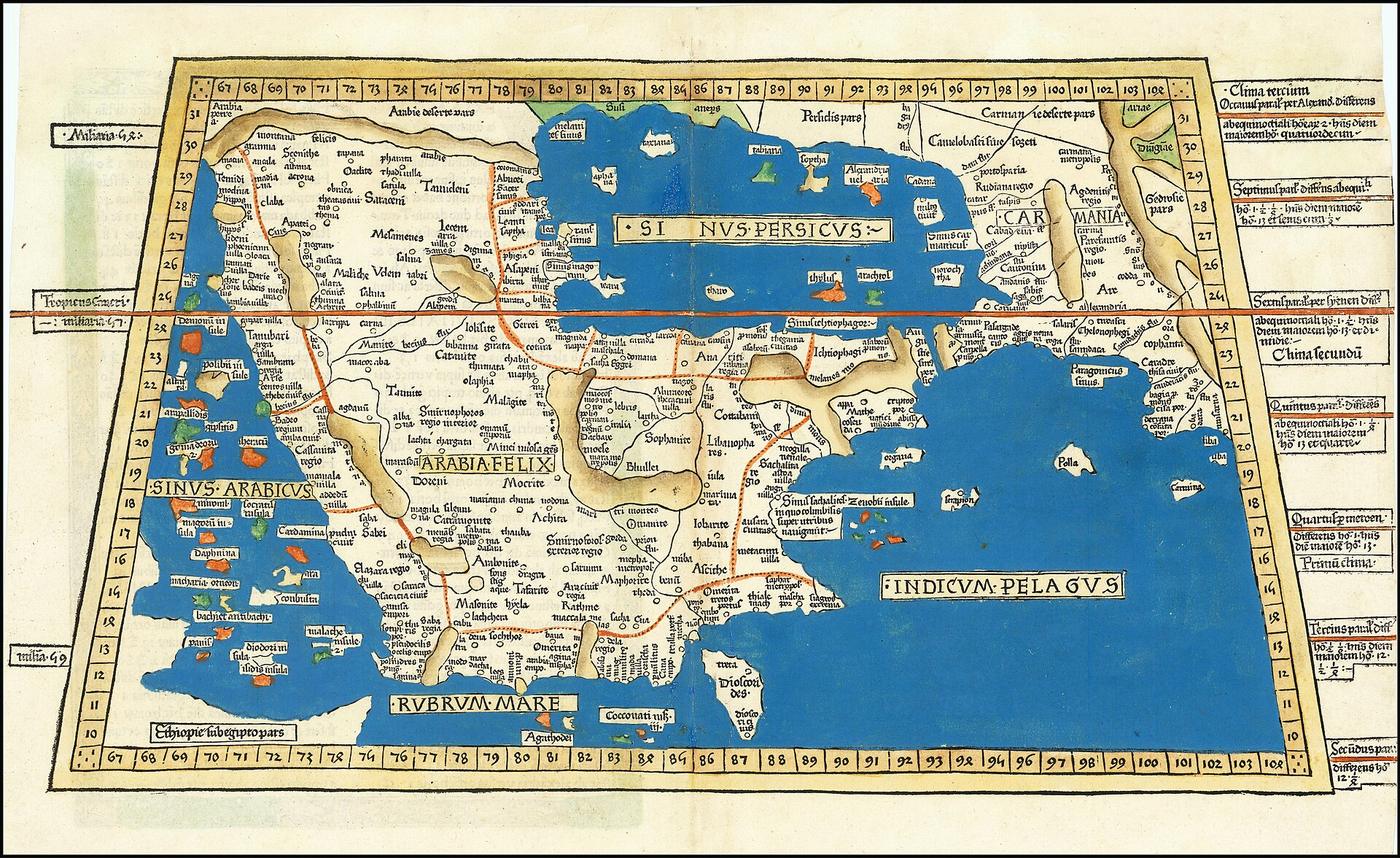
Number 2: Ptolemy: a town called Macoraba
In the second century AD the geographer Ptolemy listed a town in western Arabia called Macoraba. Scholars have long suggested that it is Mecca, and others have questioned the identification.[3] The name sits in a list of settlements with coordinates, and the list says nothing of a temple.
The historian G. W. Bowersock accepts the identification, reading the name as Makkah with an Aramaic adjective meaning “great”.[4] Patricia Crone rejects it outright.[5] Ian Morris, in a sixty-page study in 2018, agrees with Crone that Ptolemy’s coordinates are too inexact to settle the question on their own.[6]
Even if Macoraba is Mecca, the entry would show a settlement of that name in the second century, and would be silent on the Kaaba. This witness is contested, and honest use of it says so.
Number 3: A new inscription, and the word itself
In 2025 a study in a Cambridge journal published a newly found inscription in Qatabanic, an ancient language of South Arabia, that uses the word kʿbt, the first time the term has been found in that language.[7]
The study proposes a South Arabian origin for the name of the pre-Islamic sanctuary at Mecca, which Arabic tradition derives from kaʿb, “cube”.[7] It bears on the history of the name, which it places among the religious vocabulary of ancient Arabia; the sanctuary at Mecca itself lies outside its scope.
The Islamic sources already say that the word was not unique to Mecca. The Quran calls the sacred House “the Kaaba” in one verse,[8] and a well-known report in Sahih al-Bukhari describes a shrine called Dhu al-Khalasa, which the Arabs of the south called the Yemeni Kaaba and which the Prophet ordered destroyed.[9] A South Arabian inscription that uses the word fits that picture without proving anything about the building in Mecca.
Number 4: Psalm 84: a valley that is not Mecca
A psalm describes pilgrims who pass through the valley of Baca, as many translations render it, and make it a place of springs.[10] Because the Quran calls Mecca by an older name, Bakkah (Bakkah, the Quran’s name for Mecca), some have read the psalm as a reference to it.

The Jewish Encyclopedia notes that the name signifies a valley lacking water, and records the view that it comes from an Arabic word meaning “lacking in streams”.[11] Interpreters have proposed other meanings for the word, and none of them depends on Mecca. The psalm’s pilgrims are travelling to Zion, in Jerusalem.[12] A standard biblical reference work observes that a valley near Mecca lies wholly outside the region the passage requires.[13]
The psalm shares a word with the Quran’s name for Mecca, and nothing more; offered as evidence for Mecca, it would mislead. Muslim writers who want to be taken seriously by historians do better to leave it out.
Number 5: The Quran's own witness
The Quran makes the claim directly: “the first House [of worship] established for mankind was that at Makkah”, where the Arabic uses the older name Bakkah. It is blessed and a guidance, with “the standing place of Abraham”, and a pilgrimage to it is owed to God by all who are able.[14]
The first hearers of these verses were the Quraysh, who lived beside the House and already honoured it. A chapter addressed to them tells them to worship “the Lord of this House”.[15] The tradition adds that the Quraysh rebuilt the Kaaba in the Prophet’s youth, and that Aisha reported him saying they had left part of Abraham’s foundation outside the walls.[16] A claim made to people who could see the building would have been easy to refute if it were false.
That claim rests on the Quran’s authority, which the site defends on its own terms elsewhere. It does not need a Greek historian or a Roman geographer to carry it.
The bottom line
Of five witnesses, one is the Quran itself. Two are classical texts that may refer to the Kaaba and remain disputed; one inscription bears on the history of its name; and one psalm, often cited, bears on it not at all.
Arguing well means saying which is which. The critic who claims total silence overstates the case, because Diodorus and Ptolemy are at least candidates and scholars of standing have defended one of them. The defender who claims proof overstates it as well. A case built on the disputed texts would fall with them; a case built on the Quran, with the classical evidence weighed openly beside it, stands.
Notes
- Diodorus of Sicily, Library of History 3.44.2, trans. C. H. Oldfather, Loeb Classical Library, vol. 2 (1935), p. 217.
- Edward Gibbon, The History of the Decline and Fall of the Roman Empire, ch. 50, n. 45.
- Patricia Crone, Meccan Trade and the Rise of Islam (Princeton: Princeton University Press, 1987), pp. 134–135; Ian D. Morris, “Mecca and Macoraba”, Al-ʿUṣūr al-Wusṭā 26 (2018), pp. 1–60; G. W. Bowersock, The Crucible of Islam (Cambridge, Mass.: Harvard University Press, 2017), pp. 53–55.
- G. W. Bowersock, The Crucible of Islam (Cambridge, Mass., 2017), pp. 53–55.
- Patricia Crone, Meccan Trade and the Rise of Islam (Princeton, 1987), pp. 134–135.
- Ian D. Morris, “Mecca and Macoraba”, Al-ʿUṣūr al-Wusṭā 26 (2018), pp. 1–60.
- Mohammed A. Atbuosh, “South Arabian etymology for the Meccan Kaʿbah”, Bulletin of the School of Oriental and African Studies (published online 13 March 2025).
- Quran 5:97.
- Sahih al-Bukhari, Book of the Military Expeditions (Maghazi), the report on Dhu al-Khalasa. Sahih al-Bukhari 4355 (Ghazwa Dhu al-Khalasa), report of Jarir ibn Abdullah, which names the shrine the Yemeni Kaaba and the Syrian Kaaba, checked on sunnah.com; Ibn Hajar al-Asqalani, Fath al-Bari (Salafiyya edition), vol. 8, p. 70 (Shamela text).
- Psalm 84:5–6.
- The Jewish Encyclopedia (1906), s.v. “Baca, the Valley of”.
- Psalm 84:7.
- John McClintock and James Strong, Cyclopaedia of Biblical, Theological, and Ecclesiastical Literature, s.v. “Baca, Valley of”.
- Quran 3:96–97.
- Quran 106:1–4.
- Sahih al-Bukhari, Book of Hajj, the report of Aisha on the rebuilding of the Kaaba. Sahih al-Bukhari 1583 (Book of Hajj), report of Aisha, checked on sunnah.com; Ibn Hajar al-Asqalani, Fath al-Bari (Salafiyya edition), vol. 3, p. 439 (Shamela text).



Leave a Reply