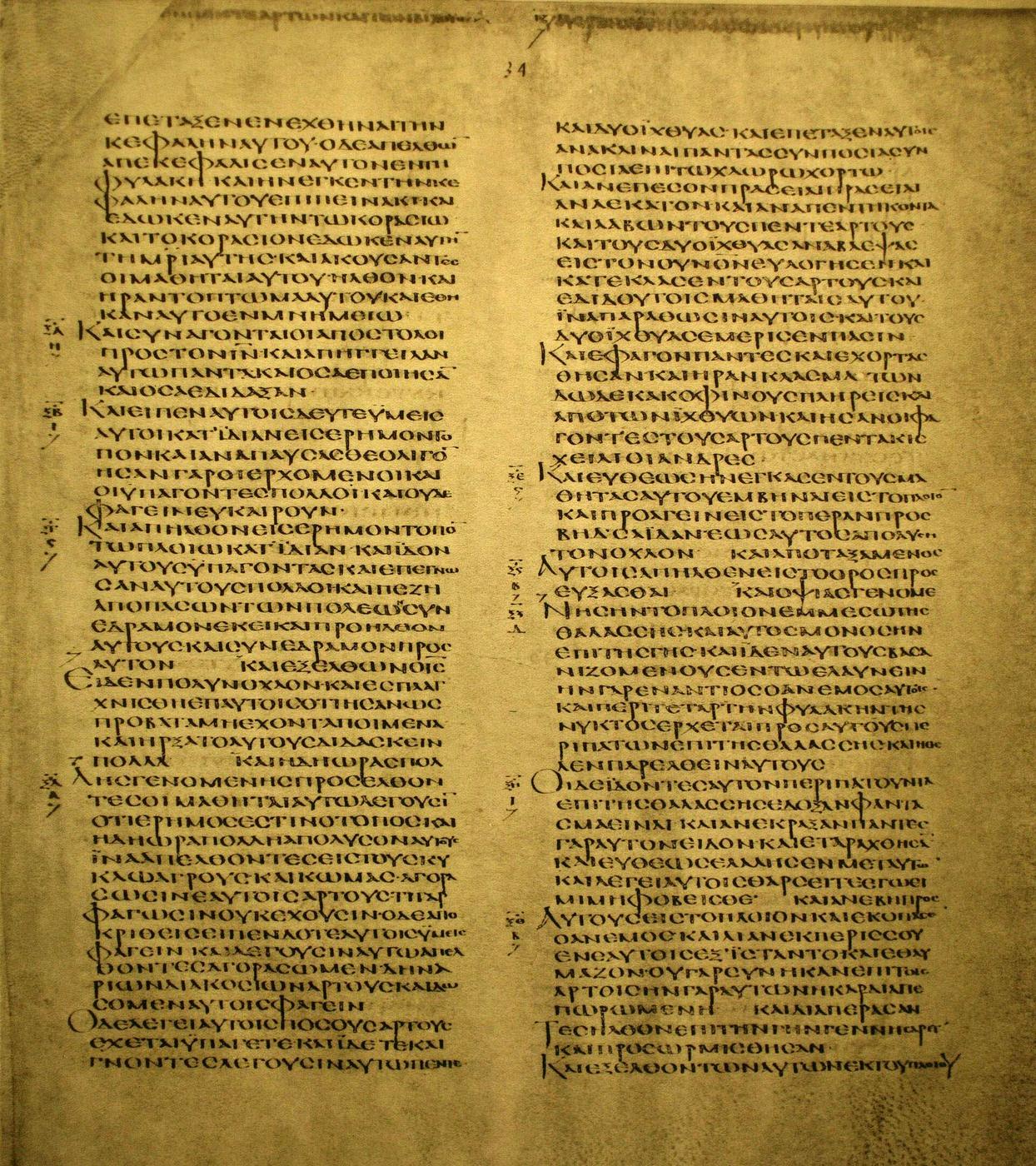
It is the most common challenge in any comment section. The Quran says God gave Jesus the Injil, the Arabic name for the revelation he received. So produce it. Show one page. And if you cannot, explain why God let it vanish while billions went astray.
It sounds decisive. It rests on a picture of the Injil that the Quran never draws. The five entries below set out what the Quran says the Injil was, what the gospels say about a gospel of Jesus, how a lost text weighs in both faiths, what the Quran claims about preservation, and who answers for what.
Number 1: The Quran never describes a book in Jesus's hand
The Quran says God gave Jesus the Injil, containing guidance and light, confirming the Torah before it. It adds that God put compassion and mercy in the hearts of those who followed him.[1] It never says he carried a bound volume, dictated one, or handed one to his disciples.
The word injīl is the Arabic form of the Greek euangelion, the good news. Asking for the physical Injil assumes the Quran means a codex. It speaks of a revelation Jesus received and preached. It also tells the People of the Gospel to judge by what God revealed in it,[2] which shows the Injil as something a community held and applied.
The strongest form of the challenge says that “gave” must mean a book, as it does for the Torah. The verb allows a book and equally allows a message, and the Quran describes the gift as guidance and light. A reader who brings a manuscript to the text has put it there.
Work on how the Quran relates to the Christian texts points the same way. Surveying the literature, the scholar Cornelia Horn reports that scholars have so far not identified instances where the Quran quotes directly from the established text of the Gospel. She notes one case that seems to echo a Gospel verse: Quran 7:40 says that those who deny the signs will not enter the Garden until the camel passes through the eye of a needle, which resembles Mark 10:25. The Quran does not name Jesus as the speaker, and, as Régis Blachère noted, the Arabic and Greek words for “camel” and “rope” can be interchanged.[3] The Quran refers to the Injil as the message Jesus brought, and it does not cite a written text of it.
Number 2: The gospels themselves say Jesus preached a gospel
The commenter wants one sentence from outside Islam saying Jesus had a message from God. Mark supplies it in the first chapter: Jesus came into Galilee proclaiming the gospel of God, and told his hearers to repent and believe in the gospel.[4]

That is Jesus preaching an euangelion before a single gospel had been written. Paul, whose letters are older than Mark, also speaks of the gospel of God.[5] Whatever Christians make of it, the idea of a gospel given to Jesus is in their own first gospel.
A Christian will answer that in Mark the gospel is the news of the kingdom, and that it came to centre on Jesus himself. That is a fair account of how the word developed in the church. It leaves Mark’s own phrase in place: the gospel Jesus announces is “of God”, a message that comes from God to the people, which is the sense the Quran gives to the Injil.
Number 3: Revelation preached aloud and never written down is not lost for want of a library
Jesus wrote nothing that survives. Christians accept that without concluding God failed to preserve his teaching. They hold that it reached people through those who heard him. Luke opens his gospel by saying that many had set out to compile an account of what was handed down by eyewitnesses and servants of the word, and that he too had investigated it from the beginning.[6]
The Islamic claim is the same shape. The Injil was the message. Parts of it survive in the gospels, mixed with narrative about Jesus written by others decades later. A Christian who thinks the missing autograph of Mark is no threat to his faith cannot consistently treat a missing autograph of the Injil as a threat to mine.
The Christian reply is that the Holy Spirit guided the four writers, so that the gospels are inspired records and not merely memory. Muslims do not share that belief, and the Quran never names the four gospels as the Injil. The argument here is narrower: both faiths already accept that a revelation can be real and reach later readers by way of human witnesses.
Number 4: The Quran claims to be the preserved record
Here is the real Islamic answer to “why did God not preserve it?” The Quran presents itself as confirming what came before and as a guardian over it, and it says the earlier scriptures were entrusted to their communities to keep.[7] The promise of preservation in the Quran is attached to the Quran.[8]

So the Muslim position is that each earlier message was entrusted to its community, and the final one was guarded directly. You can reject that. It is a coherent claim, and it answers the question as asked.
The Quran does charge some of the earlier communities with altering the word of God.[9] Muslim scholars have read that charge in two ways. Some, citing a report from Ibn Abbas in Sahih al-Bukhari, held that the people distorted the meaning by interpreting it wrongly, while the words stood.[10] Others, such as the Andalusian scholar Ibn Hazm, argued that the text of the present gospels had been changed.[11] The disagreement is old, and both views begin from the same verses. Ismail al Faruqi took the second road. He wrote that Islam regards the Bible “as a record of the divine word but a record with which the human hand had tampered, with holy as well as unholy designs”.[14] At Chambésy in 1976 he put the historical question to a Lutheran speaker: the twenty-seven books of the New Testament were not canonized “until the third century”, when, as he put it, “there were countless apostolic epistles and ‘Gospels’ in circulation”, so how could one be sure the present gospels carry the truth about God?[15] Historians would place the first list of exactly these twenty-seven books later still, in Athanasius’s festal letter of 367, which strengthens his point about a long period of choice, though it moves the date. Whether the choice preserved or lost parts of the Injil is the question the two readings answer differently.
Number 5: Nobody is damned for lacking a book they never had
The commenter says billions will burn because the Injil was lost. The Quran says God does not punish a people until a messenger has come to them,[12] and it judges each soul by what reached it.
Accountability follows the message a person received. That is a harder rule than it sounds, and a fairer one than the question assumes.
The Quran also speaks of Christians directly: those who believe in God and the Last Day and do good have their reward with their Lord.[13] Commentators differed on how that verse relates to the later verse that no religion other than submission will be accepted, and the jurists and theologians differed on those who never heard a sound account of any prophet. None of them put the matter in the hands of a critic in a comment section. Judgement belongs to God, who knows what reached each person.
The bottom line
The challenge needs the Injil to be a lost book, needs the Quran to have promised its preservation, and needs damnation to fall on people for a text they never saw. The Quran says none of the three. It speaks of a revelation Jesus preached, it attaches its promise of preservation to itself, and it ties judgement to what reached a person.
What it does say is that Jesus preached a gospel from God. On that point, Mark agrees. The question of how much of that message the present gospels carry is a real one, and Muslim scholars have answered it differently over the centuries. Every one of those answers leaves the original claim standing: a message came from God through Jesus.
Notes
- Quran 5:46; 57:27.
- Quran 5:47.
- Cornelia B. Horn, “Intersections: The Reception History of the Protoevangelium of James in Sources from the Christian East and in the Qur’ān”, Apocrypha 17 (2006), 113 to 150, at 119; she cites Sidney H. Griffith, “The Gospel, the Qur’ān, and the Presentation of Jesus in al-Ya’qūbī’s Ta’rīkh”, in Bible and Qur’ān: Essays in Scriptural Intertextuality, ed. John C. Reeves (Atlanta: Society of Biblical Literature, 2003), 133 to 160, and Régis Blachère, “Regards sur un passage parallèle des Évangiles et du Coran”, in Mélanges d’Islamologie, ed. P. Salmon (Leiden: Brill, 1974), 69 to 73.
- Mark 1:14 to 15.
- Romans 1:1.
- Luke 1:1 to 4.
- Quran 5:44; 5:48.
- Quran 15:9.
- Quran 2:75; 5:13.
- Sahih al-Bukhari, Book of Tawhid (Oneness of God), the report from Ibn Abbas on the People of the Book. Sahih al-Bukhari 7363, checked on sunnah.com; Ibn Hajar al-Asqalani, Fath al-Bari (Salafiyya edition), vol. 13, p. 333 (Shamela text).
- Ibn Hazm, al-Fisal fi al-milal wa al-ahwa wa al-nihal.
- Quran 17:15.
- Quran 2:62; cf. 3:85.
- Ismail R. al Faruqi, Essential Writings, ed. Imtiyaz Yusuf (Leesburg, Va.: Center for Islam in the Contemporary World, and Petaling Jaya: Islamic Book Trust, 2021), “Islam and Christianity”, p. 217, from “Islam and Christianity: Diatribe or Dialogue”, Journal of Ecumenical Studies 5, no. 1 (1968), pp. 58–60.
- Ismail R. al Faruqi, Essential Writings, ed. Imtiyaz Yusuf (Leesburg, Va.: Center for Islam in the Contemporary World, and Petaling Jaya: Islamic Book Trust, 2021), “Christian Mission and Islamic Da’wah: A Discourse”, p. 118.



Leave a Reply