
Mark 10:45 is one sentence long, and a whole doctrine of salvation rests on it. Jesus says that the Son of Man came “to give his life as a ransom for many.” For most Christians that is the cross explained in Jesus’s own words.
The Quran uses the same idea of ransom, and it answers no. On the Day of Judgement no ransom is taken from any soul, and no soul carries the load of another. The eight points below set the two readings side by side, say how strong each point is, and give the Christian reply its full weight. The question of whether Jesus was crucified at all is argued in The crucifixion and the Quran, and this article does not repeat it.
Number 1: Mark 10:45 says what Christians read in it
The verse closes a dispute among the disciples about rank. Jesus tells them that whoever wants to be first must be the servant of all, “For the Son of Man also came not to be served, but to serve, and to give his life as a ransom for many.”[1] Matthew 20:28 repeats the saying almost word for word. The Greek is lytron anti pollōn, a ransom in place of many.[1]

The later letter 1 Timothy 2:5 to 6 takes the thought further: Christ Jesus “gave himself as a ransom for all.”[2] From these verses the church built its teaching that the death of Jesus pays for the sins of others. Some fathers asked to whom the ransom was paid; later theology spoke of satisfaction and of penalty.
A Muslim should grant the plain point. The verse does speak of a life given for others, and the Christian reading of it is an honest reading of the words. Strength: firm. The dispute is over whether the saying is true and whether it goes back to Jesus, and the later entries take those in turn.
Number 2: In the Hebrew Bible a ransom is a price paid for a life
The Hebrew word is kofer. In the law of Moses it is a payment that saves a life the law has put at risk. The owner of an ox that kills a man may be put to death, but “if a ransom is laid on him, then he shall give for the redemption of his life whatever is laid on him.” At a census every man pays a half-shekel as “a ransom for his soul” so that no plague strikes the people.[3] The Greek translation of these passages uses the same word family as Mark, lytron.
The law also sets a limit. “You shall take no ransom for the life of a murderer who is guilty of death; but he shall surely be put to death.”[4] And a psalm says of the rich that “none of them can by any means redeem his brother, nor give God a ransom for him,” because the price of a life is too high.[5]
Christians answer that the psalm points forward: no ordinary man can pay, and so God provides one who can. That is a reading, and a coherent one. On the page, the Hebrew Bible’s ransom is money or a substitute animal, and the one verse that speaks of ransoming another person before God says it cannot be done. Strength: firm on what the texts say; open on how Mark meant his word.
Number 3: The Quran says no ransom is taken on the Last Day
Two verses of Surah al-Baqarah carry the same warning: “And fear a Day when no soul will suffice for another soul at all, nor will intercession be accepted from it, nor will compensation be taken from it, nor will they be aided.”[6] The word rendered “compensation” is ʿadl, an equivalent.

Ibn Kathir (died 1373) glosses it in one phrase: “no ransom (fidāʾ) is accepted from it.” He reports the same gloss from Ibn ʿAbbās, who said ʿadl means a substitute, “and the substitute is the ransom,” and he joins the verse to two others.[7] One says that a disbeliever who dies as one would not be ransomed by the earth’s fill of gold. The other says that if he owned all the earth and as much again, it would not buy him off the punishment.[8]
The Quran here rules out a price, whether paid by the sinner or by anyone else for him. Strength: firm.
Number 4: The Quran allows intercession, by God's leave
A fair reading has to add one thing. The same verse that denies intercession is read by the commentators as speaking of those who reject God. Ibn Kathir says so plainly: “nor will intercession be accepted from it” means “from the disbelievers.”[7] Elsewhere the Quran says, “That Day, no intercession will benefit except that of one to whom the Most Merciful has given permission and has accepted his word.”[9]
So Islam knows a kind of mediation. The Prophet Muhammad ﷺ ﷺ will intercede on the Day of Judgement, as the hadith reports describe. The difference lies in what the intercession is. It is a request that God may grant or refuse, made by His permission. Nothing is paid, and nothing is owed to God that He must collect from someone.
A Christian critic could press this point, and it deserves an answer. The Quran rejects a ransom and keeps a place for prayer on behalf of others. Strength: firm as a correction of a common overstatement on the Muslim side.
Number 5: No bearer of burdens bears another's burden
Three times the Quran gives the rule in the same words: “no bearer of burdens will bear the burden of another.”[10] Surah Fatir adds a picture. A soul weighed down calls out for someone to take part of its load, and “nothing of it will be carried, even if he should be a close relative.”[11]

The Hebrew prophets said the same. Ezekiel: “The soul who sins, he shall die. The son shall not bear the iniquity of the father, neither shall the father bear the iniquity of the son.” Deuteronomy: “Every man shall be put to death for his own sin.”[12] The site’s article on the crucifixion sets these out at more length.
The Christian reply is serious. Deuteronomy 24:16 is a rule for human judges, and Ezekiel speaks of inherited guilt, while the cross is a free gift by one who chose to bear the cost. Many Christians add that Jesus is no “other” at all, since in their creed he is God himself. That reply moves the question from the ransom to the Incarnation. For Muslims the line between Creator and creature is fixed: God does not become a creature, and a creature cannot carry what God alone forgives. Strength: firm within the Quran’s frame; against a Christian it rests on the deeper dispute over who Jesus is.
Number 6: The Quran does use the word ransom, for Abraham's son
The Quran has one ransom in its own story of the prophets. Abraham عليه السلام sees in a dream that he is sacrificing his son, the son submits, and God says: “And We ransomed him with a great sacrifice.”[13] The verb is fadaynāhu, from the same root as fidāʾ.
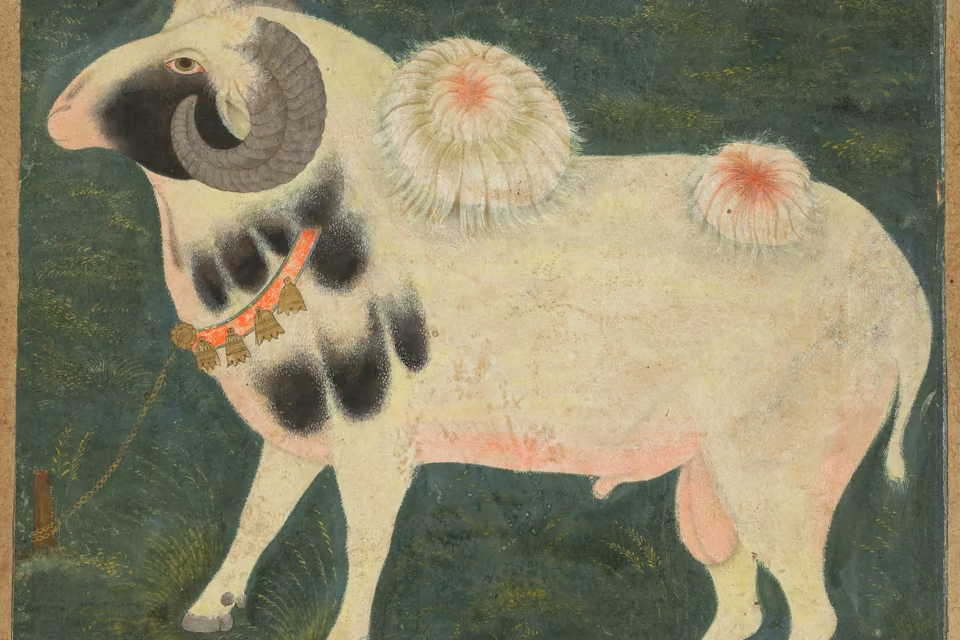
Ibn Kathir collects the early reports. ʿAlī and Ibn ʿAbbās said the sacrifice was a ram, and Ibn Kathir calls that the view of most scholars. He also records that Ibn ʿAbbās, asked about a man who had vowed to slaughter himself, said that a ram would have sufficed, and cited this verse.[14] Muslims disagreed over whether the son was Ishmael or Isaac, and Ishmael in the Quran and Genesis covers that debate.
Christians often read Genesis 22, where a ram is offered “instead of his son,” as a sign pointing to the cross.[15] The Muslim reading stays with the story as told. The son had done nothing wrong, no sin was laid on the ram, and the test was of obedience. The ransom saved an innocent from a command that God withdrew, and every Eid al-Adha sacrifice recalls that rescue. Strength: firm that the Quran uses the word; the typology is a Christian reading the Quran does not share.
Number 7: Repentance is the Quran's road back to God
Where Mark has a ransom, the Quran has tawbah, turning back. “O My servants who have transgressed against themselves, do not despair of the mercy of Allah. Indeed, Allah forgives all sins.”[16] Those who repent, believe and do good work will find that “Allah will replace their evil deeds with good.”[17] And “whoever does a wrong or wrongs himself but then seeks forgiveness of Allah will find Allah Forgiving and Merciful.”[18]
Adam is the first case. He “received from his Lord words, and He accepted his repentance.”[19] Nothing is inherited from that sin, so no ransom is needed for it. Two reports in Sahih Muslim put it in pictures. God is more glad at a servant’s repentance than a man who finds his lost camel in the desert, and if people did not sin, God would bring a people who sin and whom He forgives.[20]
Ezekiel says it too: if the wicked man turns from his sins, “none of his transgressions that he has committed will be remembered against him.”[21] Hosea gives God’s words, “I desire mercy, and not sacrifice.”[22] More on prayer and nearness to God without a mediator is in Do Muslims have a relationship with God? Strength: firm.
Number 8: Scholars disagree on whether Jesus spoke the ransom saying
This last point is the weakest, and a Muslim should hold it loosely. Luke places the same dispute about rank at the Last Supper, and his Jesus ends with “I am among you as one who serves.” There is no ransom clause.[23] Some scholars take Luke’s shorter form as nearer to what Jesus said, and Mark’s clause as the early church’s theology added to it. Rudolf Bultmann counted the saying among the church’s formations.[24]
Others disagree. In 1959 Morna Hooker and C. K. Barrett both questioned the common view that the saying quotes Isaiah 53, and that debate was about its background, with its authenticity a separate matter.[25] Many scholars, conservative and critical, accept that Jesus expected to die and gave his death a meaning for others.
The question cannot be settled from the texts we have. Strength: weak to open. The Muslim case in the entries above does not depend on it.
The bottom line
Mark 10:45 says that a life was given as a ransom, and Christians read it fairly. The Quran answers with a rule it states again and again: on the Last Day no price buys a soul free, and each soul carries its own load. Intercession by God’s leave remains, and so does the ransom of Abraham’s son, which saved an innocent and carried no sin.
The Hebrew Bible stands closer to the Quran here than to the later doctrine. It knows ransom as a price for a life under the law, it says no man can ransom his brother before God, and it opens the door of repentance to the wicked who turn. Whether the ransom saying goes back to Jesus is an open question. Allahu aʿlam.
Notes
- Mark 10:42 to 45; Matthew 20:28. Bible quotations are from the World English Bible.
- 1 Timothy 2:5 to 6.
- Exodus 21:29 to 30; Exodus 30:12 to 13.
- Numbers 35:31.
- Psalm 49:7 to 8.
- Quran 2:48; compare 2:123. Quran translations are adapted from Saheeh International.
- Ibn Kathir, Tafsir al-Quran al-Azim, ed. Sami Salama, on Quran 2:48, vol. 1, pp. 256 to 257 (Shamela text, book 8473).
- Quran 3:91; 5:36.
- Quran 20:109.
- Quran 6:164; 17:15; 35:18; compare 53:38.
- Quran 35:18.
- Ezekiel 18:20; Deuteronomy 24:16.
- Quran 37:102 to 107.
- Ibn Kathir, Tafsir al-Quran al-Azim, ed. Salama, on Quran 37:107, vol. 7, p. 31 (Shamela text, book 8473).
- Genesis 22:13.
- Quran 39:53.
- Quran 25:70.
- Quran 4:110.
- Quran 2:37.
- Sahih Muslim, Book of Repentance, 2747 (Anas ibn Malik) and 2748 (Abu Ayyub al-Ansari); ed. Muhammad Fuad Abd al-Baqi, vol. 4, pp. 2104 to 2106 (Shamela text, book 1727).
- Ezekiel 18:21 to 22.
- Hosea 6:6.
- Luke 22:24 to 27.
- Rudolf Bultmann, The History of the Synoptic Tradition, trans. John Marsh (Oxford: Blackwell, 1963), on the sayings of Jesus.
- Morna D. Hooker, Jesus and the Servant (London: SPCK, 1959); C. K. Barrett, “The Background of Mark 10:45”, in A. J. B. Higgins (ed.), New Testament Essays: Studies in Memory of Thomas Walter Manson (Manchester University Press, 1959).




Leave a Reply