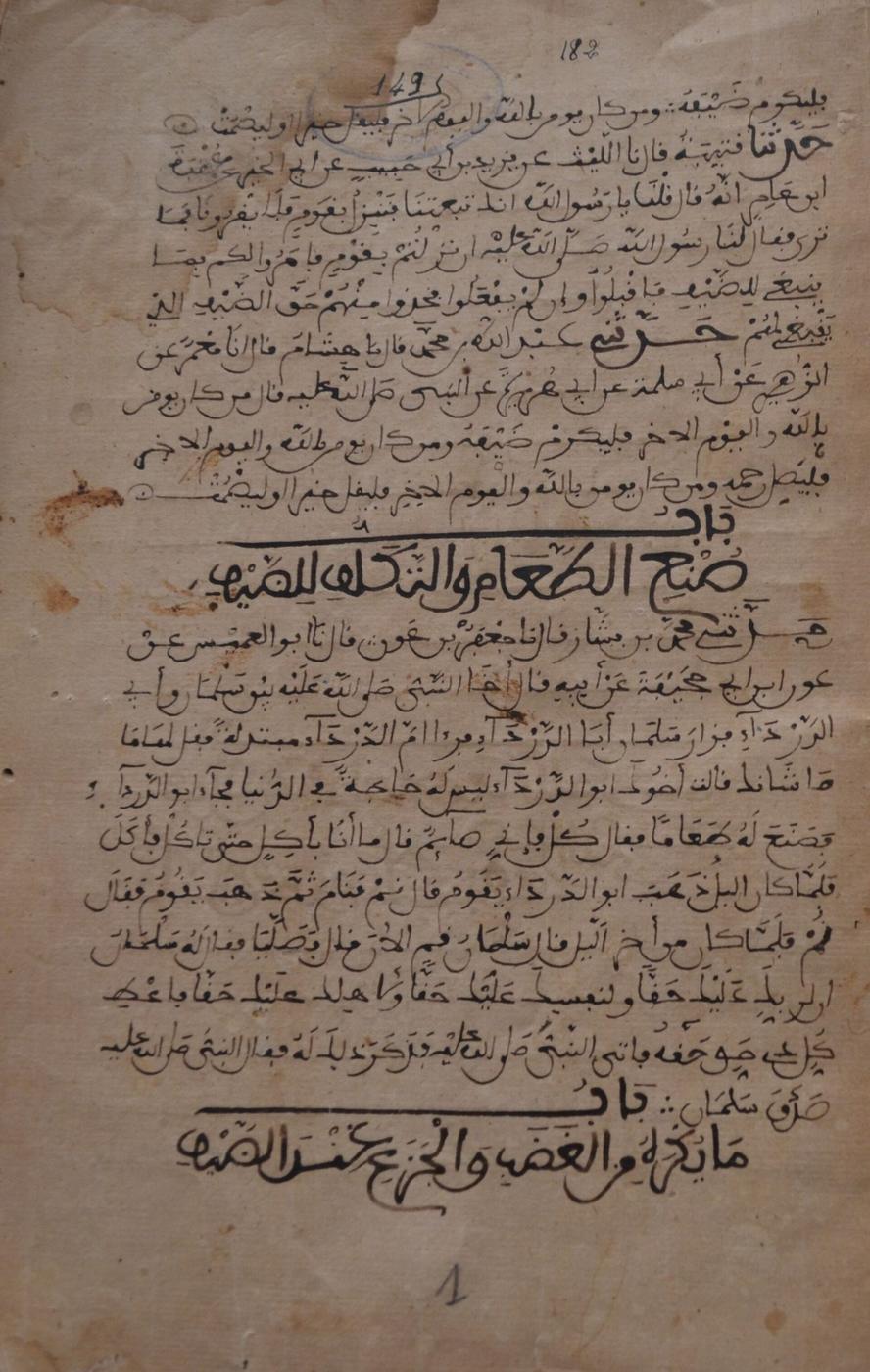
A narration recorded by Ahmad ibn Hanbal describes the Prophet Muhammad, peace be upon him, reciting the Quran to a group of beings.[1] The narrator compares their appearance to the people of al-Zuṭṭ, a South Asian people the early Arabs knew of, and says the beings yarkabūn around him. The primary sense of that verb is to mount or to ride.
Around 2022 an English reading appeared that turns this into sexual assault. It traces back to a Coptic priest, reached English readers through Raymond Ibrahim, and spread through the usual channels. The five entries below take it apart: the Arabic verb, the anatomy the text describes, the occasion, the history of the claim, and the method the polemic skips.
Number 1: The verb does not mean what the polemic needs
The root r-k-b yields a large family of senses in classical Arabic. It covers mounting an animal, boarding a ship, committing a deed, and crowding or pressing upon something. The last sense is why a wave is said to ride another wave, and why a crowd is said to ride a man it presses around. The great lexicon of Ibn Manzur, Lisan al-Arab, gathers these usages under the root.[2]
Pick the one English gloss that produces the most lurid result, then read it back into the Arabic as though it were the only option. That is the whole method of the allegation. A reader who wants to know what the verb means in this sentence asks what the surrounding words say about the scene, and here they describe a crowd gathered close around a man who is reciting.
The strongest form of the objection runs as follows: the verb can mean to mount, so the worst reading is at least possible. Possibility is cheap. Run the same method on any classical text in any language and comparable results appear. Try it on Shakespeare sometime. A reading has to be the best fit for the sentence, and this one fits neither the grammar of the scene nor the details the narrator supplies.
Number 2: The beings have no genitals, per the narration
The narrator describes the beings as tall, thin, sparsely fleshed and unclothed, and says he could not see any genitals on them.

That detail ends the sexual reading on its own terms. The reading needs anatomy, and the text states in plain words that the anatomy was not there. A polemicist who quotes the clause about the people of al-Zuṭṭ and omits this clause has chosen which half of one sentence the reader may see.
The objection is that a description of unclothed, strange beings only adds to the horror of the claim. The answer lies in the grammar of the report. The comparison to a known people is doing what comparisons do, which is to give a listener a visual handle on something unfamiliar. The narrator is reaching for the nearest human image because he has no ordinary words for what he saw. Nothing in the report turns that description into an act.
Number 3: The context is the recitation to the jinn
The narration places this scene inside a well-attested event. The Prophet recited the Quran to a gathering of jinn, and the Quran narrates the same occasion at 46:29 to 32, where a company of jinn turn toward him, listen, and go back to their people as warners.[3] Surah 72 opens with a similar confession from the jinn, who say they heard a wondrous recitation that guides to what is right (72:1 to 2).
The narration says he was reciting to them the whole time. Isolating one verb and discarding the activity the text states is editing, whatever name it goes by. A crowd pressing in close to hear a recitation is the natural picture, and it matches what the Quran says about the jinn listening.
The objection asks why a report about the jinn should shape the meaning at all. The answer is that a word takes its sense from its sentence and the sentence takes its sense from its occasion. The occasion here is a recitation and a response of belief, and no reading that ignores both can claim to be reading the text.
Number 4: Nobody found this reading for 1,400 years
Polemic against the Prophet is about as old as the Prophet. Some of it was written by people with excellent Arabic, considerable learning, and every motive to find the worst available reading of any narration in the corpus. Christian and other critics wrote against Islam in Arabic, Syriac and Greek from the early centuries, and they combed the hadith literature for material.
None of them found this reading.
It shows up in the twenty-first century, in English, from writers who do not work from the Arabic. A reading that occurred to nobody with the language for fourteen centuries is a modern invention, and the burden sits with whoever claims otherwise. The objection is that earlier critics may simply have missed it. That is possible for one critic. It is hard to believe of a whole tradition of hostile readers who were hunting for exactly this kind of material.
Number 5: The chain comes before the content
Hadith get authenticated before they get interpreted. What is the isnād, the chain of narrators? What are the variant wordings across collections? How did the scholars grade it? Only after those questions are answered does a scholar ask what a phrase means.
Polemical treatments of this narration have skipped that step entirely. They start from one English rendering, treat it as settled, and build a conclusion on it. They do not compare the wording in other collections, and they do not consult the grading of the editors who have studied the chain.
That is the reliable signal. When someone will not do the first step of the method, the goal was never the inquiry. The objection says that a hostile reader owes the tradition nothing, and that the Muslim method is not binding on outsiders. The answer is that the allegation claims to report what the hadith literature says, and that literature can only be reported by its own rules. An outsider is free to criticise those rules, but not to ignore them while citing the results.
The bottom line
There is also a prior question the allegation never asks, which is whether the narration is sound at all. In a report Muslim records, Ibn Masud himself says that none of the companions was with the Prophet on the night of the jinn.[4] The editors of the Musnad grade narrations in this cluster as weak, noting that a sound chain establishes his absence.[5] The allegation builds a scandal on a report whose own tradition questions it.
Set the rest beside that. The verb has a family of senses and the allegation picks the worst one. The anatomy the reading needs is denied in the text. The occasion is a recitation that the Quran itself describes. No reader with Arabic found this meaning for fourteen centuries. Each point alone leaves the allegation weak, and together they leave it with nothing to stand on. The narration describes a crowd of jinn pressing round a man who is reciting scripture.
Notes
- Musnad Ahmad 3788, narrated from Ibn Masud.
- Ibn Manzur, Lisan al-Arab, entry r-k-b.
- Quran 46:29 to 32, cf. 72:1 to 2.
- Sahih Muslim 450. Verified on sunnah.com as Muslim 450a (Alqama asked Ibn Masud, who said none of them was with the Prophet that night).
- Musnad Ahmad 3782, with the Darussalam editors’ grading.



Leave a Reply