
Ismail al Faruqi’s glossary of Islamic English defines the ḥajj as the fifth pillar of Islam, consisting of niyya (intention), iḥrām, ṭawāf, wuqūf (the standing), aḍḥiya (sacrifice) and rajm (stoning), acts performed at Mecca and nearby on the ninth and tenth days of Dhu al-Hijja.[1] That makes a convenient outline.
Here is what each is, and why. The entries give the text or report behind each rite, its meaning for the pilgrim, and the questions that outsiders and some Muslims raise about it. Pilgrims also walk between two hills, saʿy, which the glossary does not list, so it has its own entry here.
Number 1: Niyya, the intention
Every act of worship begins with niyya, the resolve in the heart to perform it for God. The Prophet said, “Actions are by intentions.”[2] Hajj begins when the pilgrim forms the intention at the boundary and says Labbayka Allahumma labbayk (Here I am, O God, at Your service).[3]
The boundaries, called mawāqīt, were fixed by the Prophet for pilgrims coming from different directions, so the place where a pilgrim enters the state of ihram depends on the road he or she travelled. The pilgrim can choose among three forms of the journey: the hajj alone, the hajj together with the lesser pilgrimage (ʿumra) in one state of ihram, or the ʿumra first and the hajj afterwards. The Quran refers to the combined form when it says to complete the hajj and the ʿumra for God (2:196).[4]
A reader may ask why the intention matters when the rites are visible. The jurists answered that the intention is what makes an action worship and not travel or exercise. The words of the talbiya declare it aloud, and the heart holds it.
Number 2: Ihram, the dress and the state
Men wear two unsewn white cloths and women their ordinary modest dress. The Quran states the conduct of the pilgrim: no sexual relations, no wickedness and no quarrelling during the hajj (2:197), and hunting is forbidden while in ihram (5:95).[5] The pilgrim also avoids perfume, cutting hair and nails.

The reports add that a man in ihram does not wear sewn clothing or cover his head, and that a woman in ihram does not wear a face veil or gloves.[6] The equal dress removes marks of rank, so that kings and labourers stand alike.
A fair objection is that the equal dress is visible only among the men, since women dress in ordinary modest clothes. That is correct. The levelling of rank in clothing belongs to the men, and the rules of conduct in 2:197 apply to men and women alike.
Ismail al Faruqi reads the plain white cloth as a statement of equality: wealth, class, office and learning are set aside, and every pilgrim stands before God as one creature among others.[7]
Number 3: Tawaf, circling the Kaaba
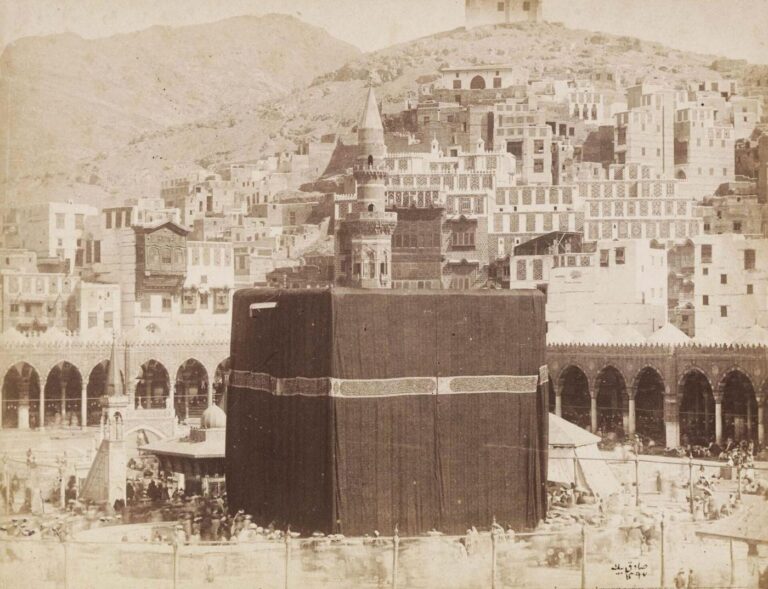
Pilgrims circle the Kaaba seven times, counter-clockwise, with the House on the left. The Quran commands the pilgrims to circle the Ancient House (22:29) and says it was raised by Abraham and Ishmael (2:127).[8]
Circling is not worship of the building. Umar, kissing the Black Stone, is reported to have said, “I know you are only a stone, which can neither harm nor benefit; had I not seen the Prophet kiss you, I would not.”[9] The Kaaba marks the direction of prayer and the place of the first house built for the worship of God (3:96).
Critics point out that the Arabs circled the Kaaba before Islam, and some conclude that the rite is a pagan survival. Muslim scholars reply that the Quran presents the House as Abraham’s, that the pagans had placed idols around it, and that the Prophet removed those idols. The act was restored to its purpose and did not change in form.
Number 4: Sa'i, between Safa and Marwa
Pilgrims walk seven times between two small hills, as Hagar did in search of water for her infant son Ishmael, until the spring of Zamzam flowed.[10] The rite keeps a woman’s anguish and trust at the centre of the pilgrimage.

The Quran does not tell Hagar’s story. It says that Safa and Marwa are among the signs of God, and that there is no blame on the pilgrim who goes between them (2:158).[11] Aisha explained the wording of the verse: some of the Ansar, the Prophet’s helpers in Medina, had hesitated to perform the walk because in the pre-Islamic period idols had stood on the two hills, and the verse removed that hesitation.
The story of Hagar comes from a long report of Ibn Abbas in al-Bukhari. The jurists also differ on the rite’s weight: most hold it a pillar of the pilgrimage, while the Hanafis count it obligatory and allow a sacrifice to make up for a lapse.
Number 5: Wuquf, the standing at Arafat
On the ninth of Dhu al-Hijja the pilgrims stand on the plain of Arafat from noon to sunset, praying and asking forgiveness. The Prophet said, “Hajj is Arafat.”[12] A pilgrim who misses the day has not completed the Hajj. The schools differ on exactly how much of the afternoon and night counts, though all agree the standing must fall between noon of the ninth and dawn of the tenth.
The Quran tells the pilgrims to remember God when they pour out from Arafat and to ask his forgiveness (2:198–199).[13] The plain is the place the Prophet gave his Farewell Sermon, which declared life and property sacred, and said that no Arab is superior to a non-Arab, nor a white man to a black man, except in God-consciousness.[14]
The sermon is the clearest answer to the charge that the pilgrimage is a tribal or national event. It was addressed to the whole community and set equality as its own standard, a standard the pilgrims restate each year by standing together on one plain.
Al Faruqi notes the practical consequence. A pilgrim prevented from some rites by sickness or accident still completes the hajj, while one who misses the standing at Arafat does not, which marks Arafat as the core of the pilgrimage.[15] The pilgrims gather there around the place where the Prophet delivered his farewell sermon in the year 632.[16]
Number 6: Adhiya and rajm, sacrifice and stoning
On the tenth, the festival of sacrifice, pilgrims throw pebbles at three pillars at Mina, recalling Abraham’s rejection of Satan’s temptation, and then sacrifice an animal in memory of Abraham’s offering of his son, which God replaced with a ram.[17] The meat is given to the poor. After shaving or trimming the hair, the pilgrim leaves the state of ihram.
The Quran tells the story of the vision and the ransom with “a great sacrifice” (37:102–107) and does not name the son. Classical commentators differed over whether he was Ishmael or Isaac, and many, including Ibn Kathir, held that it was Ishmael, whose home was Mecca. The stoning is tied to Abraham in a report attributed to Ibn Abbas, while the Prophet’s own practice, throwing seven pebbles, is recorded in the report of Jabir.[18]
Some people find animal sacrifice troubling. The Quran says that the flesh and blood of the animals do not reach God, and that what reaches him is the piety of the giver (22:37), while telling the pilgrims to feed the poor and the needy (22:28). The Prophet ordered that slaughter be done with kindness and a sharp knife.[19]
The bottom line
The hajj ties a set of physical acts to a single story. Each rite has a source in the Quran or in the reports of the Prophet’s own pilgrimage, and each is explained in the tradition by the memory of Abraham, Hagar and Ishmael. The sources are consistent on what to do and, in the main, on why. The schools differ on details such as the weight of the walk between the hills and the timing of the standing, and those disagreements are part of the record.
The pre-Islamic history of the sites is a fair question and the sources do not hide it. Aisha’s account of the verse on Safa and Marwa states it openly. The tradition’s answer is that the rites belonged to Abraham first and were restored to God alone. Judged on its sources, the pilgrimage is internally coherent and honest about its past.
Notes
- Ismail R. al Faruqi, Toward Islamic English (Herndon, VA: International Institute of Islamic Thought, 1986), the entry for Hajj.
- Sahih al-Bukhari and Sahih Muslim. Sahih al-Bukhari 1 (Book of Revelation), report of Umar, checked on sunnah.com; Ibn Hajar al-Asqalani, Fath al-Bari (Salafiyya edition), vol. 1, p. 9 (Shamela text).
- Sahih al-Bukhari and Sahih Muslim, the reports on the talbiya. Sahih al-Bukhari 1549 (Book of Hajj, “The Talbiya”), report of Abdullah ibn Umar, checked on sunnah.com; Ibn Hajar, Fath al-Bari, vol. 3, p. 408 (Shamela text).
- Quran 2:196; Sahih al-Bukhari and Sahih Muslim, the report of Aisha on the three forms of the pilgrimage. Sahih al-Bukhari 1562 (Book of Hajj, “Hajj al-tamattu, al-qiran and al-ifrad”), checked on sunnah.com; Ibn Hajar, Fath al-Bari, vol. 3, p. 421 (Shamela text).
- Quran 2:197; 5:95.
- Sahih al-Bukhari and Sahih Muslim, the report of Ibn Umar on the dress of the pilgrim in ihram. Sahih al-Bukhari 1542 (Book of Hajj, “What kind of clothes a muhrim should not wear”), report of Abdullah ibn Umar, checked on sunnah.com; Ibn Hajar, Fath al-Bari, vol. 3, p. 401 (Shamela text).
- Ismail Raji al Faruqi, Islam: Religion, Practice, Culture and World Order (London and Washington: The International Institute of Islamic Thought, 2012), p. 41.
- Quran 22:29; 2:127.
- Sahih al-Bukhari and Sahih Muslim, the report of Umar. Sahih al-Bukhari 1597 (Book of Hajj, “What is said regarding the Black Stone”), checked on sunnah.com; Ibn Hajar, Fath al-Bari, vol. 3, p. 462 (Shamela text).
- Sahih al-Bukhari, Book of the Prophets, the report of Ibn Abbas on Hagar and Zamzam. Ibn Hajar, Fath al-Bari, vol. 6, p. 396 (Shamela text), for Bukhari 3364.
- Quran 2:158; Sahih al-Bukhari and Sahih Muslim, the report of Aisha on the verse. Sahih al-Bukhari 1643 (Book of Hajj, “The tawaf between al-Safa and al-Marwa”), report of Urwa from Aisha, checked on sunnah.com; Ibn Hajar, Fath al-Bari, vol. 3, p. 497 (Shamela text).
- Abu Dawud, al-Tirmidhi and others. Sunan Abi Dawud 1949 (Rites of Hajj, “Whoever missed Arafah”), report of Abd al-Rahman ibn Yamar al-Dili, graded sahih by al-Albani, checked on sunnah.com.
- Quran 2:198–199.
- Sahih Muslim, the report of Jabir on the Prophet’s pilgrimage; Musnad Ahmad, the Farewell Sermon. Sahih Muslim 1218a (chapter “The Hajj of the Prophet”), report of Jabir, checked on sunnah.com; that report carries the declaration that blood and property are sacred, and the lines on Arab and non-Arab and on white and black come from the Musnad report.
- Al Faruqi, Islam: Religion, Practice, Culture and World Order, p. 42.
- Al Faruqi, Islam: Religion, Practice, Culture and World Order, p. 41.
- Quran 37:102–107.
- Musnad Ahmad, the report attributed to Ibn Abbas on Abraham and the stoning; Sahih Muslim, the report of Jabir; Ibn Kathir, Tafsir al-Quran al-azim, on 37:102–107.
- Quran 22:28, 22:37; Sahih Muslim, the report of Shaddad ibn Aws on kindness in slaughter. Sahih Muslim 1955a (Book of Hunting and Slaughter, “The command to be proficient in slaughtering”), report of Shaddad ibn Aws, checked on sunnah.com.



Leave a Reply