
Friday noon is the weekly gathering of the Muslim community, al-jumuʿa. Anyone is welcome to attend, and many mosques host visitors, from school groups to neighbours who have simply been curious for years. The service is short, usually under an hour, and it follows the same order everywhere.
Here is what to expect so that the first visit is comfortable. The entries follow the order of the day: the call, the washing, the dress and the hall, the sermon, the rows, and what happens afterwards. Nothing here requires you to know any Arabic or to take part in the prayer itself.
Number 1: The call to prayer
The adhān is given from the minaret or inside the mosque. It is a fixed sequence of phrases in Arabic: Allahu akbar (God is greatest), the testimony that there is no god but God and that Muhammad is His messenger, the call to prayer and to success, and the closing phrases. Ismail al Faruqi asked English writers never to translate the words of the call, and to give them in Arabic as the Muslims say them.[1]
On Friday there is often a second call just before the sermon. In the time of the Prophet, peace be upon him, the call was given once, when the imam took his seat on the pulpit (minbar). Al-Bukhari records that the caliph ʿUthmān later added an earlier call as the city grew and people needed more warning.[2] Many mosques keep both, so a visitor may hear the call twice.
The first call is the signal to come, and the congregation gathers over the next while. Arriving early is rewarded in the hadith, and it also gives a newcomer time to find the washing area and a place to sit.
Number 2: Washing first
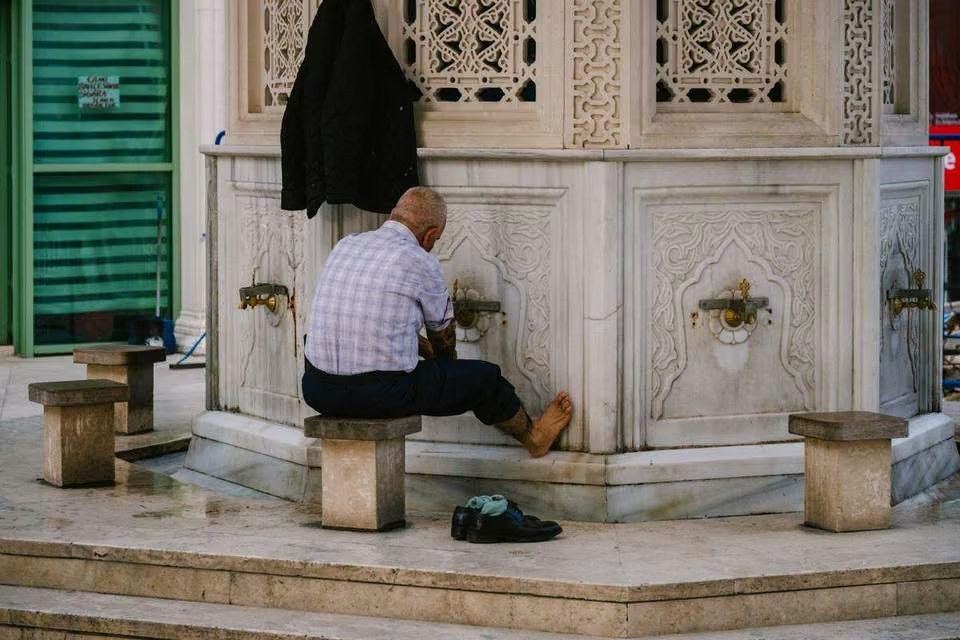
Before praying a Muslim performs wuḍūʾ, the ritual ablution, which means a wash of hands, mouth, nose, face, forearms, head and ears, and feet. The Quran prescribes it, naming the face, the forearms, the head and the feet; the Prophet’s practice added the other steps.[3] Most mosques have a washing area. A visitor does not need to wash unless he intends to join the prayer.

Many Muslims also take a full bath before Friday prayer, put on their cleanest clothes and apply perfume. A hadith in al-Bukhari encourages bathing, using scent and going early to the mosque.[2] The result is that the hall usually smells pleasant and looks tidy, and the washing area can be busy for a few minutes before the sermon.
Number 3: Shoes off, dress modestly
The prayer hall is carpeted and shoes are left at the door, usually on racks in the entrance. The carpet is where people kneel and place their foreheads, so it is kept clean. Visitors are asked to dress modestly: for men, long trousers and a shirt with sleeves, and for women, a scarf over the hair and loose clothing. Mosques often lend a scarf.
The dress is a matter of courtesy. It signals respect for a building that is used for worship, and it keeps attention on the service. Socks are fine. A visitor who arrives in the wrong clothes will usually be offered something to cover up, and nobody will be turned away for a mistake.
Number 4: There are no images
You will see calligraphy and geometric pattern on the walls and carpet, and no pictures of people or of God. Faruqi argued that this is deliberate. Because nothing in creation can stand for God, Muslim art uses stylised pattern, repetition and the arabesque, which draw the eye on and on past the edges of the design.[4] The hall is empty by intention.
The calligraphy is usually verses of the Quran or the names of God, written in a style meant to be read as well as admired. A niche (miḥrāb) in one wall marks the direction of the Kaaba in Makkah. There is no altar and no furniture beyond a pulpit and a shelf of copies of the Quran. A first-time visitor often remarks on how quiet and open the room feels, which is the effect the design aims for.
Number 5: The sermon comes before the prayer
The khuṭba, a sermon in two parts with a short sit between, is given first. The imam may speak in Arabic and in the local language. The congregation is silent during it, as the Prophet said: “If you say to your companion ‘Be quiet’ while the imam is speaking, you have spoken idly.”[5]
Then two units (rakʿa) of the prayer are performed together in rows. This takes the place of the usual midday prayer, ẓuhr, and it is a congregational obligation for adult men who are resident and well. The jurists did not require it of women, travellers or the sick, though women may attend, and many do.
A visitor can sit through the sermon without joining the prayer. The talk is usually a short reflection on a verse or a theme from daily life, and it often ends with a prayer for the community. Phones are put away, and the silence the hadith asks for is generally observed.
Number 6: Rows, not pews
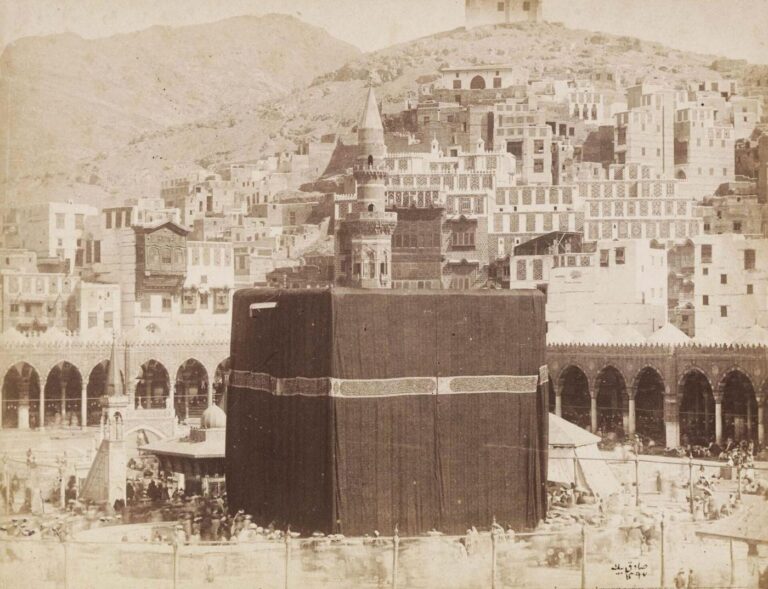
Worshippers stand shoulder to shoulder in straight rows facing the Kaaba, and fill the front rows first. Women stand behind the men or in a separate room. The Prophet told the congregation to straighten the rows and close the gaps.[6] The rows are part of the prayer’s form: everyone faces the same direction and moves together behind one imam.
Visitors can sit at the back, and nobody will mind. Follow the congregation if you wish. Prostrating is a part of the prayer, and you can stay seated if you prefer.
The practice of standing close has a practical reason as well. It leaves no empty space between worshippers, so a newcomer joining late slots into the nearest gap. The row is a visible sign that rich and poor, young and old, stand side by side in the same place.
Number 7: Friday is not a day of rest
The Quran says: “When the call is made for prayer on Friday, hasten to the remembrance of God and leave off trade. When the prayer is finished, disperse in the land and seek God’s bounty.”[7] There is no commanded day of rest.
So Muslims go to the mosque and then return to work, and there is often food and talk afterwards. In many countries shops close for an hour or two around the prayer and reopen. In others the weekend falls on Friday, which is a matter of local law and custom, since the verse itself tells believers to go back to their business.
This sets Friday apart from the Sabbath of other traditions. The day has a prayer, a sermon and a gathering, and the rest of it is open for ordinary life. A visitor who comes for the prayer will find the mosque busy before and after, and quiet in between.
The bottom line
A first Friday prayer asks little of a visitor. Take off your shoes, dress modestly, sit quietly through the sermon, and watch the rows form. You are not expected to wash, bow or recite unless you wish to join, and mosques are used to guests who arrive without knowing the customs.
The order of the day is consistent from one mosque to the next: the call, the sermon, the two units of prayer, and then a return to ordinary work. Each part has a reason in the Quran or the hadith, and knowing those reasons turns an unfamiliar hour into a readable one. If you have a question, the imam or the people sitting next to you will usually be glad to answer it.
Notes
- Ismail R. al Faruqi, Toward Islamic English (Herndon, VA: International Institute of Islamic Thought, 1986), I.D.1, rule (b), on the words of the adhan; the book also keeps al-jumu’ah and the names of the five prayers in Arabic.
- Sahih al-Bukhari, Book of Friday Prayer. Sahih al-Bukhari 912 (Book of Friday Prayer, “The call to prayer on Friday”), report of al-Sa’ib ibn Yazid, in which Uthman adds a further call at al-Zawra in the market, checked on sunnah.com; Ibn Hajar al-Asqalani, Fath al-Bari (Salafiyya edition), vol. 2, p. 393 (Shamela text).
- Quran 5:6.
- Ismail R. al Faruqi, Divine Transcendence and Its Expression (Kuala Lumpur: Muslim Youth Movement of Malaysia, 1983), III.C.
- Sahih al-Bukhari, Book of Friday Prayer; Sahih Muslim, Book of Friday Prayer. Sahih al-Bukhari 934, report of Abu Hurayra, “you have done an evil act” (laghawta), checked on sunnah.com; Ibn Hajar al-Asqalani, Fath al-Bari (Salafiyya edition), vol. 2, p. 414 (Shamela text).
- Sahih al-Bukhari, Book of the Call to Prayer (Adhan), chapter on straightening the rows. Sahih al-Bukhari 717, report of al-Numan ibn Bashir, checked on sunnah.com; Ibn Hajar al-Asqalani, Fath al-Bari (Salafiyya edition), vol. 2, p. 206 (Shamela text).
- Quran 62:9–10.



Leave a Reply