Every introduction to Islam lists the 5 pillars. Most of them stop there, as if naming a thing were the same as explaining it.
So here is the version I wish I had been given. Each pillar gets its meaning, the text that commands it, what it asks of a person on an ordinary day, and the question an outsider is most likely to put to it. The list itself comes from the hadith (a report of the Prophet’s words or actions) in which the angel Gabriel asks Muhammad, peace be upon him, what Islam is.[1] The closing section then shows why the five sit in the order they do.
Number 1: The declaration of faith
Shahādah, meaning the testimony: there is no god but God, and Muhammad is his messenger. The Quran supplies both halves. It says “know that there is no god but God” (47:19) and “Muhammad is the Messenger of God” (48:29).[2]
That is the whole entry requirement. No ceremony, no sponsor, no waiting period. Say it, mean it, and you are in. The first half clears the ground: nothing else gets worshipped. The second half fills it, because it is Muhammad’s practice that tells you how to pray, how much to give, when to fast and what to do at Mecca.
An outsider may ask whether a sentence can make anyone a Muslim, since anyone can say it. The jurists answered that people can judge only what is spoken, and that God judges the heart. In a well-known report the Prophet rebuked his companion Usama ibn Zayd for killing a man in battle after the man had said the testimony, and asked him whether he had torn open the man’s heart to see.[3]
The scholar Ismail al Faruqi describes the declaration (shahādah, “witness”) as both the Muslim’s legal entry into the community and the summary of his faith, repeated many times a day.[4] To bear witness that Muhammad is the messenger of God, he adds, is to accept the Quran as the word of God, complete and in the order in which it was collected.[4]
Number 2: Prayer, 5 times a day
Ṣalāh, meaning the prayer. Dawn, midday, mid-afternoon, sunset, night. The Quran ties the duty to fixed times: prayer is prescribed for the believers at fixed times (4:103), and other verses name the hours of the day and the night (11:114; 17:78).[5] The number five is given in the reports of the Prophet’s night journey, in which an obligation of fifty prayers was reduced to five.[6]
People fixate on the number. The point is the spacing. You cannot get more than a few hours into anything before the next one interrupts you, and that is the design. Each prayer takes 5 to 10 minutes, with a fixed form of standing, bowing, prostrating and sitting, and set words in Arabic. You do not have to think of anything to say. You show up and do the thing, whether you feel like it or not, which is most of what a discipline is.
The usual objection is that a fixed form turns prayer into routine. The Quran raises the same worry. It praises believers who are humble in their prayers (23:1–2) and warns those who pray yet are heedless of their prayer (107:4–5).[7] The form carries the body, and the attention remains the worshipper’s own work.
Al Faruqi separates two acts that English calls prayer. Ṣalāh (worship) has a fixed form and fixed times; duʿāʾ (invocation, literally “calling”) is personal prayer in any words and at any hour.[8] Neither needs a priest: any Muslim whose recitation of the Quran is correct may lead the congregation.[9]
Number 3: The obligatory charity
Zakāh, meaning purification. On cash and trade goods it is 2.5% of the wealth a person holds, once a year, above a threshold the jurists call the niṣāb. The word points to its purpose: the Quran tells the Prophet to take a charity from the believers’ wealth to purify them (9:103).[10]
Two details matter and both get missed. First, it falls on wealth held through a full lunar year, with crops due at harvest instead. The Quran condemns those who hoard gold and silver and do not spend it in God’s way (9:34), and a yearly levy gives every saver a standing reason to put money to use.[11]
Second, it is owed, and the recipient has a right to it. The Quran calls it “a known right” of the beggar and the deprived (70:24–25) and names eight classes of recipient, among them the poor, the needy, debtors, travellers and the officials who collect it (9:60).[12] The first caliph, Abu Bakr, fought tribes that withheld it after the Prophet’s death, saying that zakah is the due of wealth.[13] The poor are collecting what is theirs, and the giver is discharging a debt. A modern critic may call that a tax with a religious label, and the classical arrangement, with its named collectors, comes close to it, though each Muslim also answers to God directly for paying it.
The word carries its own explanation. Zakāh, al Faruqi notes, means “the sweetening”: paying it makes wealth that was lawfully earned rightful to keep.[14] What sets it apart from charity, in his account, is that it is institutional. Voluntary giving (ṣadaqah, “charity”) is left to the giver’s conscience, while zakāh is a fixed yearly share of 2.5 percent, collected and distributed by the state.[15]
Number 4: Fasting in Ramadan
Ṣawm, meaning the fast. From first light to sunset, through the lunar month of Ramadan, a Muslim gives up food, drink and sexual relations (2:187).[16] The month lasts 29 or 30 days. The sick and travellers make up the missed days later, and those for whom fasting is a lasting hardship feed a poor person instead (2:184–185).

Outsiders see the deprivation. Insiders talk about the month. Ramadan has a texture: late nights, early mornings, mosques full at hours they are usually empty, an entire community running on the same clock. It is also the month in which the Quran was first revealed (2:185).
The stated purpose in the Quran is to produce taqwā, meaning God-consciousness: fasting was prescribed “that you may become mindful of God” (2:183). The mechanism is simple. You go all day wanting something you are allowed to have, and you do not take it, because you said you would not. A sceptic may say this is only hunger. The Prophet addressed that directly, saying that God has no need of the food and drink given up by someone who does not give up false speech and acting on it.[17]
Number 5: The pilgrimage to Mecca
Ḥajj, meaning the pilgrimage. Once in a lifetime, if you can afford it and are physically able. The Quran states the condition itself: the pilgrimage to the House is a duty owed to God by those who are able to make the journey (3:97).[18] It is the only pillar with an escape clause built in, and the clause is generous. Cannot afford it? Not obliged. Cannot manage the trip? Not obliged.
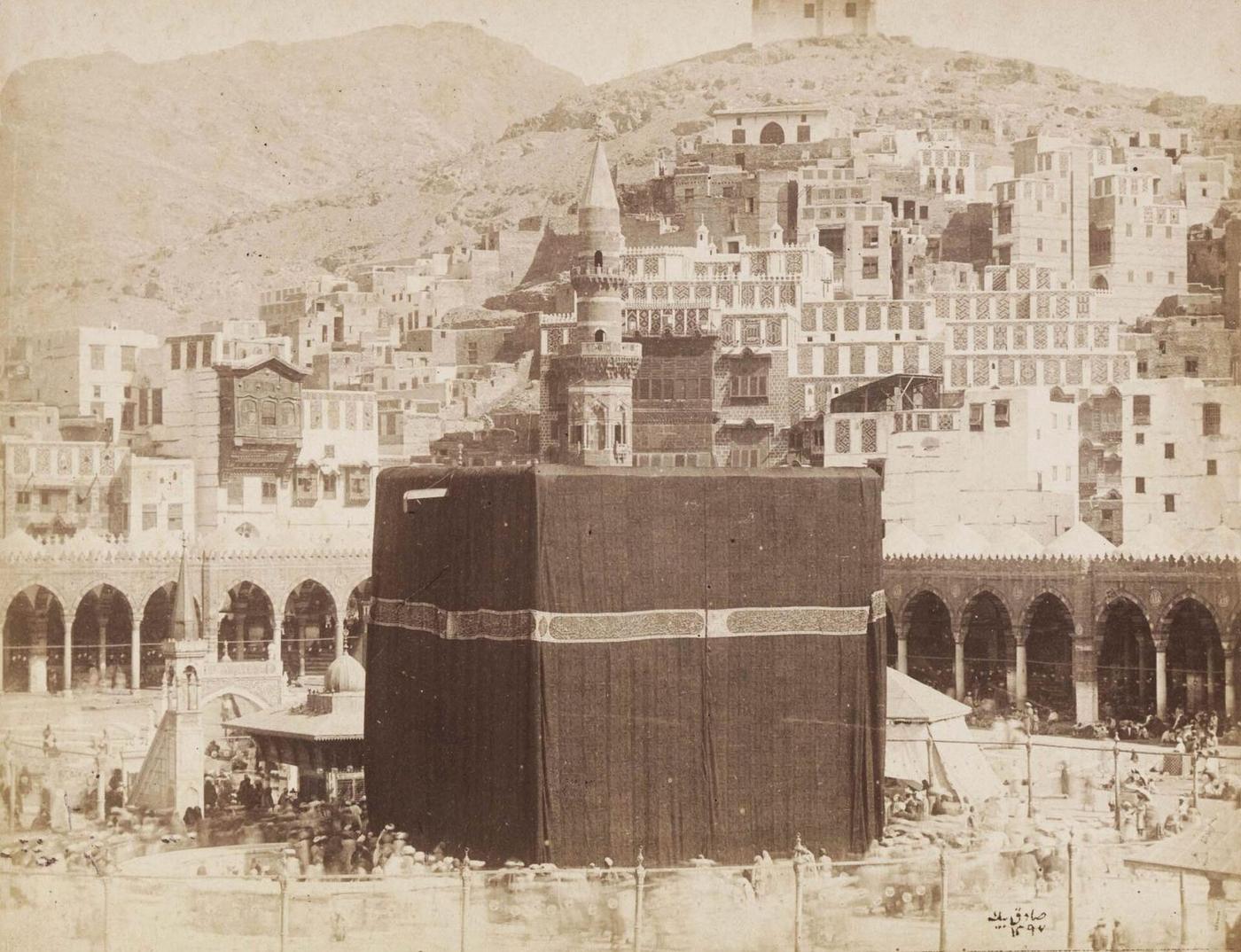
The rites reenact a story: Abraham, Hagar, and the child Ishmael, in the valley where Mecca now stands. Pilgrims circle the Kaaba, walk between 2 hills as Hagar did searching for water, and stand on the plain of Arafat through an afternoon.[19] Roughly 2 million people do this together in the same few days. Men wear the same 2 white cloths, and nobody can tell who is rich.
Historians note that the Arabs practised pilgrimage rites at Mecca before Islam. The Quran’s answer is that the House was founded by Abraham for the worship of God alone (22:26), and the Prophet told the pilgrims at his own hajj to take their rites from him.[20] The rites were purified, in this account, and not invented.
The bottom line
Read them in order and there is a shape to it. Belief first. Then a daily practice that keeps the belief in front of you. Then money, which is where belief gets tested. Then a month that tests it harder. Then, once, a trip that puts you in a crowd of 2 million people who have all been doing the same thing.
Each pillar can be performed hollow, and the sources say so: the Quran on heedless prayer, the Prophet on a fast that gives up food while keeping false speech. Each can also be performed with full attention by an ordinary person with no special training. Taken together the five are a curriculum, the minimum structure the tradition asks of every Muslim, and the rest of the religion is built on that frame.
Notes
- Sahih Muslim, Book of Faith, the hadith of Gabriel narrated by Umar; Sahih al-Bukhari, Book of Faith, “Islam is built on five”, narrated by Ibn Umar.
- Quran 47:19; 48:29.
- Sahih Muslim, Book of Faith, the report of Usama ibn Zayd. Sahih Muslim 96a (Book of Faith, “The prohibition of killing a disbeliever after he says la ilaha illa Allah”), report of Usama ibn Zayd, checked on sunnah.com.
- Ismail Raji al Faruqi, Islam: Religion, Practice, Culture and World Order (London and Washington: The International Institute of Islamic Thought, 2012), p. 25.
- Quran 4:103; 11:114; 17:78.
- Sahih al-Bukhari and Sahih Muslim, the reports of the Prophet’s night journey and the reduction of the prayers from fifty to five. Sahih al-Bukhari 349 (Book of Prayer, “How prayer was prescribed on the night of the Isra”), report of Anas from Abu Dharr, checked on sunnah.com; Ibn Hajar al-Asqalani, Fath al-Bari (Salafiyya edition), vol. 1, p. 458 (Shamela text).
- Quran 23:1–2; 107:4–5.
- Al Faruqi, op. cit., p. 29.
- Al Faruqi, op. cit., p. 30.
- Quran 9:103.
- Quran 9:34.
- Quran 70:24–25; 9:60.
- Sahih al-Bukhari, Book of Zakah, the exchange between Abu Bakr and Umar. Sahih al-Bukhari 1399 and 1400 (Book of Zakah, “The obligation of zakah”), report of Abu Hurayra, checked on sunnah.com; Ibn Hajar al-Asqalani, Fath al-Bari (Salafiyya edition), vol. 3, p. 262 (Shamela text).
- Al Faruqi, op. cit., p. 32.
- Al Faruqi, op. cit., pp. 33–34.
- Quran 2:187.
- Sahih al-Bukhari, Book of Fasting. Sahih al-Bukhari 1903 (Book of Fasting, “Whoever does not give up false speech while fasting”), report of Abu Hurayra, checked on sunnah.com; Ibn Hajar al-Asqalani, Fath al-Bari (Salafiyya edition), vol. 4, p. 116 (Shamela text).
- Quran 3:97.
- Quran 2:125–127, 2:158; Sahih al-Bukhari, Book of the Prophets, the report of Ibn Abbas on Hagar and Zamzam.
- Quran 22:26–27; Sahih Muslim, Book of Hajj, the report of Jabir on the Prophet’s pilgrimage.


Leave a Reply