
Replies on X put the objection in three parts: that a Muslim speaks as if he knows who wrote the Quran, that the God behind it is anonymous, and that a book from God must be free of error by definition. Underneath lies a fair question. Who wrote the Quran, and can anyone show it?
Below are five points: what each side claims, what the Quran says about its own origin, how the text was fixed, what is known about Muhammad (peace be upon him) and writing, and how the Quran compares with the Gospels.
Number 1: Each side names a different author
Muslims hold that the Quran is the speech of God, brought down in clear Arabic by the angel Gabriel to the heart of Muhammad, who recited it aloud to those around him. The Quran describes what he conveyed as revelation (wahy).[1] On this view the author is named, since the speaker is Allah, and the Prophet is the recipient and messenger.
Historians who work without assuming revelation answer differently, because their method admits only human causes. Many of them hold that Muhammad composed the text, or that it took shape in his community during his lifetime. Nöldeke and Schwally arranged the suras by period, and Angelika Neuwirth reads them as a conversation between the Prophet and his hearers.[2] Both sides agree on a good deal: the text was first spoken in seventh-century Arabia, and Muhammad was the person who spoke it. They disagree about its source. The remark that a book from God must be free of error does not settle that, because it assumes the answer to the authorship question. The claim of divine origin has to be weighed first, and the next entries do that.
Number 2: The Quran raised the question about itself
The text speaks to its own origin. In 69:40–47 it calls itself the speech of a noble messenger, sent down from the Lord of the worlds, and denies that it is the speech of a poet or a soothsayer. The same passage warns that, had the messenger invented sayings about God, he would have been seized.[3]
It also records that its first hearers disputed this. Quran 16:103 reports the claim that a man taught him, and replies that the tongue of the man they pointed to was foreign, whereas this is clear Arabic. Quran 25:4–5 reports the claim that others helped him and that he had old tales written down and dictated to him morning and evening.[3] Authorship was therefore an argued question from the first generation. A critic may say that the Quran records only its own defence. The accusations are preserved in the text itself, which counts in favour of its sincerity, though it does not prove divine origin.
The Quran also issues a challenge (taḥaddī): bring a sura like it (2:23, 10:38), or gather men and jinn to bring its like (17:88).[4]
Number 3: The text was written down and fixed early
According to the traditional account, the Prophet had scribes write down revelation as it came, among them Zayd ibn Thabit. After the battle of Yamama, in the caliphate of Abu Bakr, Zayd was asked to gather the text from written pieces and from those who had memorised it. In the caliphate of Uthman, differences in recitation led to the making of standard copies (maṣāḥif) by a committee that included Zayd, and these were sent to the main cities.[5]
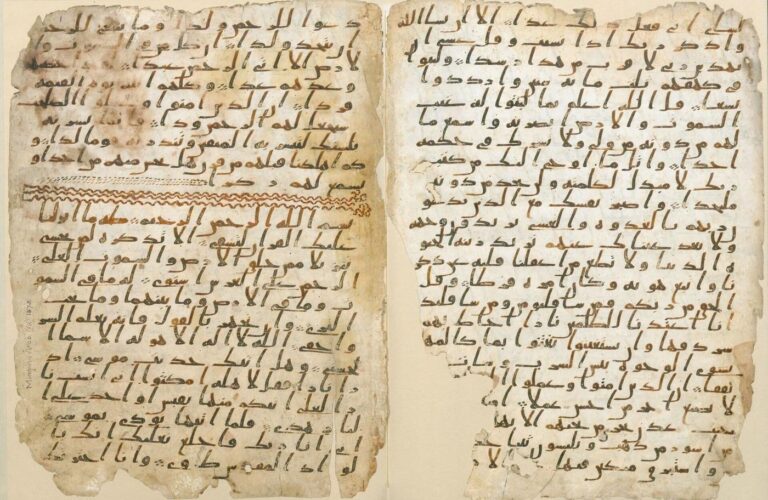
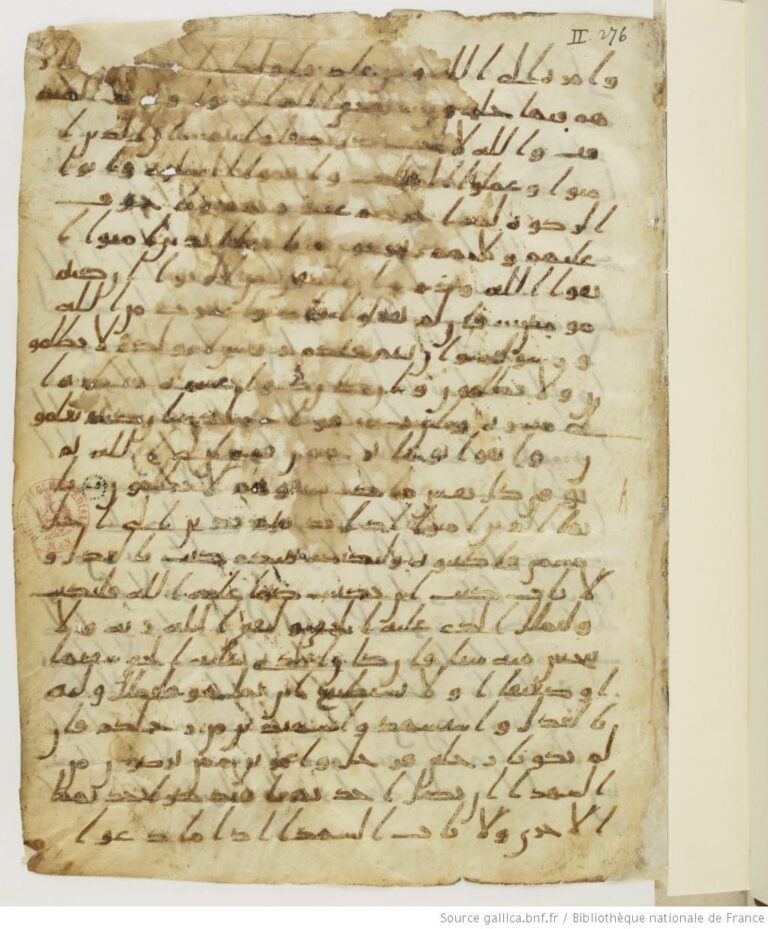
Critical scholars generally accept that a text close to the Uthmanic one existed within a few decades of the Prophet’s death, and early manuscripts point to a fairly stable consonantal text. They differ on how much was fixed in his lifetime. Muhammad Mustafa al-Azami defends the traditional account in full, while John Wansbrough argued for a much later fixing, a view that few scholars hold today. Sadeghi and Bergmann studied the Sanaa palimpsest and found a lower text that agrees with the standard text in most places and departs from it in some.[6] The evidence shows an early text. It does not by itself show who first composed it.
Number 4: The Prophet and writing, and the Quran against the hadith
The Quran calls Muhammad al-nabī al-ummī (7:157–158) and says that he had not recited or written any book before it (29:48).[7] Classical scholars understood ummī as unlettered, which would make composition by a trained writer less likely. Some modern scholars read it as “of the gentiles”, a member of a people without a scripture, as with the plural ummiyyūn in 62:2. That reading leaves his literacy an open question.[8] The report of the first revelation has him say to the angel that he is not a reader, which the classical commentators took literally.[9]

The Quran also differs from the hadith (reports of the sayings and actions of the Prophet) in form and transmission. It is presented as the speech of God, was recited and memorised in fixed wording by many people, and was written down. Hadith passed through chains of individual narrators, were sometimes transmitted by meaning, and were graded by scholars as sound, good or weak. One report in Sahih Muslim has the Prophet telling people to write nothing from him except the Quran, while Sahih al-Bukhari has reports that allow the writing of knowledge. Scholars reconcile them by period or purpose.[10]
Number 5: The Quran names its recipient, the Gospels name no author
The objection sometimes turns to the Gospels, and the comparison deserves care. The four Gospels do not name their authors in the body of the text. The headings “according to Matthew” and the rest appear in the manuscripts, and the identification of the writers rests on later church tradition, such as Papias as quoted by Eusebius and Irenaeus.[11] Many scholars call them anonymous, while others, such as Richard Bauckham, defend a link to eyewitnesses. Most Christians also do not claim that the Gospels were dictated by God, so the two books make different kinds of claim.
The Quran names Muhammad in 3:144, 33:40, 47:2 and 48:29, and Ahmad in 61:6.[12] Muslims also preserve a recorded chain of transmission for the recitation, from the Prophet through his companions to later reciters. That chain shows who received and passed on the text. It does not show that God is the source, and manuscripts alone cannot settle who wrote it. A reader who finds the challenge of 2:23 convincing will accept the claim, and a reader who does not will remain unconvinced. Both read the same evidence.
The bottom line
The Quran does have a named author on the Muslim account, and a named recipient on every account. The text records the charge that a man or helpers produced it, and answers with a challenge. Tradition and critical scholarship agree that an early, fairly stable text existed soon after the Prophet’s death.
What the evidence cannot do is decide between revelation and human composition. That choice depends on how a reader weighs the challenge, the character of the Prophet, and the text itself. A reader is entitled to ask for the argument, and Muslims are able to give it.
Notes
- Quran 26:192–195; Quran 53:3–4.
- Theodor Nöldeke and Friedrich Schwally, Geschichte des Qorans; Angelika Neuwirth, Studien zur Komposition der mekkanischen Suren (1981).
- Quran 69:40–47; Quran 16:103; Quran 25:4–5.
- Quran 2:23; 10:38; 17:88.
- Sahih al-Bukhari, Book of the Virtues of the Quran, chapters on the collection of the Quran and on the scribes of the Prophet.
- Muhammad Mustafa al-Azami, The History of the Qur’anic Text from Revelation to Compilation (2003); John Wansbrough, Quranic Studies (1977); Behnam Sadeghi and Uwe Bergmann, “The Codex of a Companion of the Prophet and the Qur’an of the Prophet,” Arabica 57 (2010).
- Quran 7:157–158; Quran 29:48; Quran 62:2.
- Encyclopaedia of the Quran, article “Illiteracy.”
- Sahih al-Bukhari, Book of the Beginning of Revelation, the report of Aisha on the first revelation.
- Sahih Muslim, Book of Asceticism and Heart-Softening, on the prohibition of writing down anything but the Quran; Sahih al-Bukhari, Book of Knowledge, on the writing of knowledge. Sahih al-Bukhari 113 (Book of Knowledge, “The writing of knowledge”), report of Abu Hurayra, checked on sunnah.com; Ibn Hajar al-Asqalani, Fath al-Bari (Salafiyya edition), vol. 1, p. 206 (Shamela text).
- Luke 1:1–4; Eusebius, Ecclesiastical History 3.39 (quoting Papias); Irenaeus, Against Heresies 3.1; Raymond Brown, An Introduction to the New Testament (1997); Richard Bauckham, Jesus and the Eyewitnesses (2006).
- Quran 3:144; 33:40; 47:2; 48:29; 61:6.


Leave a Reply