
Paul of Tarsus wrote the earliest Christian documents that survive, and he signed most of them with the same claim: Paul, an apostle. Christians have read that word for 1,900 years as settling the matter. The letters themselves show a man who had to argue for the title, against people who had walked with Jesus and did not think it belonged to him.
The Christian answer deserves a fair statement. Christ, on this view, can call whom he wishes, and a vision from the risen Lord outranks years of ordinary company. Six questions below test that answer against the New Testament itself: what Paul admitted about his own standing, how the one event his claim rests on is told, and how the apostles who did know Jesus received him.
Number 1: Did Paul ever meet Jesus?
No, and he says so. Writing to Corinth he lists those to whom the risen Jesus appeared, Peter and the Twelve and James among them, and places himself at the end: “Last of all, as to one untimely born, he appeared also to me.”[1] His knowledge of Jesus came after the crucifixion, and it came in a vision. In Galatians he adds that he did not receive his gospel from any human being, nor was he taught it, but had it “through a revelation of Jesus Christ”.[2]
The Book of Acts gives the test the first community applied when it filled the place left by Judas. The new man had to be one of those who “accompanied us during all the time that the Lord Jesus went in and out among us, beginning from the baptism of John عليه السلام until the day when he was taken up from us”.[3] That is a test of companionship. Paul met no part of it, and the community that wrote the rule knew it: Acts never once calls him one of the Twelve.

Paul knew the objection and answered it with a question of his own: “Am I not an apostle? Have I not seen the Lord?”[4] The second question is the whole of his case. Set beside the rule in Acts 1, it replaces three years of walking with a man by a single sighting of him, reported by the one person who saw it.
Number 2: The Damascus road is told three times, and the accounts disagree
Acts narrates the vision three times, once as history and twice in speeches put in Paul’s mouth. In chapter 9 Paul falls to the ground; his companions stand, hear the voice and see no one.[5] In chapter 22 the companions see the light but do not hear the voice.[6] In chapter 26 everyone falls to the ground, and Jesus delivers a long commission on the spot, with no Ananias and no blindness.[7]
The usual defence turns on Greek grammar. In chapter 9 the verb “hear” governs the genitive case and in chapter 22 the accusative, and the claim is that the first means hearing a sound and the second understanding words. Daniel Wallace, whose grammar is a standard text in evangelical seminaries, examined the claim and found that Luke does not keep to that distinction elsewhere; he concludes that the grammatical solution does not hold.[8] Honest Christian scholarship has conceded the point. The three accounts were written by one author who felt free to vary a story, which tells you what kind of record it is.
Paul’s own account differs again. In Galatians there is no road, no light and no Ananias. He went at once to Arabia, did not go up to Jerusalem for three years, and when he did, met only Peter and James.[9] Acts has him preaching in Damascus, then brought to the apostles in Jerusalem by Barnabas, going in and out among them.[10] One of these two accounts is wrong about the years that matter most, and the one written by the man himself is the one that keeps him away from the people who could have checked his claim.
Number 3: He claimed to outrank the men who knew Jesus
Galatians opens with a curse. Anyone who preaches a gospel other than Paul’s is to be anathema, “even if we or an angel from heaven” should do it.[11] The letter was written against teachers who had come from Jerusalem, so the people under the curse were followers of Jesus who kept the Law and expected Gentile converts to do the same.
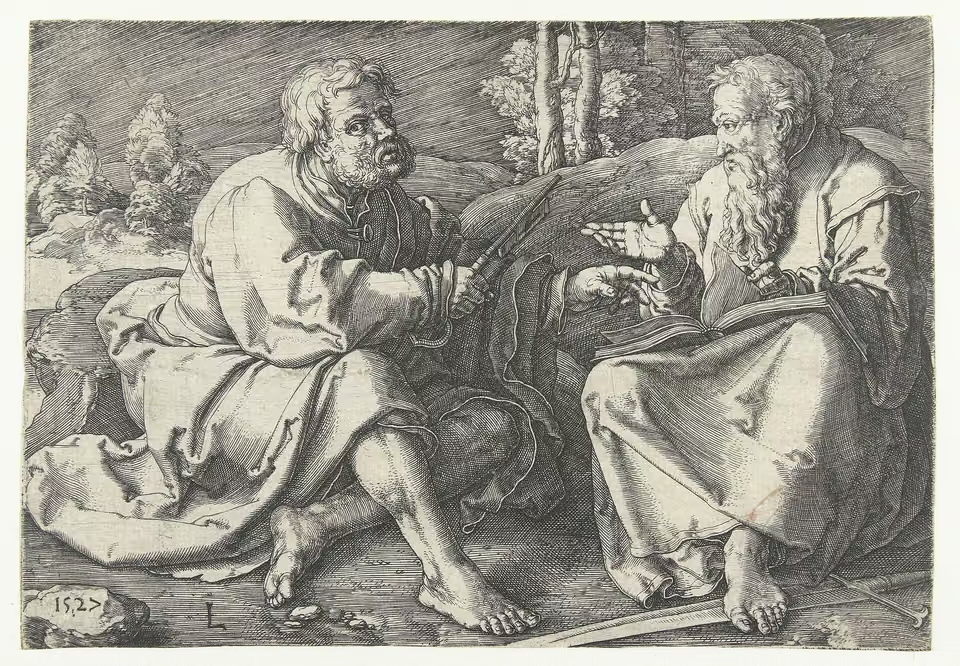
Of the Jerusalem leaders he writes: “those who were supposed to be acknowledged leaders (what they actually were makes no difference to me)”.[12] He calls James, Peter and John “so-called pillars”. When Peter came to Antioch and withdrew from eating with Gentiles under pressure from James’s people, Paul “opposed him to his face” and accused him of hypocrisy in front of the congregation.[13] This is Peter, to whom Jesus is reported in Matthew to have handed the keys of the kingdom.
To the Corinthians he insists that he is “not in the least inferior to these super-apostles”, a phrase he uses twice.[14] Whoever those men were, Paul measured himself against them and found himself their equal or better. The measure he used was his vision. The measure they used, on every account we have, was that they had been there.
Number 4: The apostles who knew Jesus did not simply accept him
Paul’s letters record the resistance in his own words. At Antioch, “certain people came from James” and Peter sided with them against Paul.[13] In Corinth, rivals said of him that “his letters are weighty and strong, but his bodily presence is weak, and his speech contemptible”, and demanded letters of recommendation he could not produce.[15] He replies that his converts are his letter. The people demanding credentials evidently did not count a vision as one.
Acts, which is friendly to Paul, records the same thing from the other side. When he arrives in Jerusalem for the last time, James tells him that thousands of Jewish believers “have all been told about you that you teach all the Jews living among the Gentiles to forsake Moses”.[16] James does not say the report is false. He tells Paul to pay for four men’s vows and go through the purification rite in the Temple, so that “all will know that there is nothing in what they have been told about you”.[17] Paul does it. The man who wrote that believers are no longer under the Law performed a Temple rite to persuade the Jerusalem church that he kept it.
The Jewish followers of Jesus who refused Paul did not disappear with the first generation. Irenaeus, writing around the year 180, records that the Ebionites used only the Gospel of Matthew, kept the Law and circumcision, and “repudiate the Apostle Paul, maintaining that he was an apostate from the law”.[18] Epiphanius, two centuries later, preserves their own account of him: that he was a Gentile who converted and was circumcised in Jerusalem, and turned against the Law when his hopes there were disappointed.[19] That story is polemic and cannot be checked. What it shows is that a community descended from the Jerusalem church was still, in the fourth century, refusing to call Paul an apostle.
Number 5: His gospel came by private revelation, and he said so
Paul did not claim to pass on what Jesus had taught in Galilee. He claimed to have received his message directly: “I did not receive it from a human source, nor was I taught it.”[2] Even the account of the Last Supper, an event with eleven living witnesses, he introduces with “I received from the Lord what I also handed on to you”.[20]
The Gospels present Jesus as a public teacher. In John he says at his trial, “I have spoken openly to the world; I have always taught in synagogues and in the temple, where all the Jews come together. I have said nothing in secret.”[21] A message given openly to crowds and to twelve companions, and then revised in private to one man who never heard it, is a problem the New Testament poses for itself.
The Quran states the standard Muslims apply: Jesus came “confirming the Torah that was before me”, and told his people to worship God, his Lord and theirs.[22] A later teaching that released believers from the Torah and made the teacher himself the object of faith fails that standard on both counts. ʿAbd al-Jabbār, a Muslim theologian writing in 995, built his critique of Christianity around exactly this point: that Paul remade the religion of Jesus for Rome, and that the Damascus story, with its single witness, is what the whole edifice rests on.[23]
Number 6: Did Paul found Christianity?
The doctrines that separate Christianity from the faith of Jesus’s first followers appear first in Paul’s letters. Jesus’s death as an atonement for sin, his resurrection as the event on which salvation turns, the Gentile church free of the Torah, and a Christ who existed before the world and “emptied himself” to take human form: all of these are stated in letters written in the 50s, before any Gospel.[24] The sayings attributed to Jesus in the Synoptic Gospels contain none of them in that form.
Critical scholars who are not Muslims have drawn the conclusion in their titles. Hyam Maccoby called his 1986 study of Paul The Mythmaker. Gerd Lüdemann, for thirty years a professor of early Christian history at Göttingen, published Paul: The Founder of Christianity in 2002. James Tabor’s Paul and Jesus (2012) argues that the religion the Gentile churches received was Paul’s, and that the Jerusalem community led by James held a different faith.[25] N. T. Wright has argued the opposite case at great length, and a reader should know that the argument exists.[26]
The Muslim position does not depend on any of these books. The Quran says Jesus was a messenger who called his people to the one God and to the Law, and that his followers divided after him.[27] The New Testament, read on its own terms, shows the division happening: a man who never met Jesus, claiming authority from a vision only he saw, pronouncing a curse on the teaching of those who had, and winning. Whether you call him a founder or a reformer, that is the record, and it comes from his own hand.
The bottom line
Strip the question to what the sources support. Paul never met Jesus. His authority rested on a vision he alone reported, which Acts tells three ways and he tells a fourth. The apostles who had known Jesus received him with suspicion he records himself, demanded that he prove he kept the Law, and left behind communities that refused him for centuries.
A Christian can still hold that Christ chose him anyway. That is a claim of faith, and it should be stated as one. The historical claim, that the man who shaped Christian doctrine spoke with the authority of Jesus’s companions, is contradicted by the companions.
Notes
- 1 Corinthians 15:3 to 8.
- Galatians 1:11 to 12; compare Galatians 1:15 to 17.
- Acts 1:21 to 22.
- 1 Corinthians 9:1 to 2.
- Acts 9:3 to 9.
- Acts 22:6 to 11.
- Acts 26:12 to 18.
- Daniel B. Wallace, Greek Grammar Beyond the Basics (Grand Rapids: Zondervan, 1996), pp. 133 to 134, on akouō with the genitive and the accusative in Acts 9:7 and 22:9.
- Galatians 1:17 to 19.
- Acts 9:19 to 28.
- Galatians 1:8 to 9.
- Galatians 2:6; the “pillars” are at Galatians 2:9.
- Galatians 2:11 to 14.
- 2 Corinthians 11:5; 2 Corinthians 12:11.
- 2 Corinthians 10:10; 2 Corinthians 3:1 to 3.
- Acts 21:20 to 21.
- Acts 21:23 to 26.
- Irenaeus, Against Heresies 1.26.2, in the Ante-Nicene Fathers translation.
- Epiphanius, Panarion 30.16.8 to 9, in Frank Williams, trans., The Panarion of Epiphanius of Salamis, Book I (Leiden: Brill, 1987).
- 1 Corinthians 11:23.
- John 18:20.
- Quran 3:50; Quran 5:117.
- Gabriel Said Reynolds, A Muslim Theologian in the Sectarian Milieu: ʿAbd al-Jabbār and the Critique of Christian Origins (Leiden: Brill, 2004), on the Tathbīt dalāʾil al-nubuwwa and its treatment of Paul.
- Romans 3:21 to 26 (atonement); 1 Corinthians 15:12 to 19 (resurrection as the hinge of salvation); Galatians 5:2 to 6 (Gentiles and the Law); Philippians 2:5 to 11 (pre-existence). The seven letters critical scholars accept as Paul’s are dated to roughly 50 to 60.
- Hyam Maccoby, The Mythmaker: Paul and the Invention of Christianity (New York: Harper and Row, 1986); Gerd Lüdemann, Paul: The Founder of Christianity (Amherst, NY: Prometheus Books, 2002); James D. Tabor, Paul and Jesus: How the Apostle Transformed Christianity (New York: Simon and Schuster, 2012).
- N. T. Wright, Paul and the Faithfulness of God, 2 vols. (Minneapolis: Fortress Press, 2013).
- Quran 5:72; Quran 3:50 to 52; Quran 61:14.



Leave a Reply