The usual telling goes: Muslims preserved Greek science, Europe rediscovered it, progress resumed. It is a story that makes the middle 800 years a warehouse, with scholars guarding crates they never opened.
The warehouse built instruments. Some of them are still on the bench. Here are six that show scholars from Baghdad to Samarkand and Cordoba improving on what the Greeks had left, and in a few cases starting from nothing. Several began as answers to a religious need, such as finding the hour of prayer or the direction of Mecca.
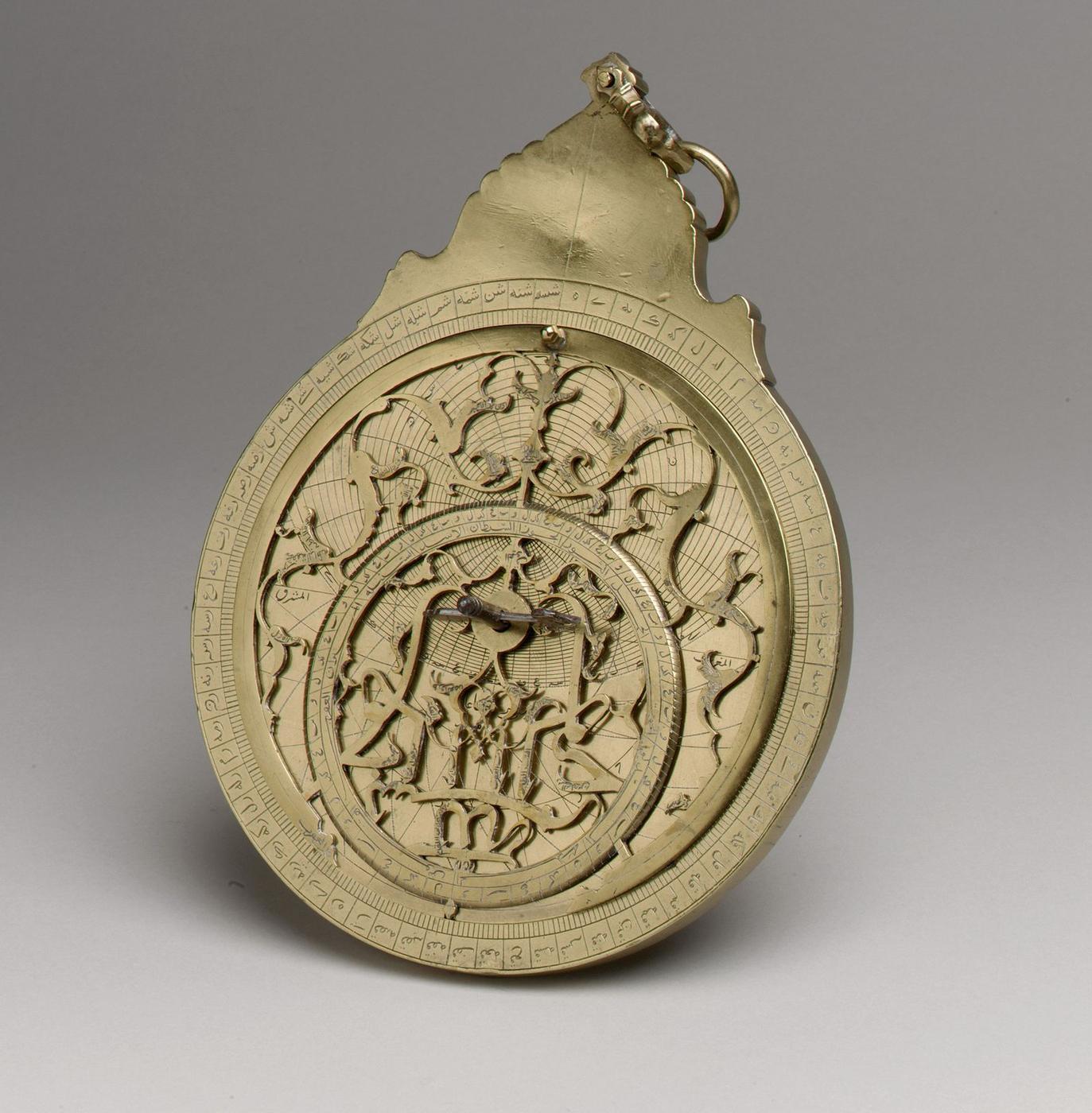
Number 1: The astrolabe, refined
The Greeks had a basic astrolabe. What came out of Baghdad and Cordoba was a different object: a computer in brass, with interchangeable plates for different latitudes and a rotating star map that let you find the time, the direction of Mecca, and the position of any listed star, day or night.
Religion supplied the demand. The Quran says that prayer, salah, is prescribed for the believers at fixed times,[1] and a Muslim must face the qibla, the direction of the Sacred Mosque in Mecca, while praying.[2] Larger mosques kept a timekeeper, the muwaqqit, who worked out the hours from the sun and stars with instruments of this kind.[3]
Mariners carried simplified versions for centuries. The principle, projecting the sky onto a flat disc and rotating it, is the same one behind every planisphere sold in a museum shop today. When Geoffrey Chaucer wrote the first treatise on the astrolabe in English, around 1391, he named among his sources a text attributed to Mashallah, an astronomer of the early Abbasid period.[4]
Number 2: The alembic
Al-anbīq. The word is Arabic, which tells you where the thing came from. English took it over with the Arabic article still attached, and so an alembic is literally “the still”.

A still: heat a liquid, capture the vapour, cool it, collect what condenses. The apparatus in the works attributed to Jābir ibn Ḥayyān is recognisably the one in a chemistry teaching lab now. Historians debate whether one man wrote the whole Jabirian corpus, since it appears to have grown through the 9th and 10th centuries, but the equipment it describes is not in doubt.[5]
Distillation is how you get rose water, essential oils and, eventually, refined fuel out of crude oil. Al-Kindī wrote a book on perfume and distillations in the 9th century, and al-Rāzī, who died around 925, is credited with distilling petroleum into a lighter fraction. The first steps toward the modern refinery were taken in workshops in Iraq and Persia, and the process starts here.
Number 3: The camera obscura, understood
A pinhole in a dark room throws an inverted image of the outside onto the far wall. People had noticed this for ages.
Ibn al-Haytham, in the 11th century, used it to settle how vision works. Greek writers had been divided. Euclid and Ptolemy treated sight as rays leaving the eye, while the followers of Aristotle held that something passed from the object to the eye. Ibn al-Haytham sided with the second view and made it exact: light travels in straight lines from every point of an object into the eye. He tested this with the dark chamber, placing several lamps outside a pinhole and showing that each one made its own spot, and that covering a lamp removed its spot alone.
He wrote the results in the Kitāb al-Manāẓir, a 7-volume treatise on optics.[6] A Latin translation appeared around 1200, and Roger Bacon, Witelo and later Kepler built on it, so Europe read it for 500 years. Every camera, digital or film, is a camera obscura with a light-sensitive surface at the back.
Number 4: The surgical catalogue
Al-Zahrāwī, working in Cordoba around the year 1000, wrote a medical encyclopaedia whose surgical volume includes drawings of roughly 200 instruments. Scalpels, forceps, bone saws, a syringe, a speculum, tools for removing bladder stones and for cauterising wounds.

The encyclopaedia is the Kitāb al-Taṣrīf, in 30 parts, and the last of them deals with surgery.[7] Al-Zahrāwī relied openly on the Greek surgeon Paul of Aegina, and what he added was a catalogue of tools drawn with their names and uses, so that a surgeon who had never seen one could have it made by a smith. Gerard of Cremona translated the surgical part into Latin in the 12th century, and European surgeons used it for hundreds of years.
Many of the designs are still in use with only the materials changed. He also described using catgut for internal stitches, which dissolves on its own, and that is still the standard for sutures that do not need removing.
Number 5: The torquetum
Less famous, more strange. A torquetum is an instrument for converting measurements between 3 different celestial coordinate systems, mechanically, without doing the trigonometry by hand. One set of scales follows the horizon, another the celestial equator, a third the path of the sun, and the operator reads off a position in one system after setting it in another.
It is attributed to Jābir ibn Aflaḥ of Seville in the 12th century. The attribution is debated, since the earliest detailed descriptions that survive are in Latin and date from the 13th century. Jābir ibn Aflaḥ himself is on firmer ground as an astronomer: his Iṣlāḥ al-Majisṭī corrected parts of Ptolemy’s Almagest and set out theorems of spherical trigonometry that later Europeans used.[8]
The idea, a physical device that performs a coordinate transformation, is an early example of the analogue computer. A slide rule does the same kind of job for a simpler problem.
Number 6: The observational instrument, scaled up
Before the telescope, precision in astronomy came from size. A bigger instrument meant finer graduations, which meant more accurate readings.
Observatories at Maragha in the 13th century and Samarkand in the 15th built instruments on an architectural scale. Maragha was founded around 1259 and directed by Naṣīr al-Dīn al-Ṭūsī, who gathered astronomers from across the Islamic world and produced a set of planetary tables.[9] The Samarkand sextant was cut into a hillside, a curved track around 40 metres in radius. With it, Ulugh Beg produced a star catalogue whose positions were the best available until Tycho Brahe, and Tycho’s own instruments were built on the same principle: make it enormous, and the errors shrink.
Both observatories were funded by rulers and staffed by salaried scholars, so the work was organised research, a team effort over years, and no single astronomer’s hobby.
The bottom line
The alembic is on the bench. The camera obscura is in your pocket. Al-Zahrāwī’s forceps are in the theatre. The astrolabe’s projection is on the star chart. The torquetum’s idea is in every analogue computer that came after.
Preservation would have been enough to earn a footnote. The evidence shows more: new apparatus, new experimental methods and new designs, often prompted by the need to pray on time and face the right way. Some attributions, such as the torquetum and the Jabirian writings, are disputed among historians. Take those two away and the rest still stands. This was invention, and the instruments are still here to prove it.
Notes
- Quran 4:103.
- Quran 2:144.
- David A. King, In Synchrony with the Heavens (Leiden: Brill, 2004 and 2005), on the muwaqqit and timekeeping in medieval mosques.
- Geoffrey Chaucer, A Treatise on the Astrolabe (c. 1391), prologue, naming Messahalla among his sources.
- Paul Kraus, Jābir ibn Ḥayyān: contribution à l’histoire des idées scientifiques dans l’Islam (Cairo: Institut français d’archéologie orientale, 1942 and 1943), on the dating of the Jabirian corpus.
- Ibn al-Haytham, Kitāb al-Manāẓir, translated by A. I. Sabra as The Optics of Ibn al-Haytham, Books I to III (London: Warburg Institute, 1989).
- Al-Zahrāwī, Kitāb al-Taṣrīf, with the surgical part translated by M. S. Spink and G. L. Lewis as Albucasis on Surgery and Instruments (London: Wellcome Institute, 1973).
- George Saliba, Islamic Science and the Making of the European Renaissance (Cambridge, Mass.: MIT Press, 2007), on Jābir ibn Aflaḥ and later astronomers.
- George Saliba, Islamic Science and the Making of the European Renaissance, on the Maragha observatory.


Leave a Reply