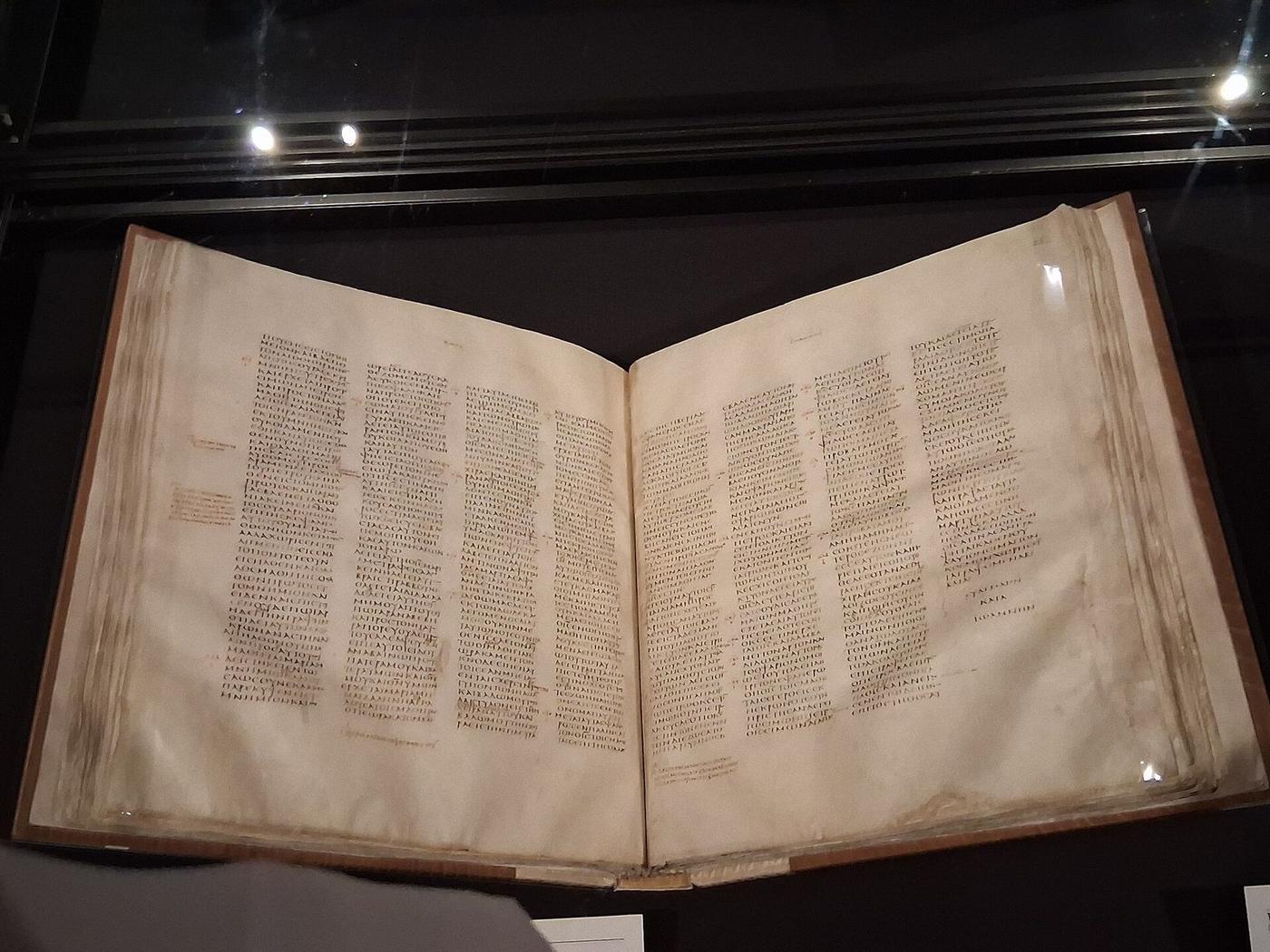
The argument, as its proponents put it: the Quran affirms the scriptures given to Moses عليه السلام and Jesus. It tells the People of the Book to judge by what God revealed in them, and it is addressing people alive in the 7th century. So either those scriptures were intact then, which makes our copies reliable and puts them in conflict with the Quran, or they were already corrupt, which means the Quran issued an order nobody could follow.
Two horns, no exit. Very tidy. Tidiness is what should make you look closer. A dilemma only works if the third option is properly closed off, and this one needs 5 separate assumptions to close it. Each entry below names one, says what the Quran and the classical scholars actually say, and gives the strongest form of the reply that the other side would make.
Number 1: That the injīl is the 4 gospels
The Quran talks about the injīl, the evangel, as something given to Jesus. Singular. A revelation he received. Verse 5:46 says that God gave him the injīl, with guidance and light.
Matthew, Mark, Luke and John عليه السلام are narratives about him, written by other people, in a language he did not preach in, and even mainstream critical scholarship dates the earliest of them decades after his death.[1] Jesus spoke Aramaic, and the four books are in Greek. The Quran never names any of them and never counts four.
Whether the Quranic injīl refers to those 4 documents is the question the whole argument turns on. The argument does not answer it. It assumes it on the way past.
The fair objection is that seventh-century Christians held the four Gospels, and the Quran tells them to judge by “the Gospel”, so it seems to treat what they held as the real thing. The reply is that the Quran refers to what God revealed to Jesus. It does not certify the canon, and Muslim scholars have said that echoes of that revelation may survive in the books while the books remain human accounts.
Number 2: That corruption has to be total
The argument runs a binary. Either a text is wholly reliable or it is worthless.

Nothing in the Quranic vocabulary of taḥrīf, meaning distortion, demands that. The Quran describes people concealing part of what they were given (6:91), writing things with their own hands and calling it revelation (2:79), twisting the text with their tongues (3:78), and moving words from their places (4:46).[2]
Every one of those describes a mixed state. Truth still in there, alteration alongside it.
A scripture in that condition is still worth consulting for what survives in it, which is what an instruction to judge by it would mean. The Prophet Muhammad ﷺ, peace be upon him, gave a rule for this situation. When the People of the Book relate something from their scripture, a Muslim should neither believe it nor reject it outright, and should say that he believes in God and in what was revealed to the believers and to them.[3]
The objection runs that a text which is partly altered gives no means of telling which part. Muslim scholars answer that the Quran is the criterion: what agrees with it is accepted, what contradicts it is set aside, and the rest is left in suspense.
Number 3: That the distortion hit the words themselves
Classical exegetes split on this, and the split is old. The two positions have names: taḥrīf al-lafẓ, a change in the wording, and taḥrīf al-maʿnā, a change in the meaning.
Some held the written text was altered. Ibn Ḥazm of Cordoba, who died in 1064, argued this at length, pointing to contradictions and unlikely details in the Hebrew Bible and the Gospels.[4] Others held the alteration was in the reading, with the words left standing and their sense inverted. A report from Ibn ʿAbbās, preserved by al-Bukhari, says that nobody could remove a word of God’s book, and that the People of the Book distorted it by misinterpreting it.[5] Ibn Taymiyya, in his reply to Christian polemic, treated both kinds of distortion as real, so the tradition did not settle on one answer.[6]
Take the second view and the dilemma just evaporates: the text stays consultable while its custodians read it wrong.
An argument advertised as inescapable has been answered since the early centuries by a position held within the tradition. That says something about how carefully the tradition was consulted before the argument was built. Even those who took the first view, like Ibn Ḥazm, still had the other four answers available.[7]
Number 4: That the Quran defers to the earlier scriptures
The verse everyone quotes sits inside a passage that also calls the Quran muhaymin over what came before it. Guardian. Criterion. Quran 5:48.[8] Classical commentators glossed the word as a witness, a trustee and a guardian.

That is a claim of authority over the earlier books.
So the instruction to the People of the Book, telling them to judge by what they hold, comes from a text that in the same breath sets itself up as the standard their holdings get measured against. Quote the instruction, drop the clause 1 verse later, and you have manufactured the dilemma. Put the clause back and it has gone.
The same verse also says that the Quran confirms what was before it of the scripture, and the proponents of the dilemma lean on that word. Confirming the scripture as a kind of revelation is different from endorsing every copy in circulation, and the next phrase, that the Quran is a guardian over it, is what governs the relationship.
Number 5: That the instruction was addressed to us
Those verses address particular communities in a particular dispute. Several of them concern a legal question the People of the Book brought to the Prophet for judgment, and the reproach is that they were holding a scripture whose ruling they would not apply.
The reports on the occasion of revelation tell of a Jewish couple in Medina who had committed adultery. Their community asked the Prophet to judge, hoping for a lighter penalty than the stoning in their Torah. He asked for the Torah to be read, and when a man covered the verse with his hand it was uncovered, and the Prophet applied the Torah’s penalty.[9] The reproach in 5:43, how they make you their judge when they have the Torah with God’s ruling in it, belongs to that scene.
Turning that into a timeless endorsement of every manuscript tradition that reached the 21st century is a long stretch. The argument makes the stretch without mentioning that it is making one. The objection is that 5:47 speaks generally, telling the people of the Gospel to judge by what God revealed in it. The reply is that it addresses the Christians of that day, and the next verse sets the Quran above their book.
The bottom line
For the dilemma to hold, all 5 have to hold. The injīl has to be the 4 gospels. Corruption has to be all or nothing. Distortion has to be textual only. The Quran has to defer to books it calls itself guardian over. And a situational instruction has to be a universal one. Knock out any 1 of them and there is a third option sitting right there.
Most of the people pushing this argument know these responses exist. The real disagreement is narrower and more technical than the marketing suggests, and it is about which reading of taḥrīf the Quranic vocabulary will carry. That is a debate worth having, and it is no trap.
Notes
- Raymond E. Brown, An Introduction to the New Testament (New York: Doubleday, 1997), on the dating of the Gospels.
- Quran 6:91, 2:79, 3:78 and 4:46; compare 2:75 and 5:13.
- Sahih al-Bukhari, Book of Commentary (Tafsir), on 2:136 and the People of the Book. Sahih al-Bukhari 4485 (Commentary on 2:136), report of Abu Hurayra, checked on sunnah.com; Ibn Hajar al-Asqalani, Fath al-Bari (Salafiyya edition), vol. 8, p. 170 (Shamela text).
- Ibn Ḥazm, Kitāb al-Faṣl fī al-Milal wa al-Ahwāʾ wa al-Niḥal, on the Hebrew Bible and the Gospels.
- Sahih al-Bukhari, Book of Tawhid, report from Ibn ʿAbbās on the distortion of earlier scripture. Sahih al-Bukhari 7363 (chapter “Do not ask the People of the Scripture about anything”), report of Ibn Abbas, checked on sunnah.com; Ibn Hajar al-Asqalani, Fath al-Bari (Salafiyya edition), vol. 13, p. 333 (Shamela text).
- Ibn Taymiyya, al-Jawāb al-Ṣaḥīḥ li-man Baddala Dīn al-Masīḥ.
- Hava Lazarus-Yafeh, Intertwined Worlds: Medieval Islam and Bible Criticism (Princeton: Princeton University Press, 1992), on Muslim discussions of taḥrīf.
- Quran 5:48, read with 5:43 to 5:47.
- Sahih al-Bukhari and Sahih Muslim, Book of Legal Punishments (Hudud), on the stoning of the Jewish couple. Sahih al-Bukhari 6841 (Book of Hudud, “The regulation for the people of the covenant”), report of Abdullah ibn Umar, checked on sunnah.com; Ibn Hajar al-Asqalani, Fath al-Bari (Salafiyya edition), vol. 12, p. 166 (Shamela text).



Leave a Reply