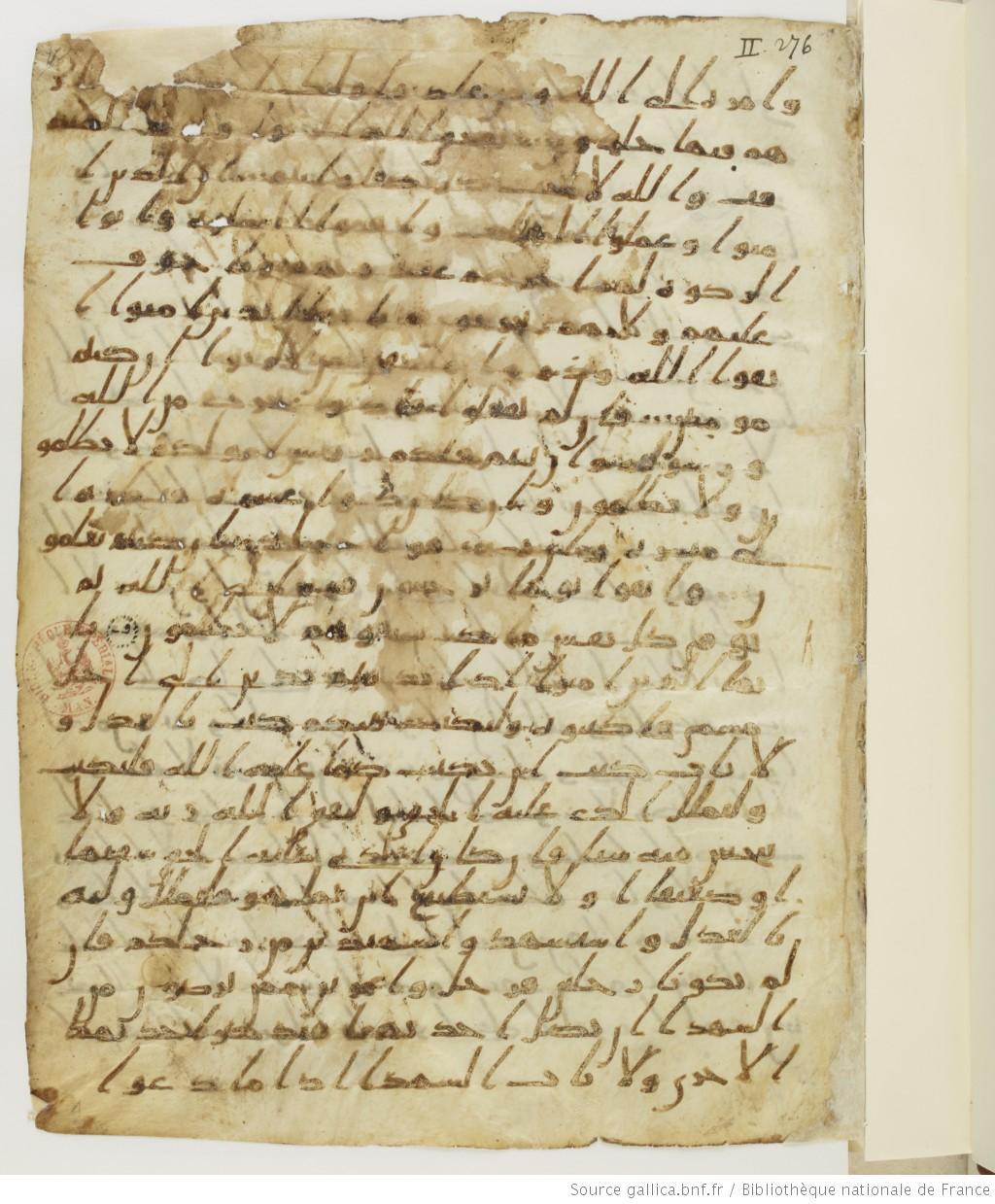
Critics ask where the copies went. Uthman, the third caliph, sent standard copies of the Quran to the provinces around 650. If the Quran is divinely preserved, why cannot Muslims show them?
Start with what survives, because it is more than the question expects. The five sections below cover the earliest dated leaves, the manuscript tradition names as Uthman’s, a large first-century codex, the place of memorisation, and the burning of copies, which the sources themselves report and explain.
Number 1: The Birmingham leaves reach back to the Prophet's generation
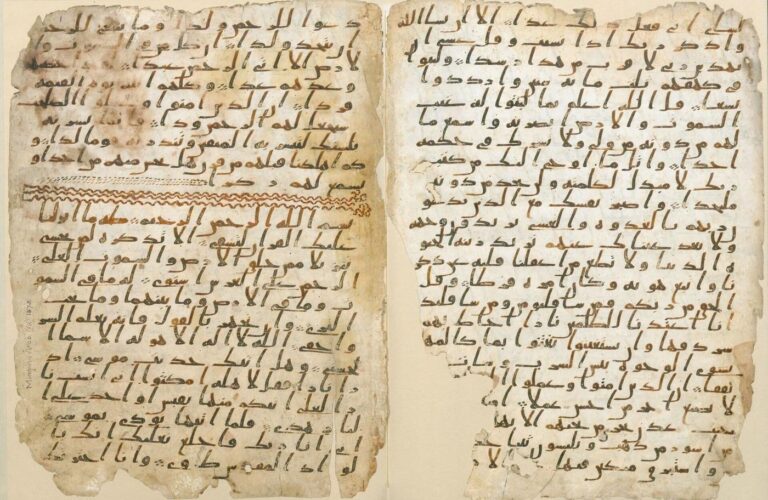
Two parchment leaves held at the University of Birmingham, carrying parts of chapters 18 to 20, were radiocarbon dated in 2015 at Oxford to between 568 and 645, with 95.4 percent probability.[1] The Prophet Muhammad (peace be upon him) died in 632. Uthman’s standard copies were made around 650.
The test dates the animal skin, and the ink could be somewhat later. A parchment can also be written on years after the animal died. Even so, these leaves place the Quran’s text on parchment within a generation of the man who recited it, and possibly before Uthman’s copies were made at all.
The leaves do not claim to be Uthman’s own copy. Their value is the date they establish: written Quran text in circulation in the Prophet’s generation or just after it, in the form that Muslims recognise. A critic is right that early radiocarbon dates carry a margin of error. The reported range, about 568 to 645, is wide: it starts before the Hijra and reaches into the first generation after the Prophet’s death. Even its latest edge falls within the first Islamic century.
Number 2: The Samarkand codex is the copy tradition names as Uthman's
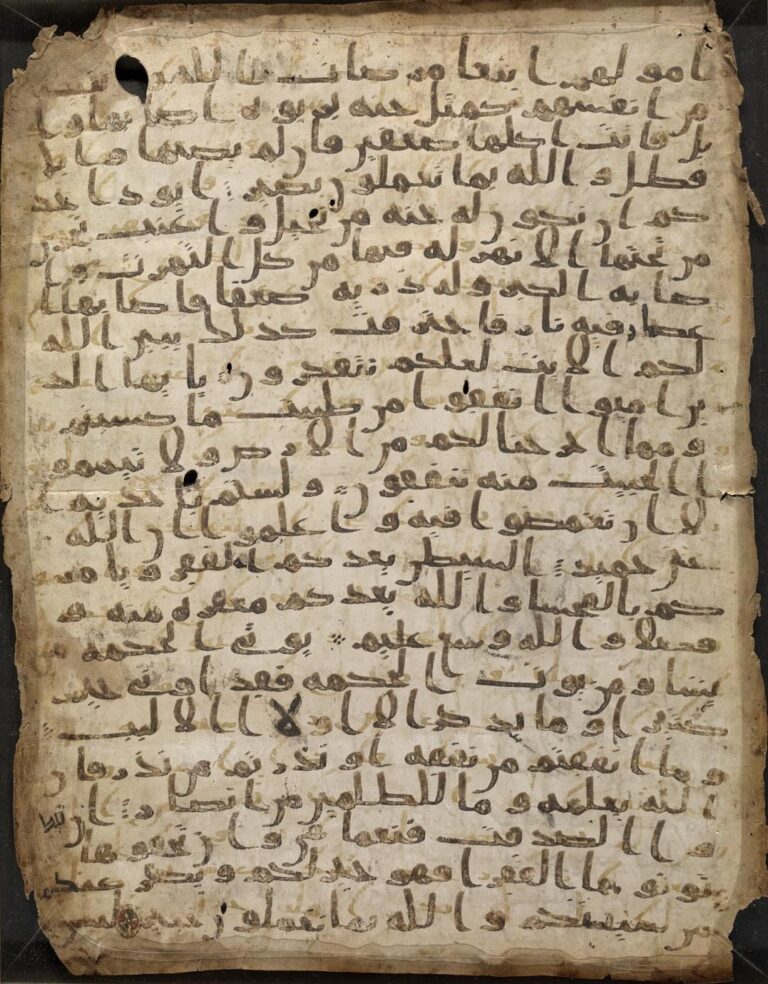
The great codex now kept in Tashkent, long held in Samarkand, is the manuscript Muslim tradition has attributed to Uthman for centuries. The tradition holds that it passed to Kufa, that Timur carried it to Samarkand as a treasure, and that it stayed there for some four hundred years until it was taken to Russia after the conquest of Samarkand in the 1860s.[2] About a third of it survives.

Its dating is argued, and most palaeographers do not accept it as Uthman’s own copy. They generally place its script in the 8th century. Radiocarbon testing of a folio held in Tashkent gave a range of 595 to 855, which takes in the reign of Uthman and the two centuries after it.[3] What the tradition and the tests agree on is a very early Quran, copied in the generations after Uthman from the text he fixed.
The honest summary is that the attribution is a tradition and the manuscript is real. It shows how Muslims treated the question: they kept the codex for over a thousand years because they believed it stood close to the original copy, and the text it carries matches the Quran of every other region.
Number 3: A large codex from the first Islamic century survives
The Codex Parisino-Petropolitanus, now divided between Paris, St Petersburg, the Vatican and London, is dated by François Déroche to the third quarter of the first Islamic century. Together its surviving leaves cover roughly 45 percent of the Quran.[4] That is close to half the text, in a single manuscript, from within decades of Uthman.
The script is of the early Hijazi type that preceded the Kufic hands, with few or none of the vowel marks of later copies. The copy comes from the world that the sources describe: a Quran written down in a standard consonantal form, with the recitation carrying the vowels.
The usual objection is that a manuscript from the 680s or 690s still stands a generation after Uthman, and so cannot prove what was in his copies. That is right. The point of the evidence is the direction it runs. The manuscripts from the first Islamic century agree with the standard text in nearly all of their content, and no early codex has turned up that presents a different book.
Number 4: The Quran was never meant to live on parchment alone
The Quran was recited aloud from the start, memorised in full by many companions, and recited daily in prayer. The text itself says “We have sent down the Reminder, and We will guard it.”[5] Each Ramadan, the Prophet recited the whole Quran to Gabriel, and in his last year they went through it twice.[6] The written copies were a check on the memory. That chain of reciters has never broken: millions hold the entire text by heart today.
Ask where Uthman’s own parchment is and you are asking for the backup. The primary system was the recitation, and it is still running. The collection under Abu Bakr and the standard copies under Uthman were made by comparing written pages with what the reciters knew by heart.[7]
The fair objection is that oral chains can drift. The answer is that the Quran was transmitted in two ways at once, and each checked the other. The recognised variant readings are ten in number, each recorded by name and chain, and scholars including Ibn al-Jazari hold all ten to be confirmed by mass transmission (tawatur). Most differ in vowelling and small details that do not change the meaning, and the printed copies in circulation follow three of them: Hafs from Asim in most Muslim countries, Warsh and Qalun from Nafi in north-west Africa, and al-Duri from Abu Amr in Sudan.[8]
Ismail al Faruqi points to a safeguard built into worship itself. The formal prayer may not be interrupted for almost any reason, yet anyone listening may interrupt it and correct the leader aloud when he makes a mistake in reciting the Quran.[9]
Number 5: Uthman did burn copies, and the sources say why
Bukhari records it: Uthman had standard copies made, sent one to each province, and ordered the other written materials burned.[10] The same report gives the reason. Hudhaifa had seen soldiers from Syria and Iraq quarrelling over recitation, and urged Uthman to act before the community split over its Book. Uthman borrowed the pages that had been kept since Abu Bakr and had a committee headed by Zayd ibn Thabit copy them out.
Burning a superseded copy is a recognised way of retiring it respectfully in Islamic law. Some jurists prefer burying worn pages or washing the ink off, and all agree it must be done with reverence. Burning a Quran in the street to insult Muslims is a different act with a different intent, and the comparison conflates them.
The sharpest criticism is that the burning destroyed evidence of variant texts. Ibn Masud, whose own codex was set aside, is reported to have objected. The differences reported from his codex are listed in early books, and they are mostly small. Ahmad Ali al-Imam counts 123 differences between the Uthmanic text and all the personal codices of the Companions, 102 of them from Ibn Masud alone, in a book of over 77,000 words.[11] The reports that Ibn Masud left out the opening surah and the last two surahs were answered by the classical scholars and judged groundless.[11] Uthman’s act was an administrative decision to end disputes, and the community accepted it, including Ali, who is reported to have approved.
The bottom line
Leaves from the Prophet’s generation in Birmingham. A codex tradition has named as Uthman’s for centuries in Samarkand. Nearly half the Quran in a single first-century manuscript. These agree with the text Muslims recite today in almost every detail. A few manuscripts, such as the lower writing of the Sanaa palimpsest, carry variants that scholars still study, and a fair account says so.[12]
Ask what the Quran said in 650. The manuscripts answer that, and they answer it in the same way, with small differences in spelling and reading that the tradition itself records. The missing parchment of Uthman is a real gap. What fills it is more than anyone expected to find, and a recitation that has never stopped.
Notes
- University of Birmingham, Cadbury Research Library, MS 1572a; radiocarbon result OxA-29418.
- Tashkent, Telyashayakh Mosque, the Samarkand Kufic Quran.
- Oxford radiocarbon results as reported for the Tashkent holdings; see Déroche on the palaeographic dating.
- Bibliothèque nationale de France, Arabe 328(a–b), with folios in St Petersburg, the Vatican and the Khalili Collection; François Déroche, Qur’ans of the Umayyads (Leiden: Brill, 2014).
- Quran 15:9.
- Sahih al-Bukhari, Book of the Virtues of the Quran, on Gabriel’s yearly review with the Prophet. Sahih al-Bukhari 4998 (Book of the Virtues of the Quran, “Gabriel used to present the Quran to the Prophet”), report of Abu Hurayra, checked on sunnah.com; Ibn Hajar al-Asqalani, Fath al-Bari (Salafiyya edition), vol. 9, p. 43 (Shamela text).
- Sahih al-Bukhari, Book of the Virtues of the Quran, chapter on the collection of the Quran.
- Ibn al-Jazari, al-Nashr fi al-Qiraat al-Ashr, on the chains of the recognised readings. IslamWeb, Fatwa No. 91213, “The ten ways of reciting the Quran” (27 February 2006), and Fatwa No. 91555, “The Quranic recitations published in the world” (27 March 2006).
- Ismail Raji al Faruqi, Islam: Religion, Practice, Culture and World Order (London and Washington: The International Institute of Islamic Thought, 2012), p. 26.
- Sahih al-Bukhari 4987. Checked on sunnah.com (report of Anas ibn Malik, chapter “The collection of the Quran”); Ibn Hajar al-Asqalani, Fath al-Bari (Salafiyya edition), vol. 9, p. 11 (Shamela text).
- Ibn Abi Dawud al-Sijistani, Kitab al-Masahif, which lists reports of variants in the early codices. Ahmad Ali al-Imam, Variant Readings of the Qur’an: A Critical Study of Their Historical and Linguistic Origins (London and Washington: International Institute of Islamic Thought, 2006), chapter 4, on the personal codices of the Companions.
- Behnam Sadeghi and Uwe Bergmann, “The Codex of a Companion of the Prophet and the Qur’an of the Prophet,” Arabica 57 (2010).


Leave a Reply