A common charge holds that Islam is a fairy tale: a winged creature that carries a man to heaven, and a talking donkey that belonged to the Prophet. When critics are pointed to similar passages in the Bible, the reply is sometimes that they criticise the Quran and the hadith and do not read the Bible.
The entries below set out what the Quran says about the Night Journey, what the hadith say about the Buraq, what became of the story of the donkey called Yafur, how the same charge falls on the Bible, and how a reader can weigh any report of a miracle. Where the argument is not decisive, the article says so.
Number 1: The Quran gives the Night Journey and names no steed
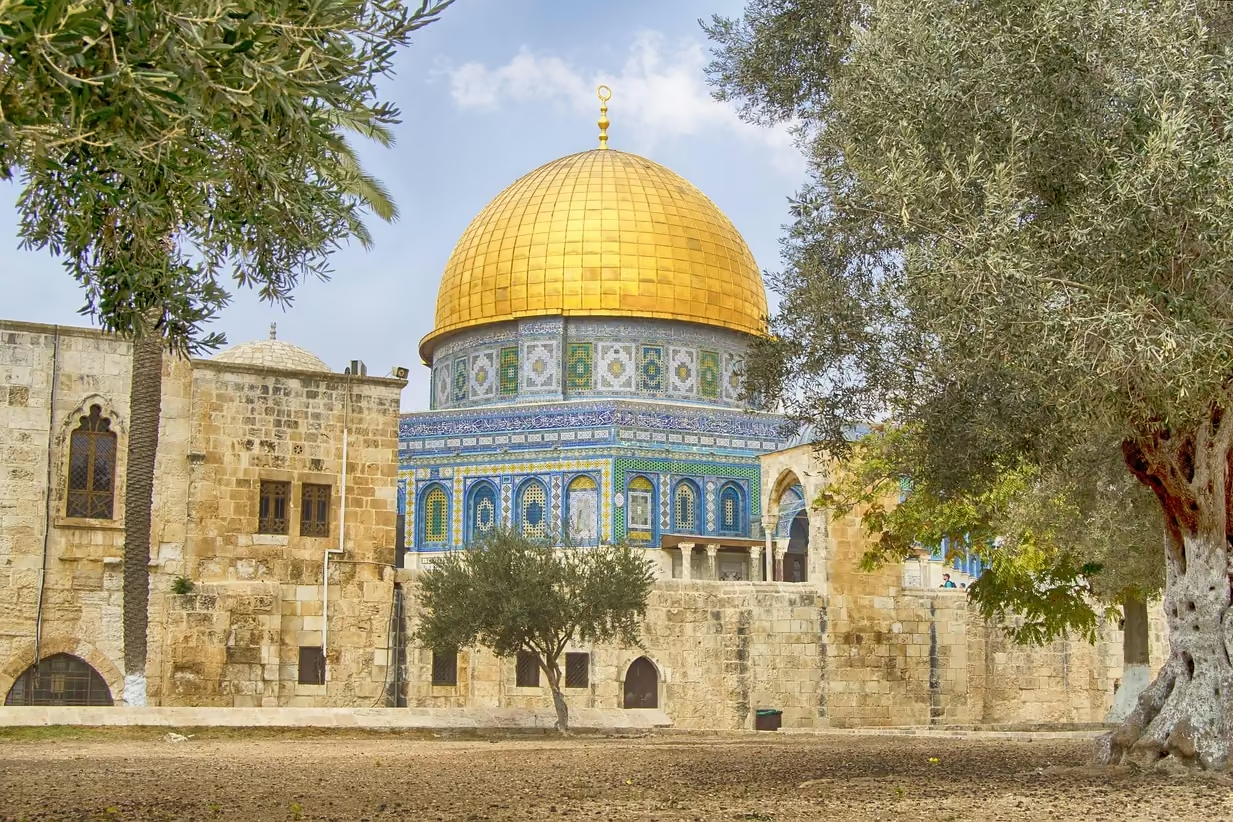
The objection at its strongest says that Muslims believe a man travelled from Mecca to Jerusalem and then to heaven in a single night, and that nobody can verify it. The Quran itself is brief. Quran 17:1 says that God took His servant by night from the Sacred Mosque to the Farthest Mosque, whose surroundings He had blessed, to show him some of His signs.[1] Quran 53:1 to 18 describes a vision of the Prophet near the lote tree of the furthest boundary and says that he saw some of the greatest signs of his Lord.[2] Commentators differ on details of that passage, including whom he saw.
Neither passage names an animal, a ladder or a route. The Quran presents the journey as a sign given to Muhammad (peace be upon him), and it offers no mechanism. Scholars differ on whether it took place with body and soul or as a vision. The majority held that it was bodily. A minority, citing reports attributed to Aisha and Muawiya, held that it was by the spirit, and the chains of those reports are questioned.[3] Both sides accepted that the event happened. A reader who finds the claim impossible is rejecting a miracle, which differs from finding an error in the text. The reports that tie the journey to the five daily prayers are treated in the article Why five prayers?, so they are not repeated here.
Number 2: The hadith describe the Buraq without wings
The sharpest form of the objection mocks a winged horse with a human face. The Buraq comes from the hadith (reports of the Prophet’s words and deeds), and the two most trusted collections describe it plainly. In Sahih Muslim, in the Book of Faith, the Prophet describes a white animal, bigger than a donkey and smaller than a mule, which placed its hoof at the limit of its sight.[4] Sahih al-Bukhari gives a similar description in the Book of the Beginning of Creation, in the report of Malik ibn Sasaa.[5]
The descriptions in those two books mention neither wings nor a human face. Those features belong to later devotional painting and popular tradition, so the charge often mocks a picture and leaves the text untouched. That distinction deserves care, because it answers only part of the objection. The text still describes an animal of extraordinary speed, and a reader who finds that impossible will find the plain description as hard as the painted one. At that point the question is about miracles in general, which the last entries take up.
Number 3: The talking donkey is graded fabricated
The objection runs that Muslims accept a story in which the Prophet’s donkey speaks and recites its own ancestry. Hadith critics graded that long narration as fabricated (mawdūʿ), and no school of Muslim belief rests on it.[6] The sound reports say only that he rode a donkey. In the report of Muadh, who rode behind him, the animal is named Ufayr in some narrations, and the name Yafur appears in others. Scholars differ on whether these are two names for one animal or two animals.[7]
This is the Muslim answer to the complaint that the tradition contains silly stories. Hadith scholars examined the chain of narrators (isnād) for honesty, memory and the possibility of meeting, and they examined the text (matn) for conflict with the Quran and with better attested reports. Reports were then graded as sound, fair, weak or fabricated.[8] The tradition kept the donkey story and labelled it. That does not make every grade certain, since scholars sometimes disagree on borderline reports. It does show that a charge aimed at the donkey story strikes at a report that Muslim scholars themselves set aside.
Number 4: The Bible carries stories of the same kind
Matthew 27:51 to 53 says that at the death of Jesus the earth shook, the rocks split, the tombs opened, and many holy people who had died were raised and appeared in the holy city after his resurrection. Numbers 22:28 says that God opened the mouth of Balaam’s donkey and it spoke. Second Kings 2:11 says that Elijah went up in a whirlwind into heaven, with a chariot of fire and horses of fire. Jonah 1:17 says that a great fish swallowed Jonah.[9] A reader who calls the Night Journey a fairy tale has to say what makes these different.
The point is consistency. A critic who rejects every miracle holds a consistent position, and that critic is then criticising all three scriptures. A critic who singles out one tradition applies a double standard. Fairness requires saying that Christians and Jews read some of these passages differently. Some Christian scholars read Matthew’s passage as a symbolic sign of the meaning of the death of Jesus, and many Jewish and Christian readers treat the story of Jonah as a parable. Other believers read them as events. The argument here claims only that these texts are in the same category as the ones criticised.
Number 5: How to weigh a report of a miracle
Four questions help with any miracle report. What is the source? How early and how well attested is it? What does the tradition itself say about its grade? What rests on it? The Night Journey is a Quranic claim that the Prophet was shown signs, and the hadith add detail of varying strength. The donkey that speaks has a fabricated chain, and nothing in Muslim belief depends on it. Muslims hold that the Quran is the Prophet’s enduring sign, and Quran 29:50 and 29:51 reply to those who ask for other signs by pointing to the Book that is recited to them.[10]
The limit of these questions should be stated. No argument will move someone who holds that miracles do not happen, and this article does not pretend otherwise. Such a person can still ask the same four questions of every tradition. Fairness also asks a critic to read what the other side actually says before judging it, in the Quran, the hadith and the Bible alike.
The bottom line
The Quran states the Night Journey as a sign and names no steed. The hadith describe the Buraq as a white animal between a donkey and a mule in size, and the wings and the human face come from later pictures. The talking donkey is a fabricated report that Muslim critics themselves rejected.
A reader may still reject all miracles, and that is a coherent position if it is applied to the Bible as well. The charge of a fairy tale loses its force when it is applied to one scripture only, or when it is aimed at a story the tradition has already set aside.
Notes
- Quran 17:1.
- Quran 53:1 to 18.
- Reports attributed to Aisha and Muawiya on the spirit journey, preserved in Ibn Ishaq’s biography of the Prophet and cited in al-Tabari’s commentary on Quran 17:1; their chains are disputed.
- Sahih Muslim, Book of Faith, the chapter on the Night Journey. Sahih Muslim 162a (Book of Faith, the Night Journey), report of Anas ibn Malik, checked on sunnah.com.
- Sahih al-Bukhari, Book of the Beginning of Creation, the report of Malik ibn Sasaa on the Night Journey. Sahih al-Bukhari 3207 (Beginning of Creation, “The mention of the angels”), checked on sunnah.com; Ibn Hajar al-Asqalani, Fath al-Bari (Salafiyya edition), vol. 6, p. 302 (Shamela text).
- The narration of the speaking donkey is treated in the literature on fabricated reports; hadith critics reject it.
- Sahih al-Bukhari, Book of Jihad, and Sahih Muslim, Book of Faith, the report of Muadh riding behind the Prophet; Ibn Hajar, Fath al-Bari, discusses the names Ufayr and Yafur. Sahih al-Bukhari 2856 (Book of Jihad, “To name a horse and a donkey”), report of Muadh ibn Jabal, who rode behind the Prophet on a donkey called Ufayr, checked on sunnah.com.
- Jonathan A. C. Brown, Hadith: Muhammad’s Legacy in the Medieval and Modern World (2009), on chains, texts and grading.
- Matthew 27:51 to 53; Numbers 22:28; 2 Kings 2:11; Jonah 1:17.
- Quran 29:50 to 51.


Leave a Reply