
Thirteen letters in the New Testament open with Paul’s name. For most of Christian history every one of them was read as his, and a fourteenth, Hebrews, was added to the pile. Since the nineteenth century the question has been studied with the same tools used on any ancient text, and the answer is now stable: 7 letters are Paul’s, 3 are doubtful, and 3 were written by someone else in his name.
That is the finding of Christian scholarship, in Christian universities, and the Christian reply to it deserves a hearing: that writing in a teacher’s name was an accepted convention, and that the later letters carry his teaching whoever held the pen. Six facts below set out how the letters were sorted, what the ancient church itself said about forgery, and why a Muslim reader should care.
Number 1: Seven letters are accepted as his; six are not
The agreed list is Romans, 1 and 2 Corinthians, Galatians, Philippians, 1 Thessalonians and Philemon. Bart Ehrman, Raymond Brown and Udo Schnelle, writing from very different confessional positions, give the same seven.[1] Ephesians, Colossians and 2 Thessalonians are disputed, with most critical scholars placing them after Paul’s death. The three Pastoral letters, 1 and 2 Timothy and Titus, are held by the great majority to be the work of a later writer.[2]
The question is older than the answer. Ferdinand Christian Baur at Tübingen, in 1845, accepted only four letters as Paul’s: Romans, the two to Corinth and Galatians.[3] Later scholarship pulled three back. The direction of travel since then has been toward the seven, and no serious school has argued the Pastorals back into the list.
The seven are the earliest Christian writings that exist. They were written between about 50 and 60, two decades before Mark, the first Gospel, and they are the only New Testament documents whose author is known by name and not by later tradition.[4] Whatever else is said below, this is a strong base, and it is why the doctrines Muslims most dispute, the atoning death and the exalted Christ, cannot be dismissed as later additions. Paul taught them.
Number 2: How the Pastorals were caught
The case against 1 and 2 Timothy and Titus rests on four kinds of evidence. The first is vocabulary. P. N. Harrison counted 175 words in the Pastorals that appear nowhere else in the New Testament, a far higher rate than in the accepted letters, and showed that a large share of them are common in Christian writers of the second century.[5]
The second is the church they describe. The Pastorals set out qualifications for bishops, elders and deacons, down to the number of a bishop’s marriages.[6] The communities of the accepted letters have no such offices; Paul addresses prophets, teachers and speakers in tongues, and tells the Corinthians that each of them has a gift.[7] The third is the meaning of faith itself. In the seven letters faith is trust in God. In the Pastorals it is “the faith”, a deposit to be guarded and handed on.[8]
The fourth is the hardest to explain away. 1 Timothy quotes “the labourer deserves to be paid” as scripture.[9] The sentence is a saying of Jesus found in the Gospel of Luke, a book written after Paul was dead.[10] A letter that cites Luke as scripture was written when Luke existed and was already being read as scripture, and that is a generation or more after Paul.
The earliest collection of Paul’s letters agrees. Marcion, who assembled a canon of ten Pauline letters in Rome around the year 140, did not include the Pastorals, and Tertullian, going through Marcion’s Paul letter by letter sixty years later, remarks on their absence.[11] Marcion accepted letters that suited him and cut ones that did not, so his silence proves less than it seems; but a man collecting Paul within living memory of Paul had three fewer letters to collect than the churches had a century on.
Number 3: Ephesians, Colossians and 2 Thessalonians: letters that imitate letters
Ephesians reuses Colossians. About a third of the words of Colossians reappear in Ephesians, often in the same order, and the two letters share a household code on wives, husbands, children and slaves that appears in none of the seven.[12] Ephesians also speaks of the church as “built upon the foundation of the apostles and prophets” and of “the holy apostles”, looking back on the apostles as a completed first generation.[13] A man writing in the 50s does not describe himself as a foundation stone.
2 Thessalonians contradicts 1 Thessalonians on the one subject both letters are about. The first letter says the Lord will come “like a thief in the night”, without warning.[14] The second says he cannot come until “the lawless one” has been revealed and a sequence of signs has run its course.[15] The second letter also warns its readers against a letter purporting to be from Paul, and ends with Paul insisting that his handwritten greeting is “the mark in every letter of mine”.[16] Ehrman reads this as a forger’s signature: a letter that protests its own authenticity and warns against the forgery it is.[17]

The Christian defence is that Paul’s thought developed, or that a secretary had a free hand. Both are possible for one letter. Applied to six, and to a shift in vocabulary, church order, theology and the meaning of faith, they amount to saying that Paul became a different writer after he died.
Number 4: Hebrews was Paul's for a thousand years, and is nobody's
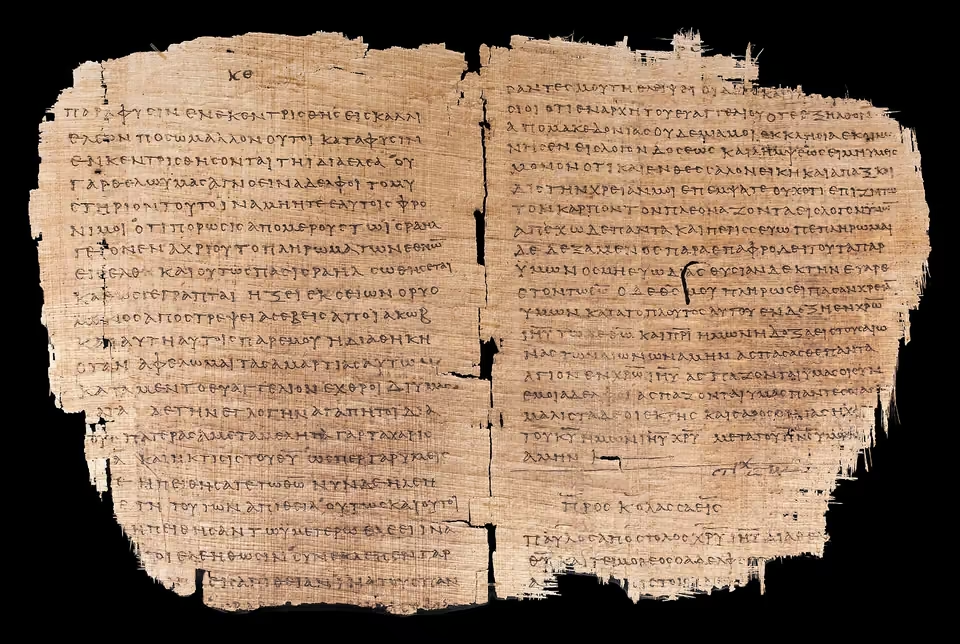
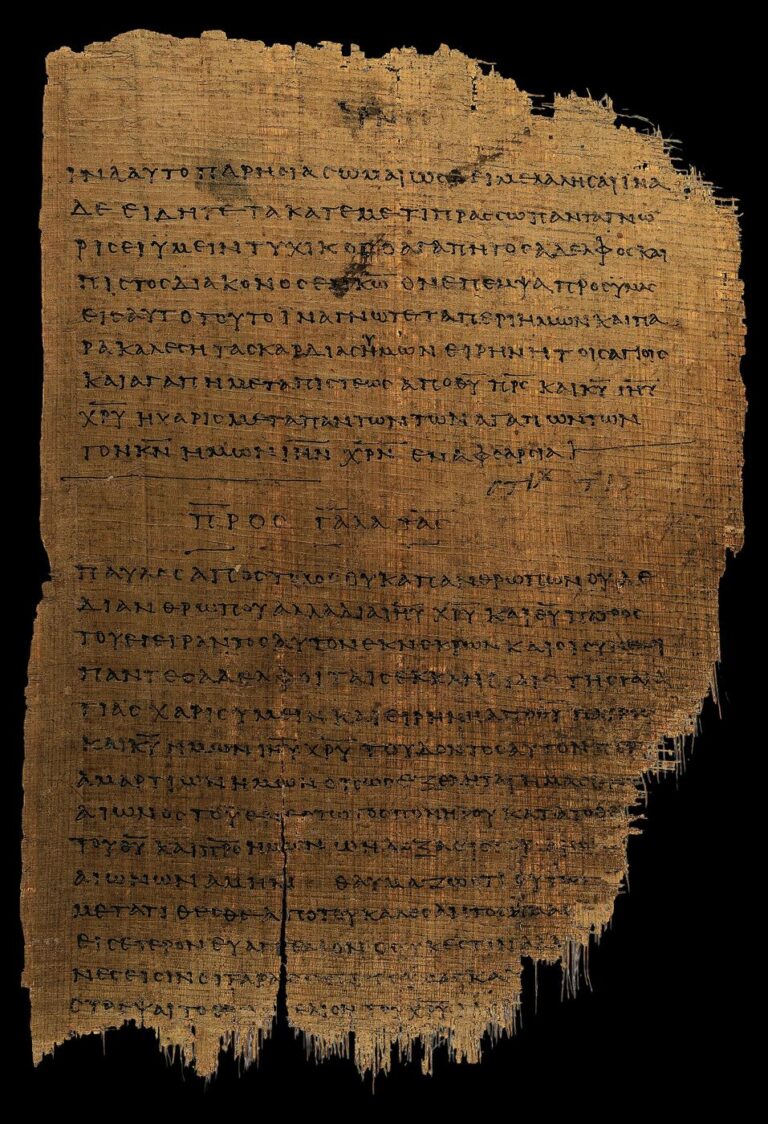
The Letter to the Hebrews names no author. The oldest collection of Paul’s letters that survives, the papyrus codex known as P46, copied around the year 200, places Hebrews directly after Romans, so the Egyptian church that produced it counted it as Paul’s.[18] The church at Rome did not. Eusebius records that some rejected the letter because the church of Rome disputed it, on the ground that Paul had not written it.[19]
Origen, the most learned Christian of the third century, had read enough Paul to know this was not him. He wrote that the style is “not rude like the language of the apostle”, and concluded: “Who wrote the epistle, in truth, God knows.”[20] The West accepted it as Paul’s anyway, and it entered the Latin Bible under his name. Luther doubted it. Today no critical scholar attributes it to Paul.
The letter itself gives the strongest reason. Its author says the message of salvation “was attested to us by those who heard him”.[21] He learned it second hand. Paul’s whole claim was that he learned it from no one.[22] A church that read the two as one voice for a millennium was reading past a contradiction in the first paragraphs.
Number 5: The ancient church knew what forgery was, and condemned it
The defence that writing in a teacher’s name was an accepted convention has a problem: the people who lived in that world did not accept it. Tertullian, around the year 200, records that a presbyter in Asia who wrote the Acts of Paul and Thecla and put it out under Paul’s authority was found out, confessed that he had done it “from love of Paul”, and was removed from office.[23] Love of Paul was not a defence. The Muratorian canon, the oldest surviving list of accepted books, names a letter to the Laodiceans and a letter to the Alexandrians “forged in Paul’s name” and refuses them.[24]
The church also knew that Paul’s name was being used before he was cold. 2 Thessalonians, whoever wrote it, warns against letters “as though from us”.[16] Later came 3 Corinthians, a Latin Letter to the Laodiceans that survives in medieval Bibles, and a correspondence between Paul and Seneca that fooled Jerome.[25] Paul’s name settled arguments, which is why so many people borrowed it.
Ehrman’s Forged (2011) collects the ancient evidence and reaches a plain verdict: writers of the period called this practice lying, and the people who did it knew that they were lying.[17] The Pastorals settle church order, the status of women and the content of “the faith” in Paul’s name. Those were the live disputes of the early second century, and the letters that settled them were written then.
Number 6: Why a Muslim reader should care
The Quran says that the people of the earlier scriptures wrote with their own hands and said “this is from God”.[26] It does not say how, and Muslims have argued over what the word tahrīf, alteration, covers. The findings above do not prove the Quran’s claim. They show something narrower and documented: that the Christian canon contains letters written in a dead apostle’s name to settle disputes he never saw, and that the churches read them as his commands for 1,800 years.
The point is not only about the forgeries. 2 Peter, the latest book in the New Testament and the one most widely agreed to be pseudonymous, speaks of Paul’s letters as scripture that “the ignorant and unstable twist”.[27] One pseudonymous letter vouching for the authority of a collection that contains others: that is how the canon closed.
Fairness requires the last word to go the other way. The seven letters stand. They are early, they are Paul’s, and they teach the atonement and the exalted Christ that Muslims reject. Critical dating does not remove those doctrines from Christianity; it removes the Pastorals’ church order and the silencing of women from Paul. What it leaves is a religion whose earliest teacher never met its founder, which is the subject of the companion article on his claim to apostleship.
The bottom line
Thirteen letters carry the name. Seven are his, by the agreement of scholars who agree on little else. The rest were written by people who wanted his authority for their own answers, and who knew, because their own church told them so, that putting his name on their work was a lie. The New Testament that Christians hold was assembled with those letters inside it.
None of this touches what Paul himself taught. It touches the claim that the New Testament is what it says it is, and that claim is the one the Quran disputes.
Notes
- Bart D. Ehrman, Forged: Writing in the Name of God (New York: HarperOne, 2011), ch. 3; Raymond E. Brown, An Introduction to the New Testament (New York: Doubleday, 1997), chs. 18 to 31; Udo Schnelle, The History and Theology of the New Testament Writings, trans. M. Eugene Boring (Minneapolis: Fortress Press, 1998), part 2.
- Brown, Introduction, chs. 28 to 31, on 2 Thessalonians, Colossians, Ephesians and the Pastorals, with his own survey of the state of opinion on each.
- Ferdinand Christian Baur, Paulus, der Apostel Jesu Christi (Stuttgart: Becher and Müller, 1845).
- Schnelle, History and Theology, on the dating of the letters; Brown, Introduction, ch. 7, on the dating of Mark.
- P. N. Harrison, The Problem of the Pastoral Epistles (Oxford: Oxford University Press, 1921).
- 1 Timothy 3:1 to 13; Titus 1:5 to 9.
- 1 Corinthians 12:4 to 11 and 12:27 to 31.
- 1 Timothy 6:20; 2 Timothy 1:13 to 14; Titus 1:13.
- 1 Timothy 5:18.
- Luke 10:7. The parallel in Matthew 10:10 reads “food”, not “wages”; the Pastoral quotes Luke’s wording.
- Tertullian, Against Marcion 5.21, on Marcion’s rejection of the two letters to Timothy and the letter to Titus; on the Marcionite collection see Metzger, Canon, pp. 90 to 99.
- Colossians 3:18 to 4:1; Ephesians 5:22 to 6:9. On the verbal overlap see Brown, Introduction, ch. 28.
- Ephesians 2:20; Ephesians 3:5.
- 1 Thessalonians 5:2 to 3.
- 2 Thessalonians 2:1 to 12.
- 2 Thessalonians 2:2; 2 Thessalonians 3:17.
- Ehrman, Forged, ch. 3 on 2 Thessalonians and the Pastorals, and ch. 4 on the ancient vocabulary of forgery.
- Papyrus 46 (Chester Beatty Biblical Papyri II; University of Michigan P. Mich. inv. 6238), dated to about 175 to 225; its surviving leaves run Romans, Hebrews, 1 and 2 Corinthians, Ephesians, Galatians, Philippians, Colossians, 1 Thessalonians.
- Eusebius, Ecclesiastical History 3.3.5, in the Loeb translation of Kirsopp Lake.
- Origen, quoted in Eusebius, Ecclesiastical History 6.25.11 to 14.
- Hebrews 2:3.
- Galatians 1:11 to 12.
- Tertullian, On Baptism 17.
- The Muratorian Fragment, lines 63 to 68, in Bruce M. Metzger, The Canon of the New Testament (Oxford: Clarendon Press, 1987), appendix IV.
- On 3 Corinthians, the Latin Laodiceans and the Paul and Seneca correspondence see Ehrman, Forged, ch. 3, and Metzger, Canon, pp. 182 to 183 and 239 to 240.
- Quran 2:79; compare Quran 5:13 to 15.
- 2 Peter 3:15 to 16. On the pseudonymity and late date of 2 Peter see Brown, Introduction, ch. 36, and the site’s own article on the letter.



Leave a Reply