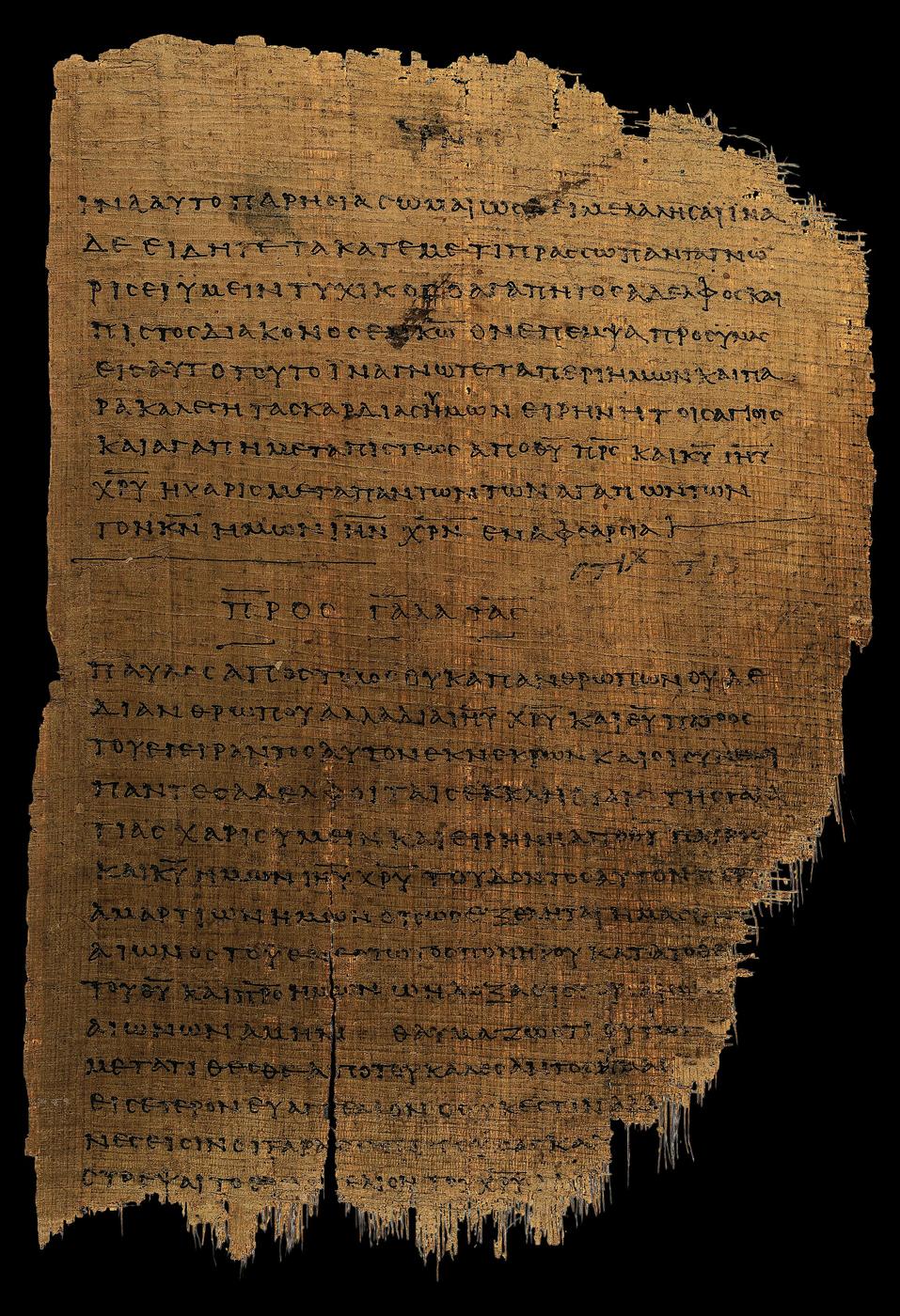
The Christian reply is a good one, and it deserves to be stated properly. Paul says the Law shows us what sin is, that we need it for that, and that it cannot save. Jesus said he came to fulfil the Law, and fulfilment changes its role without cancelling it. Jeremiah promised a new covenant.
That is the case, and many careful Christians hold it. Below are one saying of Jesus and five sentences from the letters that bear Paul’s name, each with its context and its best defence, so that the reader can set them side by side and judge whether the New Testament speaks with one voice on the Law.
Number 1: Jesus: not one stroke passes away
In Matthew, Jesus warns his hearers against supposing that he came to abolish the Law or the Prophets, and says he came to fulfil them. He adds that not the smallest letter or stroke will pass from the Law until everything is accomplished, and that whoever relaxes the least of its commandments, and teaches others to do so, will be called least in the kingdom of heaven.[1]
The usual Christian reading takes “fulfil” to mean that Jesus completed the Law’s purpose in his own life and death, so that “until everything is accomplished” marks a limit on its force. Many Jewish and Muslim readers hear the plainer sense, that the commandments stand for as long as the world stands. The sentence about the least commandment is addressed to teachers, and it sets a severe penalty on loosening any one of them. That is the standard against which Paul’s sentences are read below.
The Quran gives Jesus the same stance: he came confirming the Torah before him, and making lawful some of what had been forbidden.[2] Ahmad Shafaat argues that the earliest followers of Jesus understood him this way. In Acts, Peter still regards entering a Gentile’s house as unlawful, and protests that nothing unclean has ever entered his mouth;[3] on Shafaat’s reading, Jesus relaxed some details of the law while keeping it, and Paul turned that into freedom from the law altogether.[4]
Ismail al Faruqi read Jesus differently. In Christian Ethics (1967) he held that Jesus meant to release people from law as such, so that “Jewish Law—nay, any law—is superfluous moral pedantry” for the transformed self, and that “Jesus elaborated no law”.[5] That reading sits badly with the saying in Matthew examined above, and with the Quran’s own statement that Jesus came confirming the Torah, so this article does not rest on it. It is given here because it shows that Muslim scholars have not all read Jesus on the Law the same way.
Number 2: Paul: released from the Law
Paul tells the Romans that believers have been released from the Law, having died to what held them, so that they now serve in the new life of the Spirit where before they served under the written code.[6] Released is a strong word for a Law still in force.
Paul does not treat the Law as evil. In the same chapter he calls it holy, and in Romans 3 he asks whether faith overthrows the Law and answers that it upholds it.[7] His defenders say he is speaking of the Law’s power to condemn and to bind a person in sin, and that this power is what has ended. The difficulty is the word itself. It describes a relationship that has finished for the believer, and a finished relationship is hard to square with Jesus’s warning about relaxing even the least commandment.
Number 3: Paul: no longer under the guardian
To the Galatians he says the Law was a guardian until Christ came, and that now faith has come, believers are no longer under it.[8] The Greek word is paidagogos, the household slave who supervised a boy until he came of age. The image is of a temporary authority, and a guardian you are no longer under has stopped governing you.
The letter was written against teachers who insisted that Gentile converts be circumcised and keep the Law. The Jerusalem council described in Acts 15 sided with Paul on that narrow question and freed Gentile believers from circumcision, while asking them to avoid a short list of things, among them food offered to idols and sexual immorality.[9] A Christian can fairly say that Paul had Gentile obligations in view. Yet the “we” of the passage includes Paul himself, a Jew, and he does not limit the guardian’s end to non-Jews.
Number 4: Paul: the Law of commandments abolished
Ephesians says Christ abolished in his flesh the law of commandments and ordinances, in order to make one new humanity out of Jew and Gentile.[10] Most modern English Bibles use the same word “abolish” here as in Matthew, though the Greek verbs differ: Matthew has katalyo, to pull down, and Ephesians has katargeo, to render inactive. An English reader meets one word in both places.

The context is the “dividing wall of hostility” between the two peoples. The usual Christian reading is that the ceremonial rules which divided Jews from Gentiles were set aside while the moral law continues. The sentence itself draws no such line. Christians argue over whether Paul wrote Ephesians, and many critical scholars doubt it. Either way, it is in their canon and is read as his teaching.
Number 5: Paul: let no one judge you on food or the Sabbath
Colossians tells believers not to let anyone judge them over food, drink, festivals, new moons or Sabbaths, calling these a shadow of what was to come, while the substance belongs to Christ.[11] The Sabbath is one of the Ten Commandments.
Jesus kept it as a Jew of his time. Luke says he went to the synagogue on the Sabbath as was his custom, and Mark has him defend acts of healing on that day, saying the Sabbath was made for humankind and that the Son of Man is lord of the Sabbath.[12] Christians read the last phrase as his authority to reinterpret the day. Even so, the Gospels give no saying in which he tells anyone it has ceased to bind. Some scholars hold that Colossians was written by a follower of Paul after his death. Whoever wrote it, the churches that received it were told that the Sabbath no longer bound them.
Number 6: Paul: under a curse if you rely on the Law
Galatians again: all who rely on works of the Law are under a curse.[13] Paul supports this with a verse from Deuteronomy that curses everyone who does not abide by all that is written in the book of the Law. Set that beside the man in Matthew who is least in the kingdom for relaxing a single commandment.
The Christian answer is that Paul’s argument runs through human failure. Since nobody keeps the whole Law, reliance on it ends in the curse, and Christ took that curse on himself. Muslims reply that Deuteronomy 30 itself tells Israel that the commandment is within reach, and that the Quran describes the Torah as containing guidance and light.[14] On that view the Law was given to be kept, and a God who gave it would not have made it a trap.
And Jeremiah says the Law will be written on hearts
The Christian appeal to Jeremiah 31 cuts the other way. The new covenant there is the Law placed within the people and written on their hearts.[15] In Jeremiah the Law is internalised and kept, and the prophet announces no replacement for it.
The Letter to the Hebrews quotes the passage at length and concludes that speaking of a new covenant makes the first one obsolete. That is a Christian reading laid over Jeremiah, and the words of Jeremiah carry no such conclusion by themselves.
The bottom line
The careful Christian reading says Paul changed the Law’s role while keeping its purpose. Each of his sentences can be defended in that way when taken alone, and the defences deserve a hearing. Read the verses in order and ask a plainer question: would the Jesus of Matthew 5 have told a congregation that the Sabbath no longer bound them?
Paul did. That is the tension Muslims point to, and it comes from inside the New Testament. The Quran gives Jesus a role that fits the first saying better: he comes confirming the Torah that came before him, and making lawful a small part of what had been forbidden, by God’s permission.[16] That is a limited relaxation announced by a prophet, and it differs from a general release of the whole community.
Notes
- Matthew 5:17 to 19.
- Quran 3:50.
- Acts 10:28; 11:8.
- Ahmad Shafaat, The Gospel According to Islam (New York: Vantage Press, 1979), p. 71.
- Ismail R. al Faruqi, Christian Ethics: A Historical and Systematic Analysis of Its Dominant Ideas (Montreal: McGill University Press; Amsterdam: Djambatan, 1967), p. 81.
- Romans 7:6.
- Romans 7:12; Romans 3:31.
- Galatians 3:24 to 25.
- Acts 15:1 to 29.
- Ephesians 2:15; compare Ephesians 2:14.
- Colossians 2:16 to 17.
- Luke 4:16; Mark 2:27 to 28.
- Galatians 3:10, quoting Deuteronomy 27:26; compare Galatians 3:13.
- Deuteronomy 30:11 to 14; Quran 5:44.
- Jeremiah 31:31 to 33; Hebrews 8:8 to 13.
- Quran 3:50; compare Quran 5:46 and 61:6.





Leave a Reply